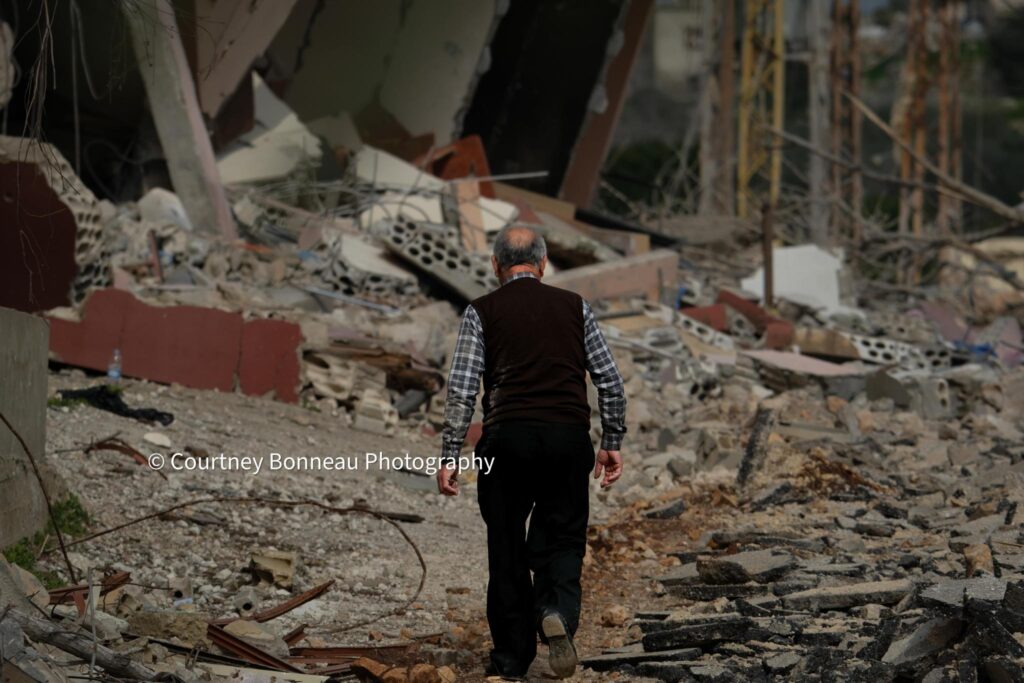
The war between the United States, Israel and Iran has set West Asia ablaze—and Lebanon has once again become one of its frontlines. As is so often the case in Lebanon, it is misleading to treat individual military incidents in isolation. The war must instead be understood as part of a broader geopolitical reordering of the region. In this process, Lebanon is less an actor than a stage on which developments play out that reach far beyond its own political conflicts.
Lebanon was drawn into the latest escalation on the night of March 2, when Hezbollah fired a rocket at Israel—two days after the killing of the Iranian dictator Ali Khamenei. Yet the events of that night explain the current situation only to a very limited degree. The situation along the Israeli–Lebanese border has been extremely tense for some time. Since the ceasefire between Israel and Hezbollah in November 2024, Israel has continued to carry out attacks in southern Lebanon; reports speak of more than 15,000 violations of the agreement. Numerous villages have been destroyed, homes systematically leveled, and agricultural land laid waste to. International observers have described these developments with terms such as “domicide”—the deliberate destruction of homes—and “ecocide,” referring to the devastation of entire landscapes. The use of white phosphorus and glyphosate has damaged soil and vegetation, leaving behind long-term ecological harm. At the same time, Israel had been mobilizing militarily for months and stationed around 100,000 reservists along the border even before Hezbollah fired its rocket.
Israel is now demanding the evacuation of the entire area south of the Litani River as well as the southern suburbs of Beirut. More than 100 villages are to be cleared, while airstrikes are carried out throughout the country. For southern Lebanon this means the evacuation of roughly a quarter of a million people; another half million live in the affected suburbs of Beirut. Within just a few days, more than 95,000 people have been officially registered as displaced—the actual number is likely much higher. More than 200 people, including children, have been killed and around 800 injured.
The Litani as Strategic Line
The Litani River is not merely a geographical line. It marks a political boundary within a space that has been repeatedly measured and re-measured as regional powers redraw the map of West Asia. The Litani is the longest river that runs entirely within Lebanon and a crucial water resource for agriculture, drinking water supply and energy production. At the same time, it has long functioned as a strategic line in the Lebanon–Israel conflict—not least since Israel’s “Operation Litani” in 1978, which first explicitly turned the river into a militarily defined security line.
When Benjamin Netanyahu addressed the UN General Assembly in September 2024, he spoke of the “blessing” of economic integration between Israel and the states of West Asia, contrasting it with the “curse” of Iranian influence in the region. In that speech he also outlined how he envisioned the region’s economic development—and pointed to the attractiveness of the Litani River region in southern Lebanon.
The Measuring of West Asia
Such remarks must be understood in the context of broader plans to redraw the region militarily, politically and economically. One of the central frameworks for this is the India–Middle East–Europe Economic Corridor (IMEC), announced at the G20 summit in September 2023. The corridor aims to connect India with Europe via the Gulf states, Israel and the Mediterranean through railway lines, ports, energy infrastructure and digital networks.
Projects of this kind do more than establish infrastructure and transport routes—they also measure and reorder geopolitical space in imperial terms.
IMEC stands in competition with China’s Belt and Road Initiative, which has been expanding global trade routes for years. In both cases, infrastructure functions as an instrument of geopolitical power: whoever controls corridors controls trade flows, and whoever controls trade flows shifts the balance of power. The eastern Mediterranean is therefore not a peripheral region but a strategically important hub.
Lebanon, marked by its position as a geopolitical node where competing interests intersect, repeatedly becomes an arena in which larger conflicts play out. Civil war, military interventions, regional power politics and international interests have left behind a fragile state whose political institutions are repeatedly shaken. This, in turn, deepens social inequality, class conflict and the unequal distribution of political power.
Hezbollah and the Limits of the Lebanese State
These inequalities were a decisive factor in the Lebanese civil war from 1975 to 1990 and in the developments that followed. Many of its front lines ran along confessional affiliations. But to describe it simply as a religious conflict—as is often done—is highly reductive. The Shia population, for instance—long the country’s largest but also its most politically and economically marginalized community—was particularly affected by these structural tensions. While segments of Sunni, Druze and especially Maronite Christian elites exercised disproportionate influence over the state, economy and administration, many Shia communities in southern Lebanon, the Bekaa Valley and later the rapidly expanding suburbs of Beirut lived under conditions of persistent state neglect. For decades these regions suffered from poor infrastructure, weak state presence and limited economic prospects.
It was from this social and political context that Hezbollah built its social base. Following the Israeli occupation of southern Lebanon in 1982, it initially emerged as a resistance movement and eventually developed into the most powerful military and political actor in the country. At the same time, it became an important instrument of Iranian regional policy and an actor that has significantly limited the political agency and sovereignty of the Lebanese state.
Accordingly, Hezbollah’s role within the Lebanese state remains deeply contested. While its supporters view it as a resistance movement against Israel, its critics within Lebanon have long argued that the organization does not act in the interest of a sovereign Lebanese state but rather in the strategic interest of Iran. In this way, it has become part of a regional power structure that repeatedly draws Lebanon into wider geopolitical conflicts.
These opposing assessments do not arise in a political vacuum. Experiences of war, occupation and repeated attacks on Lebanese territory are part of the country’s collective memory—and make the desire for retaliation or deterrence, particularly among those most affected, understandable. Yet this poses a danger for an already fragile country: the logic of retaliation repeatedly pulls Lebanon into cycles of escalation that further undermine its political stability. Many Lebanese therefore wish for a state capable of making decisions independently of regional power blocs.
State capacity, however, is not limited only by Hezbollah’s military autonomy. It is also repeatedly undermined from the outside by military interventions, attacks and occupation. It would therefore be misguided to respond to Lebanon’s reality with simplistic answers—for example the notion that a political solution could be reduced to the disarmament of Hezbollah. The entanglement of internal political conflicts, regional power interests and military escalation makes the situation far more complex.
Lines of Power
Today, the whole of Lebanon has once again become an arena of war. Airstrikes no longer hit only the border regions but cities and infrastructure across the entire country. The events cannot be reduced simply to the confrontation between Israel and Hezbollah. Rather, Lebanon now lies at the center of several intertwined conflict lines within a broader attempt to reorder the geopolitical map of West Asia.
One of these conflict lines follows the strategic confrontation between Iran and the United States. For Tehran, Hezbollah is a key component of its regional deterrence strategy against Israel. For Washington and its allies, this very connection is viewed as a security threat. At the same time, debates in Israel about territorial expansion have emerged that cannot be explained solely in terms of security interests. In this context, references—most recently by Yair Lapid—have also been made to the historical notion of a “Greater Israel.”
Recently, the Israeli newspaper Haaretz reported on a children’s book titled Alon and Lebanon, aimed at children aged two to six. The story is meant to teach children that Lebanon actually belongs to Israel. According to Haaretz, the book was partly financed by the far-right settler movement Uri Tzafon (“Awaken, O North”). The group openly advocates Israeli settlement in southern Lebanon. Maps and promotional materials depict areas south of the Litani River—including cities such as Tyre, Bint Jbeil and Marjeyoun—as part of an expanded Israeli territory. Lebanese place names are replaced with Hebrew ones. Notably, recent evacuation orders issued by the Israeli army follow the maps promoted by this movement: the areas designated for evacuation correspond to the regions marked as future settlement zones.
Projects of this kind recall a political pattern long familiar in the region: buffer zones, security belts or military control areas that are initially introduced as temporary measures but later solidify into permanent territorial realities and form the basis for unlawful territorial expansion.
Alongside this struggle over territory—often framed in the language of security policy—there is another conflict line: the geopolitical race for infrastructure corridors, trade routes and strategic spheres of influence in West Asia.
Lebanon itself is also attempting to find its place within this newly measured geopolitical landscape. Leading Lebanese politicians have begun openly discussing the possibility of the country’s participation in IMEC. President Joseph Aoun has stated that Lebanon would be ready to take part in such initiatives if they serve national interests and strengthen the country’s logistical role in the region. Prime Minister Nawaf Salam likewise emphasized that integrating the ports of Beirut and Tripoli into new trade routes could represent a strategic opportunity for the economically battered country.
What remains unclear, however, is how a country that exists in almost permanent conflict with Israel could practically participate in such a project. This question alone illustrates how geopolitical planning often moves ahead of the political realities of individual states—for instance the fact that the Lebanese state itself does not possess the capacity to militarily disarm Hezbollah or fully enforce its territorial sovereignty. Perhaps this reveals the double meaning contained in the measuring of West Asia: it refers not only to the measuring of territory, but also to the political hubris with which the territories of other states are treated as potential spaces of expansion.
For Lebanon, the existential question is how a state that for decades has served as an arena for regional conflicts can regain room to maneuver politically. Normalizing relations with Israel and making security concessions may appear to be among the few remaining options to avoid being crushed between the interests of regional and global powers. Yet even this path would be less an expression of sovereignty than of coercion.
What one might wish for Lebanon is something different: the possibility of once again deciding its own political future—without proxy wars fought on its territory, without recurring external interventions and without being treated as a geopolitical transit corridor.
Hope begins precisely here: in the utopian imagination of what might become possible if Lebanon were no longer the object of this measuring.
Sources and Background Material
The arguments developed in this text draw on reports by international media outlets, investigations by human rights organizations, analyses by regional research institutes, as well as background conversations with government representatives.
1. Conflict Reporting and Monitoring
- United Nations Interim Force in Lebanon (UNIFIL). (2025). One-year since the Cessation of Hostilities agreement. https://unifil.unmissions.org/en/news/one-year-cessation-hostilities-agreement
- Amnesty International. (2025). Lebanon: Israeli military’s deliberate destruction of civilian property and land must be investigated as war crimes.
https://www.amnesty.org/en/latest/news/2025/08/lebanon-israeli-militarys-deliberate-destruction-of-civilian-property-and-land-must-be-investigated-as-war-crimes/ - Amnesty International. (2026). Lebanon: Deliver justice, truth and reparations for war crimes victims. https://www.amnesty.org/en/latest/news/2026/02/lebanon-deliver-justice-truth-reparations-for-war-crimes-victims/
2. Human Rights Reports and Forensic Investigations
- Human Rights Watch. (2023). Israel’s use of white phosphorus in Lebanon.
https://www.hrw.org/news/2023/10/31/israel-use-white-phosphorus-lebanon - Amnesty International. (2023). Evidence of Israel’s unlawful use of white phosphorus in southern Lebanon as cross-border hostilities escalate. https://www.amnesty.org/en/latest/news/2023/10/lebanon-evidence-of-israels-unlawful-use-of-white-phosphorus-in-southern-lebanon-as-cross-border-hostilities-escalate/
3. Journalistic Reporting
- Haaretz. (2024). “Lebanon, Part of the Promised Land”: Israel’s Messianic Right Wing Targets New Territory for Settlements. https://www.haaretz.com/israel-news/2024-06-18/ty-article/.premium/lebanon-part-of-the-promised-land-israels-messianic-right-wing-targets-new-territory/00000190-2b9d-d340-a1f8-2b9d18220000
- Haaretz. (2024). An Israeli Children’s Book Encouraging Jewish Settlement in Southern Lebanon. https://www.haaretz.com/life/2024-06-24/ty-article/.premium/messianic-israelis-new-way-of-encouraging-settlement-in-south-lebanon-a-childrens-book/00000190-4ab3-da42-a1ba-7ffbefa00000
- The Guardian. (2026). Israel accused of spraying cancer-linked herbicide on farms in southern Lebanon. https://www.theguardian.com/world/2026/feb/05/israel-accused-of-spraying-cancer-linked-herbicide-on-farms-in-southern-lebanon
- Middle East Eye. (2024). Yair Lapid backs “biblical” borders for Israel. https://www.middleeasteye.net/news/israel-yair-lapid-biblical-borders
- Middle East Eye. (2025). Israel: Settler group advertises new properties in southern Lebanon. https://www.middleeasteye.net/news/israeli-settler-group-advertises-new-properties-southern-lebanon
4. Geopolitics and Infrastructure (IMEC)
- India–Middle East–Europe Economic Corridor (IMEC). https://www.imec.international
- The White House. United States–India Joint Leaders’ Statement. https://www.whitehouse.gov/briefings-statements/2025/02/united-states-india-joint-leaders-statement/
- Al Arabiya. (2026). Lebanese leadership discusses potential participation in IMEC. https://english.alarabiya.net/News/middle-east/2026/02/27/lebanon-expresses-interest-in-joining-usled-imec
5. Academic Literature
- Traboulsi, Fawwaz. (2012). A History of Modern Lebanon. Pluto Press.
- Norton, Augustus Richard. (2018). Hezbollah: A Short History. Princeton University Press.
- Carnegie Middle East Center. (2024). Lebanon and the Axis of Resistance in a Changing Middle East. https://carnegieendowment.org/events/2025/04/lebanon-and-the-axis-of-resistance-in-a-changing-middle-east
- Coward, Martin. (2009). Urbicide: The Politics of Urban Destruction. Routledge.