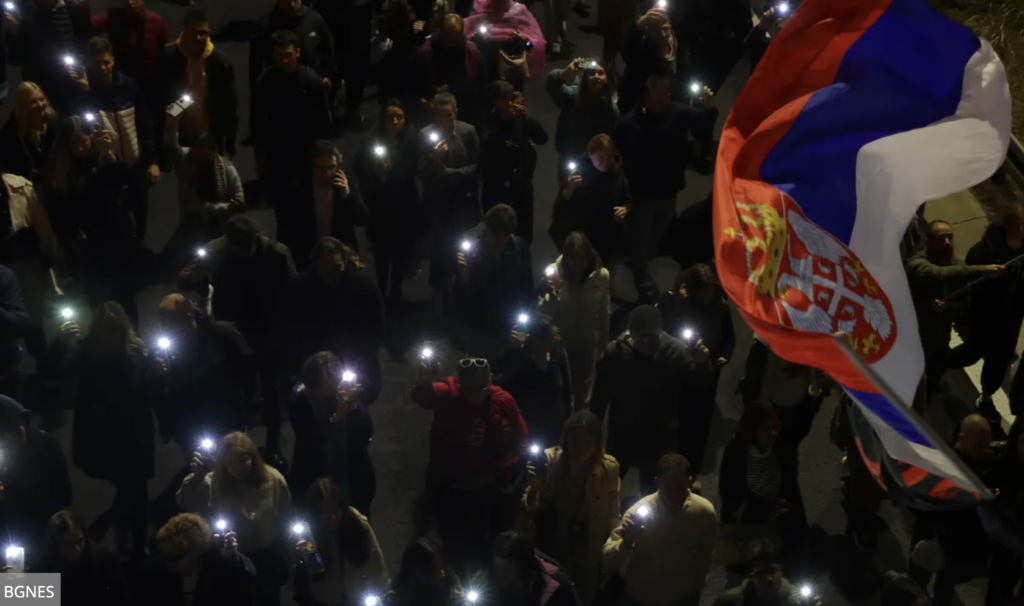
Student protest at the anniversary of the tragedy of Novi Sad.
More than a year has passed since the Serbian 2024 student uprising, sparked by the collapse of the canopy in Novi Sad that killed 16 people. What began as a call to hold those responsible accountable for the tragedy evolved into a broader social struggle against corruption, criminality, and the ruling regime’s authoritarianism. Universities—alongside secondary schools—became key hubs of resistance, with blockades backed not only by faculty but by society at large. Over the past year, the regime has used a range of tactics to not only crack down on protest but to intimidate and suppress both students and professors and deans who supported them. Those who resisted—or even expressed solidarity—risked repercussions.
In April 2025, the government of Serbia adopted a regulation that punished academic staff who had joined the blockades and suspended their teaching. The regulation changed the previous distribution of working time—20 hours per week allocated to research and 20 hours to teaching—by reducing research time to five hours. On that basis, the government was able to penalise faculty by cutting their pay to 12.5% of the full salary.
However, after classes resumed, the government went further, using financial threats to weaken university autonomy altogether. Unlike last year’s punishments, a special system of financial oversight enables the government to exert pressure on faculties in a far more subtle way. In an interview for KriSol, Professor Biljana Stojkovic describes the latest measure introduced by the government: “What has now been implemented, more broadly and systematically, is a mechanism called SPIRI, under which funds held by faculties and universities are no longer treated as ours: they are transferred to a centralized account, and decisions on spending are made by the Ministry of Finance. This applies as well to international projects and research funding. In that sense, we have lost our autonomy. It discourages anyone from pursuing research in the context of international cooperation. The specific problem is not so much the technical question of how the system will operate or how long it will take to release funds to faculties and different accounts. The most important point is that this effectively creates a kind of ‘kill switch’ for the entire university system. If we are not ‘good,’ the regime can now very easily suspend all payments, because the Ministry of Finance directly controls our finances. And without money for the university to function at all, there can be no independence.”
In addition to financial pressure, the regime has moved to target teaching staff more directly: a large number of secondary-school teachers were not offered contract renewals, and some sources report that around 100 people were dismissed in September last year. The most prominent case is that of the University of Novi Pazar, where about 30 staff members did not have their contracts renewed, and where some students reportedly lost their student status.
On this, professor Stojkovic says: “We also fear that this will open the door to a systematic way of dismissing ‘undesirable’ professors. Up to now, what we have seen is that for each individual, they have had to devise a specific method to remove them. In the cases of Jelena Kleut and two professors at the Faculty of Medicine, for example, they waited for the reappointment/re-election process and then simply did not re-elect them—that is one method. And we will see how that unfolds, unless they decide to amend the law, so that they can dismiss anyone they want. In terms of legislation—legal solutions—they are working on that intensively. Until they finalise it, they target people individually. Those in the most precarious position are those who are not full professors, because full professors no longer go through reappointments, so it is harder to find a way to dismiss them. But associate professors, assistant professors, and teaching assistants who stood with the students are at risk, because they are waiting for the moment when these staff members are due for a new appointment or reappointment.”
Financial pressure, coupled with the risk of dismissal through the manipulation of appointment and reappointment procedures, has deepened fears and made continued resistance feel increasingly costly. Despite impressive and strong mass protests and university blockades, the climate of fear has not eased but steadily intensified. Alongside institutional and legal measures, the regime also relies on tabloids and mainstream media to expose and target professors who speak out publicly and support the students. Last year, Professor Biljana Stojković was among those singled out in this way.
We also interviewed Natalija Stojmenović, an MP from the Green-Left Front. She notes that such attacks on the university are not new and describes the pattern as follows: “These attacks begin with staffing infiltration, then move on to materially worsening the position of both school and university workers, and ultimately to hollowing out the very purpose of education itself. For years, the authorities have worked to control student parliaments, to place their people on faculty councils and at the Rectorate. Then, during the blockades, they kept university staff without pay for months, and afterwards tried to undermine the entire system through a regulation that changed the way teaching and research are assessed. This is a trend in Serbia, and I believe we can also see traces of this trend in other countries. We are witnessing a wave of authoritarian tendencies that, I would say, is putting even the minimum requirements of democracy to the test. I would like to believe that this wave is trying to redefine the conditions and processes we associate with democracy, but there is also a real danger that the rise of authoritarianism is attempting to dismantle education and reduce it to a market function rather than an educational one.”
Asked how the student uprising expanded into a broader push for political change, Stojmenović says: “In terms of mobilised citizens, I would say that a crucial generational mobilisation has taken place thanks to the student movement. I wouldn’t highlight only the past year, because I think some processes need to be viewed over the longer term. Over the past five years in Serbia, citizen mobilisation around key issues has been steadily increasing—from the protests over lithium, to the ‘Serbia Against Violence’ protests, and then over the past year. This shows that the government can no longer control the consequences of a system built on corruption, and, on the other hand, that the number of citizens who believe the authorities are acting in Serbia’s interest is shrinking. The canopy collapse laid this bare, because it tragically showed that the consequences of their actions can cost any one of us our life. Still, the student movement’s greatest contribution has undoubtedly been the mobilisation and organisation it brought. ”
Although the regime appears to be entering one of its most repressive phases, these dynamics also seem to be pulling different social groups and political parties toward a common front of resistance. Whether this will translate into a unified opposition—and whether the regime can withstand it—remains to be seen. What is clear, however, is that the university has become a key site of collective mobilisation and democratic struggle, and that the defence of university autonomy has emerged as a baseline point of agreement across ideological and political divides.