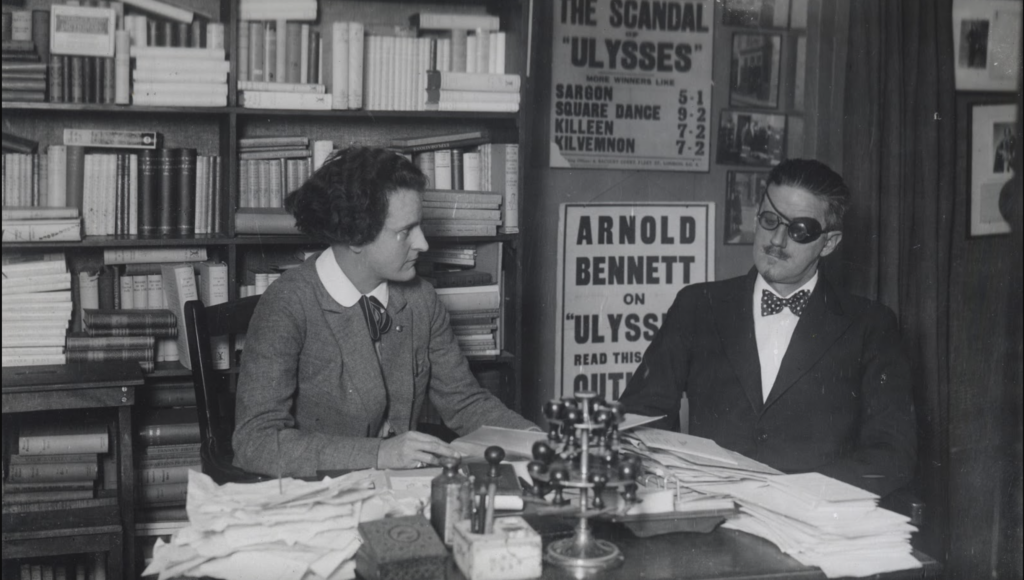
James Joyce and Sylvia Beach in front of a wall of books, posters, and pictures that one can dream of in prison. CC0 1.0 Universal, www.archive.org
Daniel, an Irish citizen, has been in pretrial detention at Ulm Prison, Frauengraben branch, since the beginning of September last year. He is one of the so-called “Ulm 5,” who, according to their lawyers, “ are accused of breaking into the Ulm site of the German branch of Israeli arms manufacturer Elbit Systems on September 8, 2025, and causing property damage there”, with the specific aim of preventing genocide in Gaza. The criminal proceedings, in which the 5 are accused of “membership in a criminal organization, among other things” are political, and have been transferred to the State Security Chamber of the Stuttgart Regional Court. The trial (and thus pretrial detention) is expected to last until the end of July, meaning that Daniel will spend eleven months in solitary confinement: in a single cell, 23 hours a day, with no contact with the outside world except for a television, handwritten letters, and a half-hour visit every two weeks. Furthermore, no books may be sent to Daniel. Nor may books be donated to the prison library, not even via any online retailer. Daniel himself is not allowed to buy fiction or poetry. The prison permits only non-fiction books for study and training purposes, but has declined, despite requests from Daniel’s lawyer, to define these parameters – or even to facilitate ordering such non-fiction books other than the three he has received in 6 months to date. Complaints have been rejected, and appeals to the prison administration have gone unheard. The only way to send Daniel books is in photocopies or print-outs, distributed across letters. He wanted to read Ulysses by James Joyce. The printout from Project Gutenberg weighed 1.3 kg; a letter must not weigh more than 100 grams; that makes 13 letters.
If the prison administration has its way, Daniel will have to be content with maximum five books per week from the prison library. The prison administration cites “security reasons (possibility of manipulation, introduction of illegal substances such as synthetic cannabinoids, etc.)” that make purchasing or accepting book donations “fundamentally impossible” and considers the inventory of its library to be sufficiently “diverse and appropriate.” If the prisoner considers that the available English-language books are not sufficient, then they believe that defendant ought to content himself with the books in German. (Daniel speaks some German due to his mother’s German family.)
Daniel’s lawyer filed a court motion “to no longer prohibit him from purchasing the books Lone Wolf by Adam Weymouth, Ulysses by James Joyce, and The Prison Letters by Nelson Mandela, or to no longer refuse him the assistance necessary for their acquisition.” At the end of January, the State Security Chamber of the Stuttgart Regional Court rejected the motion. (File number 18 KLs 36 Js 123125) One might recommend that the State Security Division re-acquaint itself with Kafka (not available in the Ulm prison library), as it wrote in its reasoning: “Access to literature is of such existential importance to interested prisoners that a discretionary refusal of access to a library is hardly conceivable; but how borrowing works is up to the prison, so there is no right to access an open-access library.“ The court echoed the prison’s argument that prisoners buying books themselves, or having them sent to them, isn’t “possible for security reasons” and that it would be unreasonable to expect prison social workers to assist in such matters .
Daniel has long since finished with the English-language collection available in the prison library. Most of these approximately 70 books were apparently purchased in the early 1970s and mid-1980s: a children’s book about a widowed mouse (1971), a study on the reading skills of people with learning disabilities (1969), a novel about an artist and one about a frustrated career woman, Wild West knockoffs, crime novels, spy novels, love stories, and thrillers from the Cold War, three volumes of Harry Potter, Orwell’s Animal Farm, a volume of Hemingway, Jack Kerouac’s Desolation Angels, The Last of the Mohicans, not by James Fenimore Cooper, but by someone with the name Watson Brown (probably a children’s book adaptation), Kim by Rudyard Kipling, a volume of Mark Twain, the 1974 debut novel by Native American Renaissance author James Welch (interesting!), a history of Germany, two books about the Vietnam War, a humor book, a biography of Reagan, three Bibles. The gem of the collection are Toni Morrison: Beloved, and indeed also Joyce’s A Portrait of the Artist as a Young Man. A volume by Kurt Vonnegut is also listed, but it’s in Serbo-Croat. In addition to the 70 English-language titles, there are over 600 titles in all kinds of other languages, in particular a large collection of Turkish books that were donated at some point.
So we copy or print out Ulysses, Moby Dick, and other books of world literature, fold up pages, and divide them between small envelopes in the permitted size. Most recently we have even carved up books and sent pages detached from their bindings.
The German-language collection with which the prison believes Daniel – a philosopher and neuroscientist who works on AI/machine learning projects on ecology, social and colonial justice – should content himself, comprises around 3,000 fiction titles and around 1,300 non-fiction books: general advice books and guidebooks, particularly on personal care and nutrition, Guinness World Records and animal books, encyclopedias, the house book of good manners, popular history, biographies, Deutschland Deine Sachsen (Germany Your Saxons), Erinnerungen eines Frauenarztes (Memoirs of a Gynecologist), a great deal of Christian literature, plus around 50 Korans and Islamic books, which are categorized under the strange heading “state religion,” countless puzzles, board and card games (a cruel irony for someone in solitary), four guitars “from Pastor Mayer,” six Olympia typewriters, and, darkly fitting for prison: Denken Sie sich frei! (Think Yourself Free!) by H.M. Glogger, Slow Down Your Life by Kai Romhardt, and Albert Speer’s Spandau Diaries.
Of the fiction titles, Daniel’s mother writes that the list, though it may be just right for some people, and that’s fine, makes her “sad,” and this feeling of sadness, also concerning our own reading history, grips us as well. How much rubbish we read in the 1980s! Gwen Bristow, lots of Pearl S. Buck, Felix Dahn: Ein Kampf um Rom (A Battle for Rome), Michael Ende, Ludwig Ganghofer, Gone with the Wind, Don Camillo and Peppone, Arthur Hailey, Daphne du Maurier, endless Karl May. Then all the school reading material by post-war German and Swiss-German men: Grass, Walser, Frisch, Dürrenmatt, Handke, Böll, lots of Siegfried Lenz, and many others whose names are forgotten today; no Uwe Johnson, no Ingeborg Bachmann. The following authors luckily passed us by in our youth: the 18 titles by Ulm local author Manfred Bomm (Notbremse – “Murder on the ICE train on the Ulm-Stuttgart line”), 29 books by Marie Louise Fischer, countless works by Uta Danella, C.C. Bergius, Josef Müller (Das Leben will dir Beine machen! – Life wants to get you going), a good dozen by Willi Heinrich: (Schmetterlinge weinen nicht – Butterflies don’t cry – about the “intoxicating love of an older man for a young girl”), 53 Konsaliks and 30 Simmels. There are, ironically, an awful lot of crime novels. Are John Grisham and Donna Leon must-reads? Manfred Bieler, Michael Crichton, A.J. Cronin, Eva Demski? Hans Herlin sounds quite interesting: Der letzte Frühling in Paris (The Last Spring in Paris) – “Paris 1944: The last spring for German soldiers in Paris. Power is crumbling, the Gestapo and Abwehr are rivals.”
Of those 3,000 German fiction titles, we can really recommend just under 30 to Daniel: first and foremost, a volume of Brecht poems, whose piercing observations of Germany in the 1930s provide many uncomfortable echoes in the world today. Then there are some classics that our grandparents also read (Ivo Andric: Viziers and Consuls, The Bridge on the Drina, Stories from Bosnia, Lampedusa’s The Leopard, Flaubert’s Madame Bovary, Maupassant’s Bel Ami, Pasternak’s Doctor Zhivago, Annette Droste-Hülshoff’s Selected Stories, Roger du Gard: The Thibaults, selected stories by Stifter, Musil’s The Man Without Qualities, Effi Briest and Stechlin by Fontante, a volume of Tolstoy, two volumes of Dostoevsky, even Anna Seghers’ The Seventh Cross, Hans Fallada’s Little Man, What Now?, Marlen Haushofer’s The Wall, Kempowski’s Dog Days). There is Peter Härtling, Ingo Schulze, Jenny Erpenbeck, and Kruso by Lutz Seiler. We would immediately borrow Elias Canetti’s autobiography, Arthur Koestler’s The Gladiators (“written in 1939 immediately after his break with communism”), Gustav Meyrink’s Der Golem and Walpurgisnacht, and by Fritz Rudolf Fries: Das Luftschiff, as well as by Jurek Becker: Amanda Herzlos.
But it’s understandable that even this selection is saddening. Having to read the one volume of Susan Sontag in German translation would, we expect, make Daniel even sadder. It’s painful when the state determines what you’re allowed to read, and in which language, whether that’s in a school library or a prison. No one should be allowed to prevent you or your fellow prisoners from buying or receiving donations of Ulysses, Nelson Mandela, Kafka, or even Palestinian literature.
The legal situation is actually on the side of the prisoners. Prisoners, whether unconvicted of any crime and in pre-trial detention, like Daniel, or serving a sentence, continue to enjoy fundamental and human rights other than the right to personal freedom (of movement). The right to access books is part of freedom of expression and information (Art. 5 (1) GG; Art. 10 (1) ECHR; Art. 19 (2) ICCPR). Prisoners also have a right to education (Art. 2, 1st Additional Protocol to the ECHR; Art. 13 IPWSKR) as a cultural right that is indispensable for human dignity and the free development of personality. In 1989, the Committee of Ministers of the Council of Europe issued recommendations on “Education in Prison” (R (89) 12). According to these recommendations, prisoners’ educational opportunities should be comparable to those in the outside world, the range of learning opportunities should be as wide as possible, and prison administrations should facilitate and support education as much as possible. In 2006, these recommendations were supplemented by the European Prison Rules – also in the form of recommendations from the Committee of Ministers (R (2006) 2). They stipulate that all prisons should have a library for use by all prisoners, which should be adequately equipped with a wide range of leisure and educational resources, books, and other media (Rule 28.5). If possible, the prison library should be organized in cooperation with public libraries. It appears that this may even have been done in Ulm, suggested by the loving little clips describing most of the books in the catalogue.
In 2015, the United Nations General Assembly adopted minimum standards for the treatment of prisoners, known as the Nelson Mandela Rules (UN GA Res. 45/111). Rule 117 states that prisoners awaiting trial shall be allowed to obtain books, newspapers, and writing materials at their own expense or at the expense of third parties, insofar as this is compatible with the interests of the administration of justice and the security and order of the institution. The fact that the “security” reasons claimed by the prison and echoed by the court are illogical is evidenced by the fact that ordering books, or having them sent, via online retailers is permitted in many other prisons across the Federal Republic, presumably without constant threats to their security.
German prison law also contains provisions on access to books. The relevant law for remand prisoners in Ulm Prison, Code II on the Prison System in Baden-Württemberg, stipulates in § 39 sentence 1 that remand prisoners must be given the opportunity to “occupy themselves in their free time.” And in sentence 2: “In particular, sports facilities, leisure groups, community events, continuing education events, and the use of an institution library shall be offered.” However, setting aside the fact that leisure activities and community events are almost impossible in 23-hour solitary, the very focus of that provision raises concerns that German lawmakers have not really understood the meaning of cultural rights. Eric Steinhauer noted years ago that library services in prisons are “conceptually the stepchild of both prison and library legislation” (E. Steinhauer, Bibliotheken und Büchereien in den Justizvollzugsgesetzen [Libraries and Book Collections in Prison Laws] in: Petra Hauke, Andrea Kaufmann, and Vivien Petras (eds.), Bibliothek – Forschung für die Praxis, 2017, p. 511). The prison administration at Ulm Prison, Frauengraben branch, is simply unaware of the cultural right to read Ulysses, even though they could probably look it up somewhere in their non-fiction books in the “PhilPsyPäd” category and see that learning constitutes more than just technical training and entertainment. For German prison law and German prisons, the “institutional library” is on a par with the tennis table, the weights room, and the television. Yet in accordance with human rights, the regulations governing the prison system must be interpreted in such a way that they take into account the recommendations of the Council of Europe, which in turn are to be understood as implementing the rights of prisoners guaranteed in the ECHR: prisoners have a right to their own personality, to education and dignity, and to books of their own choice.
According to these provisions, access to books, their provision and possession, may be restricted if this would jeopardize the security and order of the prison. However, prison authorities must determine this with regard to specific content – they must make a “fact-based risk assessment” (KG, decision of 17 November 2017 – 2 Ws 99/17 Vollz). Before completely refusing access to certain texts, it must examine whether a measure that less severely impairs prisoners’ rights could be applied – for example, whether it would be sufficient to remove certain “dangerous” pages (see ECtHR Mehmet Çiftci v. Turkey, judgment of November 16, 2021, Chamber II, Bsw. No. 53.208/19). There have been a few German court decisions that found it lawful to deny prisoners access to the book Wege durch den Knast (Ways Through Prison). The fact that the prison authorities classified the entire book as potentially dangerous was considered permissible because of “statements hostile to the prison system” and “destructive instructions for action” that were “scattered throughout the book” (KG, decision of November 17, 2017 – 2 Ws 99/17 Vollz; OLG Nuremberg decision of March 9, 2017 – 1 Ws 26/17).
This is a non-fiction book that is critical of prisons, not literature. However, Daniel and his fellow prisoners in Ulm are being denied books, not because of their content, but because of a repeatedly asserted security risk posed by their materiality. Could one theoretically bribe someone at Amazon or Thalia to smear synthetic drugs on the pages of a book or hide a weapon in the spine? This is too far-fetched to be taken seriously. Given the stubbornness with which state authorities are now denying political prisoners the right to order or receive works of world literature, another suspicion arises: Literature, art, and the freedom of personality once again appear potentially dangerous. Art itself is a disturbing factor in the prison library – that also becomes evident in how poorly the genre of poetry is represented at the Ulm Prison. Apart from that volume of Brecht poems, there are only “festive poems,” German poems “for everyone,” Robert Gernhardt’s 555 funny poems from 5 centuries, the “cheerful, thoughtful, and ironic verses” of Franz Walter Leyh, and by Heinz Ludwig Arnold: Komm. Zieh dich aus (Come. Take your clothes off).
Ulysses was banned in the US in 1921. One judge at the time ruled that it seemed “like the work of a disordered mind”, suggesting that the courts may not be ideal arbiters of the value of literature. Art and literature confront readers with other possible worlds – with the possibility of freedom. When reading, one can easily conclude that the world we live in is fundamentally wrong, perhaps especially if you are in prison. But banning reading is, in the end, more likely to fuel such thoughts rather than to silence them.