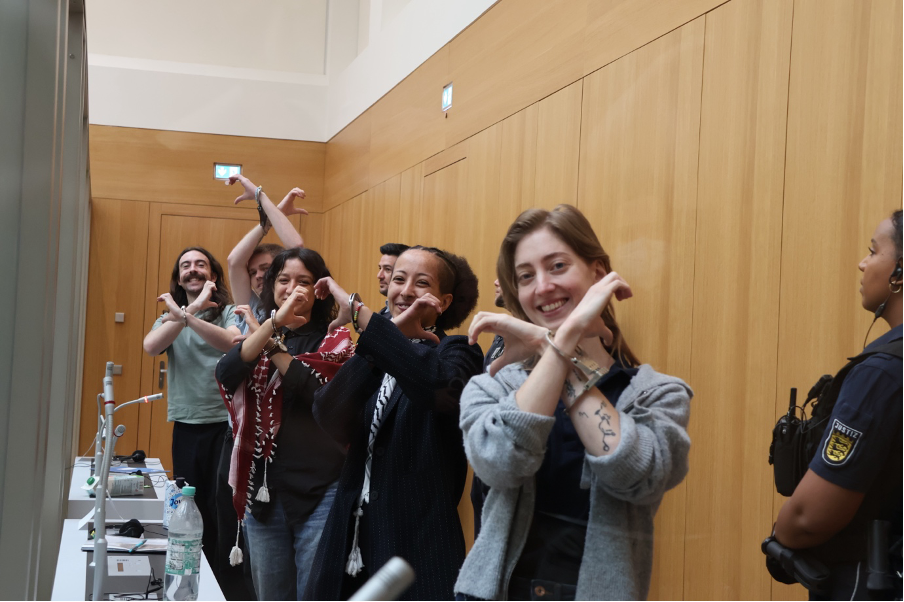
Picture showing, from left to right, Daniel, Crow, Leandra, Zo and Vi. Taken by Hebh Jamal, on 3rd July
This report is based on my observations attending the trial of the Ulm5 on the 1st and 3rd of July. At the court, I got to know some of the mothers, families, friends, and activists who come to support them. I draw on my conversations and observations to continue Marion Detjen’s court watch reports, which covered proceedings up to day eight of the trial at Stammheim prison and can be accessed here and here. I focus on the afternoon of the 8th and 9th trial days (1st and 3rd July). Like all members of the public, I could not take notes because pens are considered a security threat by the judge. What follows is reconstructed from personal memory, conversations with the mothers of the defendants, and the records of other court attendants.
I arrive at the courthouse on July 1st for the afternoon session, struck by the bleak surroundings, high security fencing, razor-wire, and stern looking officials in what seems like riot gear. The contrast with those here to express solidarity with the defendants is stark. These are, first and foremost, the mothers. I came because a mutual friend put me in touch with Nicky, the British mother of Zo. She greeted me with a big hug. Her warmth and openness are mirrored by the other mothers I meet: Vi’s mother and Mimi, Daniel’s mother. They come to trial as often as they can – to be a vigilant presence in the courtroom and to connect with their children. The court never sits on consecutive days, and, especially for family outside Germany, each day must be carefully planned, flights booked, accommodation organised, and time off work arranged. Some who wish to be there are unable to. And yet, the mothers say what they suffer is nothing compared to what their children are going through––Vi recently described some of the brutal conditions of their imprisonment in a six-page letter––, not to speak of conditions in Palestine.
The mothers gratefully acknowledge support from activists and others. I witness this when I walk out of court with Nicky on my second court-watch day: a friendly stranger, wearing a hijab, who I had seen in the public gallery, walked up and offered her a place to stay whenever she is in Germany. People introduce themselves, express their solidarity, and cheer for the defendants as if they were family too. Outside, opposite the high-security prison adjoining the court, a gazebo is set up and decorated each day with art about Gaza, Palestinian flags, posters, books, and flyers. There is free water (water is not allowed in the courtroom – people drink from the tap in the toilets if they get thirsty) and snacks, mint tea and coffee, and people sit on the floor to get some shade. At the gazebo a sound system allows speeches to be made and music to be played.
I meet activists from Baden-Württemberg and Cologne, locals who come in solidarity, students, and journalists. Some attend every trial day. The defence team give speeches and talk to family during breaks and after court. Perhaps most moving are moments of spontaneous solidarity from strangers beyond us: we hear a chant from behind the prison walls, “free, free Palestine!”, and supporters outside echo his words, adding “you are not alone!” When some people at the tent chant “free, free Palestine”, we hear an echo, again unseen, this time from the construction site next door. People laugh and respond. As Germany has repeatedly proscribed solidarity with Palestine, these moments become testimony to the strength of the struggle across the country.
It is this solidarity – with all its strength, laughter and love – that appears to be on trial here. There are about thirty waiting outside the courthouse this afternoon. The mothers go to the front encouraged by other court attendees who know who they are. An officer instructs us to hand over passports, and disappears with them. We are brusquely instructed to keep our place in the queue, to enter in the same order as our passports. Only one person may enter the building at a time. There are more officers, stony faces, more questions. Once through the metal detector, a female officer gestures for me to enter a small windowless room. Family members of the Ulm5 and others have been sexually assaulted during this routine control. My security officer is not as invasive, only short tempered: she commands that I turn around and face the wall to firmly frisk me back and front. I am told to sit down, take off my shoes for checking; I must lift my feet so my socks can be checked too.
The court is designed for trials of terrorism and national security matters. Its architecture and feel is more restrictive than any courtroom I have seen before. There are armed officers in the riot gear-like uniforms everywhere outside the courtroom, I count seven standing against the walls, and the courtroom itself is manned by more. The public is separated from proceedings and the defendants by a glass wall. The judge has on previous occasions cleared it when she felt it was too noisy and once paused proceedings and brought a member of the public who had made a noise to the bench and started reading out their personal details. Nicky, like the other mothers, is careful not to antagonise the judge for fear of being thrown out: trial days are a rare occasion when she can see her child and be a witness to the proceedings, and she does not want that to be taken away. “I will stand by my child who I taught principles of fairness”, she tells me. When the defendants are brought in, everyone in the public gallery stands up, people start clapping and cheering. The Ulm5 also smile and make eye contact with loved ones, they seem calm and composed; Mimi would later speak about “the atmosphere and stance of moral clarity” that surrounds them. The mothers and defendants form their hands into broken hearts. But Nicky and the other mothers remain silent when the public bursts into spontaneous chants of “Free, free Palestine” as they worry about the judge’s possible punitive reaction. When the judges walk in, the entire room falls silent.
Day 8, 1st July 2026
I rely on Seán Ó Maoilearna’s reconstruction for the first half of the court day. It began with a motion from defence lawyer for Zo, Nina Onèr, regarding separation from their clients by the glass wall. Communication is through an intercom, criticised by the lawyers for being unreliable and for its lack of privacy. Alternatively, the lawyers can speak to their clients in their cells but even there they remain separated from them through a glass wall. Onèr noted that in another trial in the same courthouse, of Reichsbürger conspirators who shot and injured two police officers, the same arrangement was not in place. In that case, defendants and defence meet during breaks in rooms without barriers. The prosecutor rejected the comparison to the Reichsbürger trial saying the same rules did not apply as some of the defendants were not on remand (unlike the Ulm5 who have been detained for 10 months now).
More requests were made: defence lawyers asked for an update on a previous application to record translations via the court’s microphones so as to check for accuracy, and an update on the application for the public to use pens and paper. No application was granted.
The trial’s first witness was called, Bastian Gropp of the Baden-Württemberg state police (Landeskriminalamt) who wrote the police report on which the prosecution based their charges. Several members of the public would tell me later how nervous he seemed, his face twitching on several occasions. Gropp told the court upon questioning by the judge and the prosecution that he had not been present at the arrest of the Ulm5, nor did he visit Elbit Systems Deutschland. Only after the case began was he informed that the company produces night vision and radio transmission equipment. During cross-examination he confirmed that he had not investigated whether the case could be counted as ‘emergency assistance’ regarding war crimes or crimes against humanity committed by Elbit Systems. He also confirmed that the state prosecutor (Generalstaatsanwalt) advised that the role of Elbit Systems was irrelevant. Upon further questioning, he revealed he had met or telephoned with the prosecutor at least five times, but declined to say who had initiated this, where they had met, and who else had attended. Gropp affirmed his role was to establish facts that both incriminate and exonerate. However, exonerating facts were not investigated. The prosecutor interjected at this point that it had been clear from the outset that there were no grounds for justification.
When I join the day’s proceedings, the witness has gone. The mood between defence, prosecution and judge is visibly tense. More than once, I hear members of the public comment that the morning revealed the bias in the investigation as any potential for justification had not been investigated; and that the witness had repeatedly claimed he was not authorised to answer questions put to him by the defence. The afternoon stretches out with long extracts from the investigation file read out by two judges on either side of the presiding judge: traces, damage, objects found on the site. Repeatedly, this refers to the incident as an “attack”. The public and defendants grow visibly bored as the passages – most seeming to involve accepted facts – are read out in a monotonous voice.
For me, the most remarkable moment in the afternoon is what happens during the break. As soon as the judge calls a 5-minute break, the officers sitting with the defendants get up to handcuff them. They make moves to take the defendants down to the cell, but the public and lawyers protest by tapping the glass wall to indicate that their clients should be allowed to stay. The judge agrees, and almost immediately, three officers stand along the glass partition to disrupt the public’s view. “Hey, was machen Sie da? Warum machen Sie das?” (Hey, what are you doing there? Why are you doing that?), a woman who had been translating proceedings into English for Nicky and others, shouts. “Warum nicht” (why not?), comes the aggressive response. Some laugh in disbelief at this non-sequitur. Later, a defence lawyer brings this up in court, including that all five are handcuffed even for a five-minute break. The judge ignores this, claiming it is news to her, doesn’t say anything about the handcuffing, and the trial continues.
Moments such as these are glimpses of resistance – by the defendants, public, and lawyers – and speak of the refusal to give in to the state’s disciplining of the singing, joy, and solidarity in- and outside the courtroom. Another moment that stands out is during a thirty-minute break. The public is growing tired. When we get back into the room, just before the judges come back in, some start to sing quietly, getting progressively louder:
Old as the olive tree
The will of those who fight to be free
Land and people will thrive
In a free Palestine
People repeat the song as a canon, until the entire courtroom is filled with a beautiful harmony, a stark contrast to the monotony and legalistic language of the reports all afternoon. When the defendants are brought in, handcuffed, in single file, they join the singing, smiling towards the public gallery. The solidarity is palpable, the mood almost joyful. Nicky leans across and whispers, “we have to be careful, the judge hates singing”. Again, there is the fear of the gallery being cleared. When the judges enter the courtroom a few minutes later, the public falls silent. Proceedings commence again.
Day 9, 3rd July
During their day off from attending court, the mothers were busy. Some had to work, Mimi went to visit Daniel in prison, and I accompanied Nicky to a meeting with the lawyers and to a public event held in Madrid that she, Mimi, and Daniel’s sister Clara spoke at remotely, organised by Roser, an activist and journalist who has followed the trial meticulously from the start. What impresses me most is the mothers’ strength, resilience, and the support and care they show one another. The only time I see Nicky become emotional during the panel is not when she talks about her child in prison – despite the routine denial of basic rights, the heat in a heatwave, working conditions, or the prison’s neglect of their health. The only time Nicky tears up is when speaking of the conditions in Palestine and what she describes at the panel as the suffering and death inflicted upon children there.
The spontaneous solidarity is there again at the courthouse. There are new faces, and some I recognise from the trial two days ago. We wait to see if we can catch sight of and greet any of the Ulm5 being transported by prison van to the courthouse. Hebh Jamal, a journalist and filmmaker comes to court this morning, greeted warmly by the mothers and activists who have come to know her; she takes pictures of the defendants and the public.
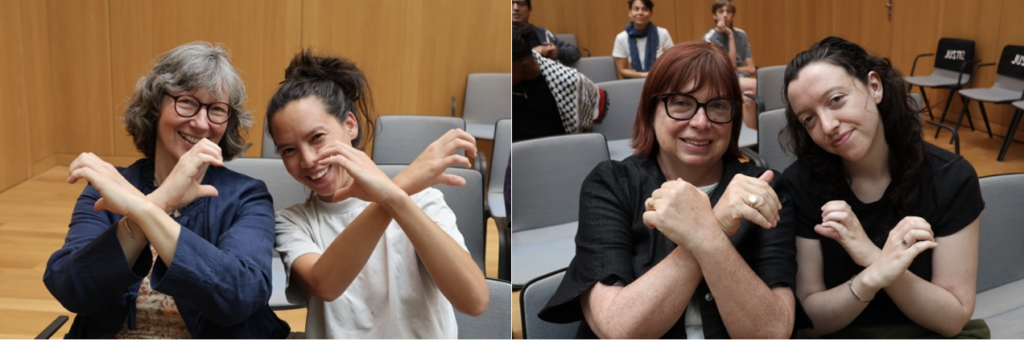
Pictures taken by Hebh Jamal on July 3rd, showing on the left Nicky Robertson, mother of Zo, and Insa Lee Koch (author). On the right, Mimi Tatlow-Golden, mother of Daniel, and Clara Tatlow-Devally, sister of Daniel.
It’s nearly 10 am by the time the trial commences. As the defendants are brought in, the public calls out “free, free Ulm5”. There are smiles, gestures of broken hearts and waves. The morning starts again with applications: first Leandra’s lawyer Mathes Breuer and Daniel’s lawyer Benjamin Düsberg on the seating arrangements and the defendants’ separation from the lawyers. Nina Onèr, Zo’s lawyer, asks once more for the public to be allowed to bring writing implements into the courtroom. The judge gives the prosecution until Wednesday next week to respond to the first applications in writing, but the application about writing implements is rejected again.
The next application, brought by Leandra’s defence team Anna Busl and Mathes Breuer, is for the lead prosecutor, Ronny Stengel, to be recused for bias and lack of objectivity, evidenced – the lawyers argue – in both investigation and trial. The long list of alleged lack of objectivity includes: bias during the investigation, including his immediate ruling out of considering the defendants’ motivations for their actions; insistence they were driven by antisemitism; meetings with the investigation lead Gropp , of which – contrary to legal requirements – no records had been kept; and an alleged failure to ensure a fair trial throughout. The lawyers put it to the court that the prosecutor’s violation of his duty to be objective constitutes an abuse of state power and undermines basic principles of fairness.
As the lead prosecutor is not present today and cannot respond, his replacement, a Dr. Mark, tells the court he thinks little of the application. He dismisses the defence’s claims of alleged failures to investigate as “wolkig” (“cloudy”), prompting a sharp response from defence counsel. A defence lawyer describes the prosecution’s conduct as “völlige Inkompetenz”(“utter incompetence”), prompting the judge to reprimand counsel for their choice of words. Once again, the judge grants the prosecution until the following Wednesday to respond in writing to this application.
The remainder of the day is taken up by the second witness, a police officer called Kai Dominik Niewald from Ulm. He coordinated the police response and arrest of the Ulm5 on the night. Dressed in a t-shirt and jeans, the informality appears at odds with his role in this trial. Initially led by the judge, Niewald describes his recollections: being called to the scene, entering the building, making his way to the room , and conducting the arrests. At first he describes on-site security claiming they had seen an axe. Here Daniel seeks to contact his lawyer, who calls for a break; later, on cross-examination, Niewald agrees no axe was found anywhere in the building or in the surroundings.
During cross-examination, some of the questioning centres on a “white powder” Niewald says was found in a backpack that police officers brought out of the room after the defendants were escorted out. He initially suspected the powder, tightly packed and sealed in a plastic bag approximately 10×3 cm, was an explosive. He tells the court he changed his mind having seen a smile on Vi’s face. Vi looks confused and tries to speak to her lawyers. After a break, Vi’s defence lawyer Matthias Schuster cross-examines Niewald. Why did he not take steps to secure this alleged explosive? Niewald has no answer other than the implication that he trusted Vi’s response. This rather undermines the image the prosecution and court have tried to build of dangerous criminals that present a risk to the court and the public.
Those in the public gallery appear confused by the discussion of the white powder. I also watch Vi and Zo glance at each other and laugh in what looks to one of the mothers like “disbelief” when the powder is first mentioned. When Niewald says he changed his mind about what it was because of Vi’s smile, the defendants laugh, joined this time by members of the public. “Why would he believe someone he has just arrested?” the person sitting next to me whispers. Later in the cross-examination, it emerges that Niewald was told by his colleagues that the powder was a class-A drug. When it finally becomes evident it was not a drug at all, this is a surprise to Niewald. Once again, there is an audible drawing of breath from the public gallery.
The exchange leaves observers with many unanswered questions. Why did a police officer, suspecting an explosive, place the substance in a police car, without taking further precautions? Why would the police tell each other something was a class-A drug when it was not? Why was the substance not on the indictments? Why, as emerged during defence questioning, was it not mentioned in the subsequent seizure report(Sicherstellungsprotokoll), and only appears to have been added later to the file? As it was not an explosive or a drug, what was it? Washing powder? Sugar? By the end of the hearing, many questions remain unanswered.
Another notable moment in the defence’s cross-examination was when a lawyer for Leandra, Anna Busl, asked Niewald if he had been in contact with Gropp, the investigation lead. Earlier, Niewald had said his involvement in the case had ended on the day of the event and had no contact with Gropp since last September. Yet now he stated he had spoken with Gropp about two weeks ago. What had they spoken about? He refused to answer this as it was an internal work-related conversation (“innerdienstliches Gespräch”). This led to another application from the defence: the witness should give evidence on this pre-trial discussion with the lead case investigator. The judge rejected this, so the defence sought a formal judicial decision, arguing that while exemptions for police witness evidence cover investigatory tactics, a conversation between police witnesses shortly before a court appearance (after an investigation had been finalised many months earlier) falls outside such exemptions. The judge put the decision back to the next court date, 22 July.
For me, what stands out is how the emerging narrative contrasts with the court’s portrayal of the Ulm5 as a security threat: the evident calmness, care and ordinary human conduct of five people who, on the night they broke into Elbit Systems in Ulm, were unarmed, did not pose a threat to the police, and co-operated from the moment of arrest (Vi even offered to translate for the others). On the police’s own admission, there was no danger to personal safety from the defendants. Leandra’s lawyer Mathes Breuer had asked Niewald whether he would describe the atmosphere in the room as playful (“spielerisch”). He answers no. Breuer asks the court to show footage from the police bodycam, and we hear Niewald observe, shortly before breaking into the room, that “the persons are sitting in the middle of the room and playing together or something” (“Derzeit sitzen die Personen in der Mitte im Raum und spielen miteinander oder so”).
This image of relaxed calm and cognizance is reflected in how the defendants watch the witness give evidence from behind their glass partition– heads high, alert, smiling. Throughout the day I see them engage in small acts of care: sharing moments of humour or reassurance; passing a pack of mints, hands briefly touching; at times talking quietly to the person next to them. When the court breaks, with the next hearing date over two weeks away, the Ulm5 quickly hug before officers step forward to handcuff them and take them out again. Nicky, Mimi and the public stand up one last time, clapping and cheering before making their way home – to catch trains or planes to elsewhere in Germany, the UK, Ireland, and beyond.
The trial continues on July 22nd.