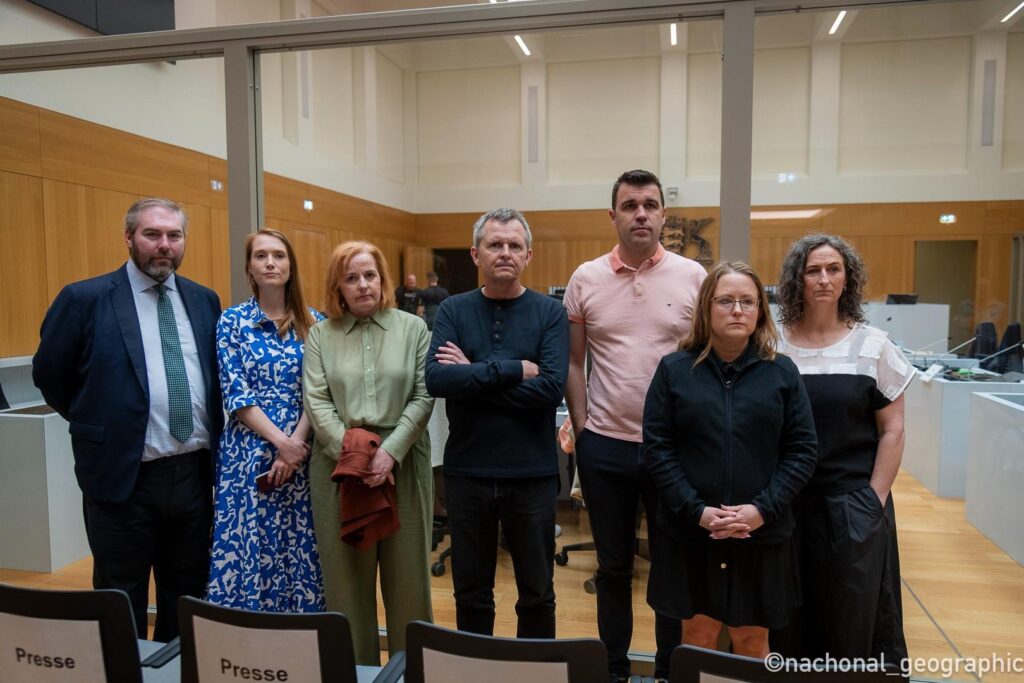
Irish parliamentary delegation in front of the bulletproof glass partition in the courtroom; photo: Ignacio Rosaslanda
At last, I managed to travel from Berlin and spend a day observing the “Ulm5” trial: the 11th day of proceedings on Wednesday, July 22. Much has already been written here about the surrounding circumstances and the location itself, from the concrete wasteland of the prison complex to the people who gather in solidarity from early in the morning. Therefore, I will focus mainly on the course of the trial itself, which by the end of the day should make the absurdities of these proceedings plainly visible.
As a journalist, I have the privilege of taking a press seat and bringing a computer, pen, and paper with me. What may not sound particularly remarkable is, in this specific trial, a notable privilege indeed. “Ordinary” visitors are denied these items because pens could supposedly be used as weapons. At least that seems to be the court’s reasoning. It is the same reasoning that led them to move the proceedings to this notorious high-security venue and to treat and present the five defendants (Daniel Tatlow-Devally, an Irish citizen; Leandra Rollo, Spanish; Zo Hailu and Crow Tricks, British; and Vi Kovarbasic, German) as if they were dangerous terrorists. They have been held in pre-trial detention for more than nine months and are brought into court in handcuffs.
Or perhaps they are treated even worse than terrorists. One of today’s absurdities is that, in the courtroom next door, a trial is taking place against the Reichsbürger group that planned to overthrow Germany’s democratic order and heavily armed itself to do so. Despite the clearly documented militancy of those defendants, they face less drastic security measures than the “Ulm5”. For example, pre-trial detention has been suspended for some individual Reichsbürger defendants.
For today’s hearing, a group of Irish parliamentarians has travelled to observe the proceedings because Daniel is an Irish citizen. Even they are prohibited from bringing pen and paper into the courtroom. Given their parliamentary rights and immunity, that alone is astonishing. But many aspects of the circumstances surrounding this trial are extraordinary.
Today, admission proceeds smoothly. The security checks are similar to those at an airport, and the court officers are friendly. Only the physical search is somewhat more thorough, and shoes are checked separately. By 9 a.m., most observers are already in the courtroom. Behind an estimated 2.5-meter-high pane of bulletproof glass, all approximately 70 seats are occupied. The trial is supposed to begin now, but nothing happens. Six court officers are present in the room, apparently fewer than on other trial days. Some speculate that this is a concession to the Irish parliamentarians. Will today’s hearing be different?
It is not until 10:15 a.m. that proceedings finally begin. The five defendants are brought in wearing handcuffs, greeted by applause and calls from the audience: “Free Ulm5!” The young defendants smile gratefully. They appear so confident, so friendly, so upright; yet at the same time it is clear that this is a rare moment of strength and empowerment, standing in sharp contrast to the painful and damaging days they endure in prison. Vi recently described this movingly in a letter.
Here in the courtroom, they make the heart gesture again. Because of the handcuffs, it remains an offset, divided heart. The “Ulm5” are once again seated in a narrow enclosure separated by bulletproof glass, isolated from their defence lawyers. This is a situation that has been described as unworthy of Germany’s judicial system ever since the trial began, and it is once again raised today. The trial has been running for several months, and nothing has changed about these questionable conditions.
The presiding judge, Kathrin Lauchstädt, initially strikes me as unobtrusive and reserved. She establishes who is present, and then the proceedings begin with a statement from Zo (“the accused person Hailo” is how the court refers to them. Is this legal jargon, or an awkward attempt to avoid using the queer defendant’s pronouns?). Zo first requests that the absurd seating arrangement in the courtroom be abolished so that the five defendants can sit with their lawyers. Secondly, Zo requests that conversations before the trial and during breaks be allowed without a separating barrier, since even outside the courtroom the lawyers are unable to speak directly with their clients. The seating arrangement has apparently been justified up to now on the grounds of limited space. But Zo, and later the defence lawyers as well, make it clear that this is merely a pretext. Alternative courtrooms are available, they argue, and those rooms would even offer more space for the public. Furthermore, trials have already been held in the same court where defendants were allowed to sit beside their lawyers.
During Zo’s statement, their voice cannot be heard because the microphone is switched off. The content only becomes understandable through the German interpretation spoken by the translator. The defence lawyers interrupt and request that arrangements be made so that Zo’s remarks in English can be heard directly. After all, there are English-speaking people present in the courtroom, not least the members of parliament from Ireland.
These are the kinds of small, seemingly obvious things that repeatedly fail to function and then have to be addressed by the court in a time-consuming and cumbersome manner. At this point, the judge orders a recess for a “technical review”. After an eleven-minute break, Zo continues. Their voice can now be heard, along with the subsequent translation.
“It’s always the same”, Zo says. “On every day of the trial, the technology here doesn’t work properly. A huge amount of time is being wasted while we are wearing these very painful handcuffs and our pretrial detention continues.”[1] Being seated with their lawyers, Zo argues, is an absolutely fundamental right, and a genuine defence is simply impossible without direct communication, coordination, and the ability to review documents together.
Zo then asks: “Is the court really so afraid of what would happen if we moved out of the glass cage?”
The entire setup is absurd. These five young people recorded themselves carrying out their action, allowed themselves to be arrested without resistance, and have behaved in a completely cooperative and peaceful manner ever since. Yet they, and even the spectators attending the trial, are subjected to a sweeping presumption that they are potentially dangerous, violent criminals. The contrast between this assumption and these thoughtful, calm, smiling, warm-hearted young people could hardly be greater.
Warm-heartedness is probably not a common feature of court proceedings, and certainly not of this one. Senior public prosecutor Ronny Stengel, who appears largely detached, never changes expression. Whenever motions are submitted, even those seeking only the smallest improvements to these absurd trial and detention conditions, the response is repeated like a mantra: the prosecution has already commented on the matter or will submit a written statement. No reasons are ever given. According to the senior prosecutor, the seating arrangement does not violate the right to a fair trial. That is the only response to Zo’s statement and to the defence motion requesting that it be changed.
Vi also reiterates: “We’ve been in court for three months, and being unable to sit with my defence team severely restricts me. As a defendant, I have the right to speak with my lawyers! I can’t imagine that this is supposed to continue for another three months.”
The defence lawyers point out that, during their conversations before the proceedings begin each morning, their clients must stand bent over for up to an hour in order to communicate through the partition. Defence attorney Matthias Schuster states: “Whoever designed this room has no understanding of the fundamental principles of the rule of law. These conditions are unworthy of a defence in a constitutional state.” Defence attorney Maja Beisenherz points out that, in the parallel Reichsbürger proceedings, the lawyers are permitted to enter the cell area and speak directly with their clients there. And defence attorney Benjamin Düsberg underscores the point by inviting the judge to personally sit in the defence position and assess the conditions herself: “I’d be happy to conduct the hearing while you’re doing that.”
The criticism of the difficult conditions facing the defence becomes so concentrated that the prosecution requests a 30-minute adjournment unless “a return to a factual discussion” can be achieved. Defence attorney Mathes Breuer criticises these repeated threats of adjournments, which have characterised the trial throughout, as an unlawful means of discipline.
At this point, the judge wants to postpone further motions, arguing that a witness has already been waiting for more than an hour to be questioned. However, it was the judge and her colleagues who were responsible for the delayed start of the proceedings in the first place.
Attorney Düsberg makes this point clear and then simply takes the opportunity to welcome the seven Irish parliamentarians: “Welcome to Germany, welcome to Stammheim.” As he addresses them in English and urges them to tell the world about these proceedings, whose circumstances he says are more reminiscent of Russia, the senior prosecutor begins gesticulating wildly, and the judge loses patience. She orders a 30-minute adjournment, switches off Düsberg’s microphone, and leaves the courtroom together with the prosecution. For the “Ulm5”, this means that the handcuffs go back on, they are transported back to their cells, and they once again have no direct contact with their lawyers. After the half-hour break, they are brought back into the courtroom to the applause of the spectators.
These interruptions are clearly intended to intimidate the defence. Instead, however, they reveal the judge’s lack of composure. When asked about the purpose of the adjournment, she snaps loudly: “This is not a discussion forum!” She also claims that Düsberg should not have addressed the Irish visitors in English: “The proceedings are conducted in German. The language of the court here is German.” The scene reminded me of Guido Westerwelle, who, after the FDP’s electoral success in 2009, when he was the incoming foreign minister, rebuked an English-speaking journalist as a show of worldly sophistication by saying: “Just as it is customary to speak English in Great Britain, it is customary to speak German here”, before emphasising once more: “…this is Germany.”
Yes, this is Germany. All of the defence lawyers criticise what has by now become quite obvious: the court is dragging out the proceedings through delays and adjournments. Above all, the concrete motions by the defence are not being properly addressed, let alone granted. Not even the request that the Irish members of parliament be allowed to use pen and paper. Eventually, a police officer takes the stand. At the previous hearing, the officer had refused to answer part of the questioning, citing “internal police procedures”. Now, however, the officer is being required to testify on those matters after all, one of the rare instances in which a defence motion has actually been granted. The questioning focuses on what access the officer had to the case files in order to prepare for giving testimony.
After the witness testimony, repeated requests are once again made to allow the Irish parliamentarians to take notes. Yet the supposedly dangerous weapon of a pen remains forbidden to them for the rest of the day.
And after all these small, nerve-racking, and pointless legal skirmishes, a substantive section begins, even before the lunch break. This part concerns not procedural details but the alleged war crimes that the defence argues motivated the actions of the “Ulm5”.
To begin with, defence attorney Breuer requests that the managing director of Elbit Systems Deutschland be summoned as a witness. First, he argues that the German subsidiary of Elbit supplied high-frequency communications technology without which the devastating conduct of the war in Gaza would not have been possible in its current form. Second, he contends that Elbit Systems Deutschland, through its capabilities, forms an integral part of the overall corporation and therefore cannot be separated from it. Elbit, and thus also Elbit Systems Deutschland, has therefore, in his view, supported genocide and other crimes relevant under international criminal law.
What follows is a lengthy presentation on the death toll in Gaza, the high proportion of civilians among those killed, the widespread destruction of living conditions and healthcare infrastructure, the use of starvation as a weapon of war, and the broader horrors unfolding in Gaza. Several massacres in which civilians and aid workers lost their lives are discussed as examples. Among them is the attack on a World Central Kitchen convoy, in which seven aid workers were killed. According to the defence’s argument, the drone used in that attack was equipped with radio communications technology supplied by Elbit Systems Deutschland.
Breuer then turns to the arrest warrant issued by the International Criminal Court (ICC) and begins quoting, in the original English, from the reasoning behind the warrants for Prime Minister Netanyahu and former Defence Minister Gallant. Once again, a confusing scene unfolds. The judge insists that the presentation be made in German; otherwise, she argues, the text cannot form part of the court proceedings. In passing, she also makes a racist remark, saying that one cannot simply “tell something in Swahili” in court. When the interpreters attempt to translate the arrest warrant, the judge rejects that approach as well and escapes into the lunch break. She declares that from now on submissions will be made exclusively in German, despite having accepted English-language submissions earlier in the proceedings.
In the end, however, the judge decides that translation may continue after all. The solution is that the text will now be translated from English into German and then back into English again for the English-speaking participants in the proceedings, a procedure that appears entirely bizarre. The defence lawyers point out that these translations once again contribute to delaying the trial.
During the lunch break, the Irish parliamentarians hold a press conference. Over the following hours and days, they continue to comment extensively on what they have witnessed. They say they are shocked by what they have seen, to the point that some characterise the proceedings as a “show trial” taking place in Germany, or at the very least as a trial that is seriously violating the rights of five young people, including the Irish citizen Daniel.
After the lunch break, Breuer continues his presentation on the ICC arrest warrant and the details of Elbit’s responsibility, which are now in fact being interpreted twice. Once again, the court’s focus appears to be on formalities and minor procedural issues rather than on the substance of what is being presented: repeated crimes against humanity and serious war crimes identified by the International Criminal Court, as well as what numerous international experts and scholars of international law now assess as an attempt to destroy an entire population group, evidenced by the high proportion of children among those killed, repeated expressions of genocidal intent by Israeli politicians, and the carrying out of a genocide.
According to the defence lawyers, Elbit, through its extensive contributions to this conduct of the war, is directly involved and therefore qualifies as a perpetrator under international criminal law. They argue that 65% of the drones, ground vehicles, and munitions used in Gaza are produced by Elbit. The company also provides AI systems for target identification. Through these systems, they claim, 850,000 targets in the Gaza Strip have been marked, an enormous number.
According to the defence, Elbit Systems Deutschland plays a central role through its high-frequency communications technology. Without the transfer of technology within the company, the machinery of killing in Gaza could not continue to function in its present form. Elbit Systems Germany is a wholly owned subsidiary of Elbit, and products are supplied directly from Germany to the parent company. The corporation and its management therefore make their contribution knowingly and with full awareness of the conduct of the war, the lawyers argue, and the corporation’s actions can therefore be attributed to natural persons. In the defence’s view, this makes them accomplices, while the actions of the “Ulm5” amount to emergency assistance to prevent a greater harm.
At the time of the action itself, in September 2025, the killing was still fully ongoing. (Although a ceasefire has been in place since 16 October 2025, it hardly deserves the name, given the continuing daily Israeli attacks, in which more than 1000 Palestinians have since been killed.) Only a short time before the action, further deliveries had been sent from Ulm to Israel. The defendants’ actions should therefore be understood as an attempt at prevention, the defence argues, because the hope of exerting a real influence on the continuation of the genocide, even if only by slowing it down or reducing its intensity, was entirely realistic. The presentation concludes with the assertion that the wrong people are sitting in the dock. It comes as no surprise when the prosecutor once again dismisses the presentation as legally irrelevant. Yet, as Benjamin Düsberg remarks, these are facts that the prosecutor himself ought to be presenting, or at the very least investigating.
The proceedings then turn once more to the defendants’ extremely harsh detention and trial conditions. Motions are submitted concerning the fact that Vi is prohibited from making telephone calls in Schwäbisch Gmünd prison, that handcuffs and leg irons are always used during transport, and that the entire procedure is degrading. Vi considers these measures unjustified and unlawful.
Zo then speaks again and describes this degrading treatment personally. Red marks on the wrists still hurt for hours after court sessions, and during the lengthy transports it is impossible to read, eat, or drink. There is no risk of escape, Zo argues. So why does this ongoing torture continue?
Yet the court has not agreed to even the smallest improvement. The situation has become so absurd that a motion filed back in May, simply requesting a different type of handcuff that would allow slightly greater mobility, has not been granted. Even an artist who wishes to produce courtroom sketches is not permitted entry. It seems as though every motion has already been rejected before it is even submitted.
Finally, transcripts of the videos that the five defendants produced to explain their actions are read aloud. At the end, Zo and Daniel each make further statements.
Zo states: “At the time of my action, I knew that a genocide was being committed, that civilians were being killed every single day. It was precisely to prevent this that I acted, even if doing so might save only a single child from being killed by an Elbit drone. During the previous two years, I had already tried to achieve this goal through protests. But the massacre continued. And Germany continued exporting weapons. Even if one does not describe what is happening as genocide, everyone agrees that Israel has committed serious war crimes and crimes against humanity. Between June and our protest in September, Germany approved arms exports worth nearly three million euros. That was the motivation for my actions, and it is clearly visible in the video.”
Daniel then begins a statement in English, which is to be translated into German by the interpreters. However, by the end of the long day, the interpreters also seem exhausted. Sentences are repeatedly interrupted and restarted, and the translation struggles to proceed smoothly. As a result, there is yet another interruption. In a further bizarre twist, Daniel, who speaks German quite well, ends up translating the text into German himself and continues in German after the break:
“It has been a long time since we saw the relevant videos [this refers to the video material regarding the “Ulm5’s” action, including from surveillance videos, which were edited for use in court, and videos by the “Ulm 5” speaking about the motives for their action]. Despite the questionable editorial decisions made in that surveillance video, taken together with our own videos, it presents a clear picture.
A picture of five people who have long recognised the injustice of the occupation of Palestine. Five people who, not without horror, discovered that the German authorities not only intended to allow arms companies based here to profit from mass killing, but also deliberately ignored all objections to this practice or dismissed them as nonsense. Five people who came to the sobering conclusion that they had a moral duty to stop shipments from Elbit in order to stop ongoing war crimes.
The connections between our knowledge, our values, and our actions are clear and straightforward. To claim other motives would severely strain credibility. If the prosecutor believes that we were wrong about the genocide and Germany’s involvement in it, then he would have to engage with the fact that there is a great deal of thoroughly researched evidence supporting those claims.
I have already spoken clearly about the accusations of antisemitism. They are baseless. In a fair and just system, the presentation of these videos would be sufficient to order our release from pretrial detention, if not to dismiss the charges entirely. Yet we are still here. And we fully intend to defend ourselves, day after day, against accusations whose sole purpose is to distract attention from Germany’s complicity in yet another crime against humanity.”
A long day in court comes to an end, full of absurdities, trivialities, and wasted time. The lives of five young people continue to pass by while they remain imprisoned under extremely harsh conditions, having now spent ten months in pre-trial detention, while at the same time more Palestinians in Gaza and the West Bank are killed each day with the very weapons that Germany supplies to Israel.
[1] This and all subsequent quotes are taken from the author’s notes; where possible they have been cross-checked. Nevertheless, minor discrepancies may occur; minimal corrections have been made to improve readability.