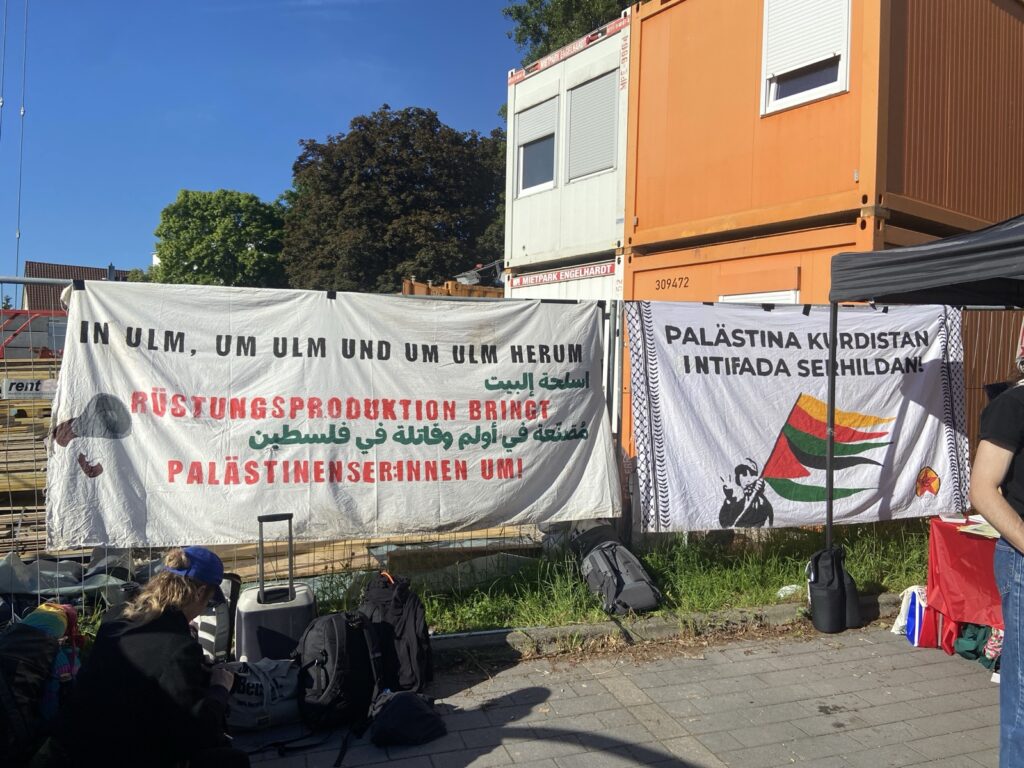
Ulm, Palestine, Kurdistan – the solidarity camp on the parking grounds of the court
What did the Ulm5—five young people living in Berlin with Irish, British, Spanish, and German citizenship—do? In the early morning of September 8, 2025, while the war in Gaza was still raging, they broke into a building belonging to the Israeli arms manufacturer Elbit Systems Germany in Ulm, damaged computers and other equipment, toilets, windows, and measuring devices, and spray-painted slogans on the walls (the Attorney General’s Office considers “baby killers” in particular to be anti-Semitic). According to the prosecutor’s office, several others who are being sought had also sprayed slogans and possibly red triangles outside and then fled. The Ulm5 filmed themselves during their break-in and vandalism and then waited to be arrested. Beforehand, each of them had delivered a short speech to camera, justifying their actions as resistance against the ongoing genocide and again using some of the slogans that the prosecutor’s office considers to be incriminating. Other unknown individuals edited the videos and uploaded them to social media after the incident. Some of the group’s statements and actions link them to “Palestine Action,” a Palestine-solidarity sabotage network previously active in the UK.
(I happen to know two of the individuals involved in the act: one—Daniel, an Irish citizen—since they were a small child; our families have been friends for three generations; the other—Zo—only very briefly, as a student at Bard College Berlin. They’re both gorgeous!)
From the very beginning, it was clear that the judicial system in Baden-Württemberg would treat the Ulm5 as enemies of the state. Strange incidents occurred—a few of which cannot be made public while the trial is ongoing—along with all manner of harassment. For 30 hours, while they were held at the police station in Ulm, they were denied contact with lawyers. Zo sat in their cell for six hours having been forced to undress completely and given only an adult diaper to wear. Daniel sat in their cell for much of the 30 hours, they later wrote to their girlfriend in a letter, without clothes, naked except for underwear. It wasn’t until two weeks later that Daniel‘s court-appointed attorney was given an appointment to speak with Daniel in Ulm prison. For a month, Daniel‘s family was not allowed to contact them, and even Irish consular staff were not allowed to visit.
Instead of suspending pretrial detention on bail, as is customary when there is no risk of flight, it is being extended further and further, with the trial not beginning until seven months later and the trial dates stretched out as much as possible. At the moment, the court plans to reach a verdict only in January 2027, that is, after 16 months of pretrial detention.
Pretrial detention at the Ulm Am Frauengraben Correctional Facility is very harsh: except for one hour of yard time early in the morning every day, sometimes one hour of access to a gym once a week, and a half-hour of visiting time every two weeks, he is in solitary confinement with no access to the outside world except for a television. Letters take weeks and sometimes up to 5 months to arrive. Only after six months, after multiple appeals, was a court order issued granting Daniel the right to purchase fiction books. When Daniel‘s family was finally allowed to visit, they sat separated from them in a glass enclosure and could communicate with them only faintly through small drilled holes; physical contact was not permitted. It was only when Irish members of parliament went to the German ambassador in Ireland and lodged a complaint that this unlawful practice was discontinued after five months.
Because of these harassments alone, the defense attorneys were embroiled in a battle with the court from the very beginning. At the latest when the Stuttgart Higher Regional Court, in upholding the decision in February that the suspects must remain in pretrial detention, were antisemites with „high criminal energy“, and stating that they faced long prison sentences (all this without hearing evidence from the defence), it became clear that the judiciary was biased and not interested in a fair trial.
There are several peculiarities of the German court system that have a structurally negative impact in a political trial such as this: 1) Unlike Anglo-Saxon legal systems, German procedural law does not provide for a jury, but rather, in addition to the three professional judges, only two lay judges, who, while formally equal to the professional judges, generally do not develop their own corrective dynamic because they are in the minority; 2) Prosecutors are subordinate to the Ministry of Justice and are bound by instructions; they are part of the executive branch. While judges are independent and not bound by instructions, they are structurally close to the prosecutors: As judicial officials, both share a common career path, a common employer, common associations, common institutional interests, common conferences, cafeterias, social networks, and a similar self-image. Prosecutors, too, are bound by a duty of “objectivity” and are supposed to investigate not only incriminating but also exculpatory circumstances. This moderates the prosecution, but conversely, a judge who wants to advance his career or simply keep the peace among his colleagues can hardly afford to alienate the prosecution and, by extension, the government. The prosecution and the court tend to act as a united front, albeit with divided roles. 3) Simply as a counterweight to this, criminal defense attorneys—who are primarily obligated to their clients and work as independent professionals—often hold left-leaning and state-critical views in Germany. 4) My impression: The dominance of state interests and the blurring of roles, combined with certain personal character traits, foster the impression in political trials that members of the judiciary are actually weak, insecure individuals who are not free in their actions and compensate for this with passive-aggressive authoritarian behavior. This, in turn, leads to petty fights in the courtroom with attorneys and the public that actually undermine the dignity of the court. 4) There is no provision for verbatim transcripts to be prepared of the court proceedings in most German trials. One of the three judges takes the minutes, and the presiding judge determines what is noted down and what is not. Lawyers may have something entered into the record, but only after the presiding judge has granted them the floor. In the absence of verbatim transcripts, not to mention audio recordings, lawyers are forced to constantly ensure that what they say is actually recorded. This slows down the proceedings and contributes further to the impression of indignity. 5) Trials must be public, the press must be admitted and allowed to take notes. However, members of the public not accredited as press may be barred from bringing writing materials under courtroom regulations. From my experience at the Berlin-Tiergarten District Court, paper and a (often poor-quality) pen are at least provided in such cases. At the Stammheim Regional Court, however, you receive neither pen nor paper and must rely on mnemonic techniques to remember what happens throughout the long day. Visitors are searched before entering, sometimes roughly and with force in intimate areas, even after surrendering all personal items including belts and going through a metal detector. The public nature of the trial is undermined by the ridiculous insinuation that the audience could use a pen or paper to attack “participants in the proceedings”—a scenario in which, at Stammheim, behind a bulletproof glass wall, the audience would have to attack either each other or the court officers standing around in combat gear: stab vests, padded clothes, reinforced leather gloves, armed and carrying handcuffs. 6) And as is likely the case everywhere in the world, the architecture of the court itself expresses mistrust toward the audience. In Stammheim, the bulletproof glass walls separate not only the defendants but also the audience from the courtroom.
The Ulm5 trial involves a host of other issues that are actually uncommon in German legal proceedings. From the very beginning, the court has been completely unresponsive to the defense attorneys; Presiding Judge Kathrin Lauchstädt subjects them, the defendants, and the public to harassment that seems as arbitrary as it is unnecessary. All attempts by the defense attorneys to engage in dialogue with her in the run-up to the trial failed. She refused to accept phone calls or emails from the defense (only snail mail), while—as the attorneys have since discovered—communication with Attorney General Ronny Stengel took place via email. On the first day of the trial, she did not allow the defense to speak at all, without giving any reasons for doing so. There is no judicial decision or justification for the discriminatory seating arrangement, and the judge has provided no schedule for the trial days, despite repeated requests from the defense. The 16 trial days initially announced were arbitrarily extended last week by another 28 days, stretching into January. Not only does this prolong the defendants’ pretrial detention, it also makes it virtually impossible for the lawyers to continue running their law firms in Berlin, Munich, Nuremberg… The experts to be appointed do not know when they are supposed to appear in court and cannot plan accordingly. Since the defendants filmed their own actions and the facts are clear, one wonders what is actually supposed to happen during these 44 days. Perhaps this is an empty threat. But perhaps the court also intends to carry out this strategy of attrition in earnest. Although the trial days officially begin at 9 a.m. and the public must arrive as early as 8 a.m. for security checks and searches, the proceedings do not actually begin until around 10:30 a.m.; lunch breaks of two hours or more are scheduled, and the presiding judge uses every pretext to interrupt the proceedings or even adjourn them for the day entirely. Indeed, after 4 sitting trial dates so far, only about 8 hours of actual court proceedings have been undertaken.
On the first two days of the trial (which I did not attend), the court got no further than establishing the defendants’ identities. When proceedings did take place at all, they always concerned the attorneys’ motions to be allowed to file motions before the indictment was read, in order to clarify issues that had not been resolved before the trial began due to the presiding judge’s refusal to engage. The lawyers want 1) to ensure that the defendants are allowed to sit next to them, as is customary, because only then is confidential communication possible. This is in line with multiple European Court of Human Rights rulings. The arrangement of having the defendants behind a glass partition, where they are supposed to follow the proceedings and translations as well as communicate with their lawyers via microphones and headphones, significantly curtails their right to legal counsel and violates Article 6 of the European Convention on Human Rights, the right to a fair trial. This has been repeatedly refused by the judge. 2) The attorneys seek to ensure that they may bring a law clerk to prepare verbatim transcripts, or alternatively, to permit audio recordings. This has also been refused repeatedly by the judge – contrary to custom. Indeed the prosecutor, invited by the judge to take a view on this, remarked that it was not necessary as this case was neither of contemporary nor of historical significance. 3) Due to the apparent prejudgment evident in the court’s refusal to allow the defence to speak at all on the first day of proceedings; the court’s highly prejudicial media statements likening the Ulm 5 to multiple murderers, terrorist coup plotters and rival gang warfare participants; and other matters, the attorneys have filed a motion for recusal against the presiding judge.
The first day of the trial ended dramatically: After one of many arbitrary recesses, the lawyers protested the seating arrangement by moving en masse behind the bulletproof glass in their robes, with their laptops, ready to work and reading to wait for their clients there and stand beside them. They basically occupied the glass box. Like an overwhelmed elementary school teacher, the presiding judge ordered them to take their seats within five minutes. When the lawyers refused to comply, the judge adjourned the hearing, sent everyone home, canceled the hearing days scheduled for the following week as a collective punishment, and extended the trial into January. It wasn’t until May 20, after a two-week break, that proceedings resumed.
In the following, I describe what I saw and experienced on the third and fourth days of the trial, the days on which I was present myself:
Report from Wednesday, May 20, the third day of the trial:
On the way from the subway’s last stop to the prison and courthouse, we run into the other mothers (Vi’s, Crow/Walter’s, and Zo’s). For me, these mothers are and remain the most striking figures of the entire process. They greet each other affectionately. At home, some of them cry their eyes out, but when they talk to each other, they laugh at the absurdities. They laugh at how the court asked the defendents for their current addresses of the respective detention centers. They laugh at Vi’s answer in German to the question about her marital status: “leeedig” („ledig“ is a German bureaucratic word for not married). “Either you’re married or you’re a ‘spinster’”. The laughter helps a lot, and if I had to choose between the fate of the mothers or the sad existence of the presiding judge, I would always choose the fate of the mother. When we arrive in front oft he court house, the activists treat them with touching courtesy, they always let them go to the very front of the lines.
The mothers are all in their mid-50s to early 60s and were, until recently, by no means „radical“. For some time, the families weren’t sure if the lawyers’ conflict strategy was the right one. But the unjust and harsh treatment of their children from day one, the many acts of harassment, the absurd accusations of anti-Semitism, and the countless experiences of being at the mercy of a state power that is blind to reality, self-contradictory, and inhumane have driven them completely to the side of the activists in solidarity with Palestine. Not only in court, but also before every prison visit, they are searched and frisked and, depending on the facility, might not be allowed to bring in either paper or pens. Before her prison visits, Daniel’s mother tries to write the most urgent things she wants to tell Daniel in the scant half-hour visit on the back of her hand. “Does the German state realize how they are radicalizing women over 60 whose skin is too wrinkled to write prison notes on their hands?”
You can see Stammheim Prison from a distance. The courthouse is right next to it. It was rebuilt in 2023 in a corporate-chic style. The interior of the building was compared to a “wellness oasis” in an architecture magazine; Daniel’s stepfather jokes that he will only give it two stars on TripAdvisor. “The Stuttgart hospitality thing—measured cordiality.”
The numerous court officers in the gallery are dressed in riot gear and ready to interpret their powers broadly and arbitrarily. While we wait for the trial to begin, a row of seats reserved for the press is opened up to the public. The mothers want to move to the front so they can see their children better behind the glass partition. They are denied this for no reason: “I have my instructions,” says the court officer. “Just following orders,” say the mothers; this excuse sounds familiar in Germany. The activists hunch in their seats so the mothers can still have a somewhat clear view.
After a delay of over an hour and a half, the defendants are finally brought in, and at first it is a shock. Vi is wheeled in on a chair, handcuffed, by several officers. She has lost over ten kilos in detention in Schwäbisch-Gmünd, where there is apparently not enough to eat; they say it is cold and dirty within the old walls of a former monastery. She really looks terrible. Has something happened? Can she no longer walk? Her friends from her hometown of Offenbach, who have traveled here for the day, are fighting back tears. But when the others, too, are not walking on their own but are carried in by four police officers each, it becomes clear to that this is a protest: Unlike the RAF defendants, who withdrew from the trial by going on a hunger strike, the defendants do want to participate in the trial, but with this action they are demonstrating that they do not accept the glass partition, being handcuffed and separated from their lawyers.
This is not the only difference to the RAF trial that comes to mind: The RAF defendants had killed people, whereas the Ulm5 defendants have only damaged property and harmed no living being. The RAF defendants refused to participate in the trial by going on a hunger strike. The Ulm5 defendants want the trial to proceed but insist on their rights. The RAF defendants did not claim that their actions were intended to hinder, for example, the Vietnam War or the Shah’s policies in Iran. The Ulm 5 wanted to hinder the genocide in Gaza and Germany’s support for it, at least temporarily. Today, the state is attempting to exploit the symbolism of the RAF trial. A dynamic of radicalization happens today as it happened then. However, the defendants and the defense are doing everything in their power today to counter dehumanization and the violation of life, and to insist on the rule of law.
As the defendants are escorted to their seats, the audience greets them with a standing ovation and sustained applause. Today, however, unlike on previous trial days, there are no cheers and no singing. One of the mothers had asked the activists waiting outside the entrance to refrain from cheering and singing so as not to provide further pretexts for interruptions, but she told them to clap as they entered. We know how important this encouragement and support from the audience is for the defendants.
The first few hours of the trial, which has finally begun, are consumed by the complicated legal maneuvering surrounding the motions with which the attorneys have already spent the first two days attempting to assert their clients’ rights: these include the stigmatizing nature of the proceedings, the restrictions on communication and public access, the recording of proceedings, and—since these motions are constantly being denied without justification—the court’s bias. In addition, the lawyers are trying to secure permission to show an eight-minute film as part of their opening statements—using the courtroom’s equipment or on a screen they have brought with them. Presumably, it is a film showing the war crimes committed in Gaza using Elbit’s weapons systems. The court is determined not to allow this under any circumstances.
The contrast in demeanor and bearing between the court and the lawyers is striking. The presiding judge embodies, in a jarring way, the archetype of the timid bureaucrat. One cannot help but feel that she is not making decisions freely, but is somehow receiving instructions from above—or is, in some incomprehensible way, biased and incompetent. The lawyers—a total of 11 court-appointed and private defense attorneys, of whom 7 or 8 are present—are all quite young. While there may have been disagreement about the trial strategy during the preparation phase, the court, with its obstructions and incompetence, has achieved the opposite of what it intended. The lawyers are not intimidated, but appear determined and completely united.
The Attorney General seems even more intransigent than the judge, less insecure, contemptuous; he speaks little, and when he does, he makes himself as incomprehensible as possible. He clearly has a problem with the lawyers’ media relations. Time and again, he mentions media coverage, “international and domestic,” as if it were something objectionable for which the lawyers were responsible. At one point, he warns that he will not let it pass if, as he fears, the defendants’ opening statements were to “depart from the foundations of the Basic Law.” He apparently confuses German national interest/the „Staatsräson“ with the Basic Law. He laughs when the lawyers later speak about the war crimes in Gaza. For his part, he contributes to delaying the trial by usually not responding to the lawyers’ motions, or responding only briefly, and reserving the right to submit written statements, for which the presiding judge has given him until the middle of next week.
In the end, the presiding judge must hear one final motion before the indictment is read: a defense attorney requests that the public be excluded during the reading of those sections of the indictment that deal with the alleged “anti-Semitism” of the crime. She argues that her client’s safety at Stammheim Prison is at risk, as right-wing ideology is circulating there; a prison chaplain had approached them and unsolicitedly given them a book on anti-Semitism. Since someone from the BILD newspaper is also sitting in the audience and it is actually surprising that there hasn’t yet been a full-scale smear campaign against Ulm5, the lawyers, and the family members, there may be some truth to the fear. But my impression is that the motion primarily gives the defense attorney the opportunity to explain, even before the indictment can be read, that her client’s actions were not directed against Jews, nor even against the State of Israel, but exclusively against the leadership of Elbit Systems, its weapons production, its involvement in the genocide in Gaza, and German support for it. The many other motions, which may seem confusing to the public, also allow the defense—regardless of whether they are rejected or not even admitted—to present the defendants’ motives before the prosecutor can shape the narrative by reading the indictment.
The indictment focuses primarily on “Palestine Action Germany,” as an alleged part of “Palestine Action Global,” which is said to have emerged from “Palestine Action UK,” and attempts to prove that these networks constitute organized “crime” and a “criminal organization” into which the defendants’ act was “integrated.” The preparations for the act, and above all the red Palestine Action overalls that the Ulm5 would have worn had the postal mail delivered them in time, serve as evidence of “membership”. But since the act was a one-time occurrence, and apart from this single act, an organization named “Palestine Action Germany” has not had an appearance anywhere else to date, and above all, since trespassing and property damage alone do not constitute serious crimes, the justifications for assuming the existence of a criminal organization do not really hold up. Apparently, this is why the Attorney General needs the astronomical figure of over one million euros in damages, for which he provides no evidence whatsoever. He also needs the accusation of anti-Semitism to make the act appear particularly reprehensible. The slogans and the mere fact that Elbit Systems is an Israeli company are supposed to substantiate the accusation of anti-Semitism. To insinuate that the defendants support Hamas, the red triangle and FTRTTS are used as evidence.
After the long, imposed lunch break, when most of the press had gone home, the lawyers were finally able to deliver their opening statements. They have obviously decided not to address the charges brought by the State Attorney General’s Office at all. Their defense is not a defense, but rather a full-scale offensive. Two lawyers begin with presentations on the history of the RAF trials and the symbolism of Stammheim, and they explain the defendants’ one-time, symbolic refusal to enter the glass box. One lawyer, who had intended to show the eight-minute video featuring footage from Gaza, states for the record that he was denied the opportunity to present his case and has nothing further to say. One lawyer draws a parallel to the members of the climate activist group Last Generation, who caused millions in damage and yet were not taken into pretrial detention. Daniel’s lawyer, Benjamin Düsberg—who is simply excellent at rhetoric—presents on the war in Gaza and how, above all, children were killed, starved, and injured, deliberately and systematically; he speaks in detail about the types of weapons produced by Elbit Systems, how they are used for genocidal warfare, how Germany supports this weapons production; what international law prescribes and how international law relates to German law. “No one who has even a shred of heart and reason left can turn a blind eye to this.” As he speaks, two of the defendants are crying. I no longer remember where Düsberg stopped and the lawyer Breuer took over, or who read the quote from Fritz Bauer: the defendants’ actions—trespassing and property damage—were not merely excusable, were not merely justifiable as self-defense; they were resistance, necessary resistance against an ongoing genocide, “the least they could do,” after all other means of persuading Germany to cease its complicity in the crimes had failed. The lawyers concluded that the criminals were sitting on the other side; Elbit and Germany should be the ones on trial, whereas the defendants had drawn the only correct conclusion from the lessons of National Socialism and the Holocaust: “Never again!”
The presiding judge seemed to be listening, at least. The prosecutor, on the other hand, made dismissive hand gestures and even laughed once. When asked if he wished to respond, he sneered that he had nothing to “replicate,” since nothing relevant to the trial had been presented.
Outside, we meet the lawyers. They are confident. The presiding judge is making one mistake after another. Indeed: her weakness and lack of composure are glaringly obvious. Nevertheless, that very evening, the information screen in the subway displays a version of the story that blames the “chaotic day of proceedings” on the defendants who allowed themselves to be dragged in, and on the lawyers with their motions. This is the epistemic violence that Mimi had said was almost harder to bear than the physical violence of imprisonment and deprivation of liberty: “It’s unbelievable when you experience this live, and then have to hear and read what the state and the media have to say about it—and that’s something completely different.” When you’re being fed a pack of lies; when you’re forced to accept a false, constructed parallel reality instead of the reality perceptible to your own senses.
Report from Friday, May 22, 2026, the fourth day of the trial
It is the day on which the defendants’ statements are finally expected. As we wait in the morning sun in front of the supporter camp, Greta Thunberg comes around the corner, with her heavy backpack, accompanied by Judith Scheytt and Heba Jamal, just like the rest of us from the subway; completely unassuming and without any fuss being made about her arrival.
Yesterday, Roser, the most active activist, visited another trial that is currently taking place on alternate days in the very same courtroom in Stammheim out of curiosity—one that involved a person charged with membership in a terrorist (!) organization. She reports: This defendant had not been in pretrial detention at all, but had arrived by taxi. He was treated politely and courteously by the court and was informed of his rights; a “normal” trial, which once again shows just how abnormal the Ulm5 trial is. At the entrance in front of the courthouse there is a notice box that shows all the upcoming trials, with hearing dates—for the public, one would think. When I take a photo of them, a police officer approaches and aggressively orders me to stop.
Security checks: At the entrance, the punk-style policewoman who is nice and discreet and already knows me takes over the pat-down in the booth again. But others end up with a policewoman who is a sadist. Mimi after the afternoon check: “She stuck her hands up inside my bra, pushed the underwire up hard—very painful—and felt my breasts. Like both palms on the whole of both my breasts, I consider it a sexual assault.” In response to her loud complaint: “Hey, what are you doing? That’s not normal,” she replied: “That’s how I always do it,” but at least refrained from reaching into her pants between her legs, as she did with Greta, the other mothers, and four journalists. This happened to every woman as far as we know who was sent to this woman including the very experienced trial observer representatives from the Basic Rights Committee NGO, who have filed a formal complaint already. The lawyers will file a formal complaint about sexual abuse.
In the courtroom, the slips of paper for the “press” are no longer on the chairs but are laminated and glued to the backs of the chairs in the first two rows. No one is supposed to get the idea to use the slips of paper for writing anymore. It is details like these that make one particularly feel the court’s meanness.
The defendants are led to their seats behind the glass partition, on foot today. Vi looks much better; in fact, the defendants are in high spirits. Mimi and Jem were able to visit the day before; he’s doing well, despite the terrible prison conditions and even though a fellow inmate he’d befriended during the morning yard walks has disappeared. When the sun creeps over the prison walls, they stand on their tiptoes to feel a few rays on their faces. Daniel does hundreds of push-ups in his cell every day and looks stronger than ever. It seems they won’t succeed in breaking the defendants and their families.
Now the lawyers are raising the motions that had previously been denied: Regarding the seating arrangement, they have discovered that the presiding judge lied: Stammheim was designated as the courtroom from the very beginning; no other venues were even considered, even though there were 14 or 15 other courtrooms in the region. The fact that no eye contact with the clients is possible, and above all that they cannot simultaneously follow the proceedings and communicate with their lawyers, constitutes a violation of their rights that they will not accept. In response, for the first and only time so far, the young prosecutor sitting next to the Attorney General speaks up and asks—perhaps ironically, since it is quite cramped at the lawyers’ tables—where exactly the defense thinks the defendants should sit? This is a perfect setup: The lawyers laugh, one (Anna Busl) speaks up and thanks her for the question: Where the prosecution is sitting right now—that is the right place for her clients! Because in fact, they are the real plaintiffs, and the real accused are Elbit Systems and the German state, which supports genocidal warfare. The prosecution could then sit down behind the bulletproof glass and see what the trial looks like from there.
Regarding the issue of recording, the lawyers cite the RAF trial as a historical counterexample, where the court permitted a court reporter. Above all they point to the obvious practicality. The Attorney General counters for now that the RAF trial had media and historical significance for contemporaries and posterity, whereas he considers this trial as insignificant. (Posterity will see it differently.)
On the question of pen use in the audience: the attorneys point out that the pretext that pens could be used as stabbing weapons is absurd. The Attorney General claims that he has reasons to be afraid as he and the judges have been named on Indymedia and threatened “with sanctions.” Defense: they are sorry to hear this, but the audience can’t be blamed for that, and what does it have to do with the pens?
The motion to make an audio recording of the trial is denied. In most cases, the Attorney General does not present oral arguments but instead refers to written statements, for which the presiding judge sets a deadline for the following week. When the attorneys point out that the motion to at least bring the defendants out of the glass enclosure for their opening statements must be decided immediately due to time constraints, the judge wants to end the day’s proceedings entirely—it is noon, after only an hour and a half of proceedings. Great unrest in the courtroom: are the defendants once again not to be given an opportunity to speak? Several lawyers cite the principle of expeditious proceedings, their clients’ civil liberties, and the fact that the presiding judge herself had referred to the principle of expeditious proceedings on the very first day; they also mention the families who had traveled from abroad to hear their children. The judge has to give in, but orders another two-hour lunch break, probably in the hope that most of the press will no longer be present by then.
I, too, am prevented by this long lunch break from hearing the statements. But according to reports from others and Mimi’s account, only Daniel managed to speak up, and not the whole of his statement. At first, the presiding judge granted the request to let the prisoners out of the glass box for their statements, but with a “meanness” attached (as one of the lawyers put it): They were to be led to the witness stand in handcuffs. Daniel therefore preferred to deliver the speech behind glass after all, rather than be paraded “like an animal”, according to Düsberg. Daniel spoke in German about his exclusively humanitarian motives for the act: the systematic destruction of the foundations of life in Gaza, the artificial famine, the sexual violence against Palestinian prisoners. The Ulm5 had wanted to “cause a stir,” to at least temporarily interrupt the arms shipments. “Looking the other way is reprehensible, but supplying the equipment for it is even worse.” The accusation of anti-Semitism did not surprise him, but it outraged him: “To label resistance against occupation and mass murder as anti-Semitism is a disgrace.” –
After this sentence, which landed powerfully in the room, the presiding judge completely lost it: She seized upon a brief and isolated cheer from the audience as a pretext to interrupt Daniel’s statement—not to remove the disruptor from the courtroom, but to have them led through a side door from the gallery into the courtroom itself and to stage a small trial within the trial there: She had the person’s ID card handed to her and began to read out their personal details before everyone. When the lawyers, the defendants, and the audience covered their ears and protested, she must have realized the illegality of her action. She abruptly closed the hearing and went off for the weekend.
To be continued.