Nicola Perugini, “Between Anti-Colonial Resistance and Colonial Genocide: Gaza at the Limits of International Law”, The Journal of Imperial and Commonwealth History, November 2025, 1–14, doi:10.1080/03086534.2025.2578214.
Perugini highlights a major blind spot in International Humanitarian Law (IHL) as to how it has recognised anti-colonial wars. Perugini points out that IHL’s limited recognition of anti-colonial violence – enshrined in the 1977 Additional Protocols which institutionalised the right to fight against colonial occupation through armed struggle – rests on a static state-centric framework where the civilian is imagined only as a passive, nonpartisan victim in need of protection, while it is the combatant who engages in violently dismantling colonial occupation and domination through anti-colonial resistance. However, historically we know that anti-colonial movements have challenged this IHL principle of distinction between civilians and combatants by blurring the line between the two in a collective struggle. Adopting the perspective of the colonized, Perugini thus calls for “decolonizing the civilian” in international law. To Perugini, this perspective “forces us to rethink the civilian as a figure of resistance rather than passivity” (p.2).
In the context of Israel’s ongoing genocide in Gaza, the stakes around the distinction between civilians and combatants decide over life and death for most Gazans, and certainly for all males and even male children. As Perugini points out, Israel uses precisely this distinction to kill with impunity all those who dare to blur the line between civilians and combatants. The recent example of a local ZDF contractor also illustrates, how targetting of journalists is justified by Israel and German media by questioning the civilian status of journalists.
More specifically, by drawing on Israel’s genocide in Gaza, Perugini highlights two dialectically entwined forms of transgression that are at odds with IHL. On the one hand, anticolonial forces merge the civilian and the combatant in their anticolonial struggle through, for instance, the network and infrastructure of tunnels which have a commercial and a military purpose. Through tunnelling, Palestinian resistance groups have undermined the distinction to be able to “challenge the asymmetry of the battlefield” through “subterranean warfare” (p.7). On the other hand, the state of Israel uses this very indistinction in order “to destroy the colonised people as people”. To Perugini, both transgressions of international law allow us to better grasp the limits of international law, as well as the relationship between colonial genocide and anticolonial resistance in settler-colonial contexts.
Perugini’s call to decolonize the civilian in IHL thus allows us to better understand why anticolonial resistance necessitates the indistinction, and how IHL allows Israel to justify self-defence as a coloniser by denying the colonised their own right to self-defence. “This inversion of aggression and defence is central to the colonial logic of genocide.” (p. 10).
Both in internal KriSol debates and, for example, in an interview with Omer Bartov in German-language Jacobin, it has recently become clear that there are considerable reservations about the term “war” within movements in solidarity with Palestine. Instead, the preference is to link the moral and political assessment of the mass violence against Gaza and its population to the legal concept of genocide—even though for some time now, members of the German federal government have been deliberately using this term as an opportunity to avoid drawing any conclusions from the violence. They point out that the courts have yet to decide whether genocide has actually been committed, or they ignore journalistic inquiries about consequences of genocide altogether. The latter was the case, for example, at a government press conference shortly after the fragile ceasefire began in October 2025, which dealt, among other things, with the German chancellor’s considerations regarding the resumption of unrestricted arms exports to Israel. Obviously, the term “genocide” alone is not enough to build political pressure. Moreover, it is by no means certain that the courts will actually rule in a few years’ time that the Israeli government has committed genocide in Gaza.
There is therefore ample reason to fear that a discursive narrowing to the term genocide could be used not only now, but especially in the future, to ward off responsibility and deny mass violence. Against this background, we advocate the strategic revaluation of an empirical-analytical concept of war that refers to observable reality, thereby emphasizing the political significance of empirical evidence and not making itself dependent on legal judgments.
Genocidal war is no less cruel than genocide
The term “war” is often considered inappropriate, especially by those who strongly condemn the mass violence against Palestinians and urgently demand political consequences. They criticize that “war” implies symmetry—a conflict between sides with at least roughly equal capacity to act—and thus could enable both-sidesism in the assessment of mass violence against Gaza (this is also roughly the reasoning behind the rejection in the interview with Bartov linked above). We share the criticism of both-sidesism. At the same time, as peace and conflict researchers, we disagree with the impression that wars are symmetrical per se. Empirically, this is definitely not the case.
“War” primarily refers to the circumstance that violence is exercised and suffered on a massive scale. Admittedly, in quantitative research, the term is indeed mainly attached to the number of battle-related deaths, suggesting that war consists primarily of combat between opposing sides. The idea here is that armed actors (at least one of them a state army) fight each other and that both combatants and (unintentionally or acceptably) civilians are killed in the process (see, for example, the Uppsala Conflict Data Program). However, such definitions have long been criticized within peace and conflict research and are considered overly simplistic and insufficiently reflective of the actual dynamics of war. The concept clearly does not apply to Gaza, for example, where civilians and civilian infrastructure were directly and immediately attacked, killed, and destroyed. Direct attacks on the civilian population also occur in wars for which no genocidal logic can be empirically identified, i.e., wars that do not specifically destroy the living and survival conditions of members of a national, ethnic, racial, or religious group, to stay close to the Genocide Convention. Examples of non-genocidal violence against civilian populations can be found, for example, in the context of military interventions – think of the US drone wars and the unspeakable term “collateral damage” – and also in civil wars, where non-state armed actors sometimes use violence against the civilian population to obtain food, labor, and forced recruits.
When we nevertheless speak and write of “war” in such situations, this takes into account the fact that, from a global and historical perspective, mass violence has rarely been symmetrical and that it has very often been and continues to be directed against civilian populations. All forms of colonial, and often genocidal, violence since the 16th century could serve as examples here. In this respect, unilateral mass violence is not actually a special case. Rather, the symmetrical struggle between uniformed armies, which has mistakenly (only thanks to Eurocentrism) shaped the image of war in Western minds, should be considered to be a special case.
We therefore propose not rejecting the concept of war outright, but using it free of Eurocentric assumptions of symmetrical violence in order to bring the relevance of empirically proven violence to the fore. The advantage of such a term is that it can be used to characterize mass violence in very different forms as morally and politically relevant—because “war” is a man-made catastrophe, and the term signals that action is needed here. The second step is to empirically clarify the central characteristics of the war in question. One suggestion for the empirical description of mass violence in Gaza is “genocidal war”: that is, mass violence that, based on empirical observations, can plausibly be interpreted as an intent to destroy. Compared to genocide, “genocidal war” has the advantage that it does not have to be confirmed by courts, but is based solely on extensively documented empirical observations – which in politics is usually sufficient as a basis for decision-making and action! The use of the term “war” can and should therefore be used to counter arguments that court proceedings must be awaited before decisions can be made about consequences in relation to the Israeli government. Whatever the courts decide, the empirical evidence alone should be proof enough that a genocidal war has been waged and that this is just as unacceptable as genocide established by a court of law.
This brings us finally to the de facto hierarchization of suffering, which also concerns Dirk Moses and is undoubtedly a core problem of the legal concept of genocide. This concept is intended to describe the worst of all crimes, but is so narrowly defined that the vast majority of mass violence cannot be covered by it and is thus inevitably labeled as “less serious.” Here, too, the concept of war could have a corrective effect in the long term by counteracting such a hierarchy.
Taking a multi-pronged discursive approach
Of course, it still makes sense to use the concept of genocide, especially to demand the application of international law. Our central point is only that it is unwise for movements in solidarity with Palestine to put all their political and moral eggs in one basket—especially in the case of international law, which is known to be selectively effective and permeated by colonial logics! We should pursue a multi-pronged discourse in order to escape a situation in which key actors deny responsibility for the most serious crimes and in which moral and legal condemnation are so closely intertwined that future acquittals would, in the worst case, amount to whitewashing. The term “genocidal war” allows us to do this.
Köppert, Katrin: “Für eine radikale Imagination von Wissenschaft” [For a radical imagination of scholarship], Zeitschrift für Medienwissenschaft, 17 (2025), Nr. 2, pp. 140-144, http://dx.doi.org/10.25969/mediarep/24183.
Peters, Kathrin: “Kritik der Wissenschaftsfreiheit” [Critique of academic freedom], Zeitschrift für Medienwissenschaft, 17 (2025), Nr. 2, pp. 135-139, http://dx.doi.org/10.25969/mediarep/24182.
What does it mean when there is so much talk about academic freedom at the moment? Who uses the term and for what purposes? To whom does this freedom apply? Who is not being considered, what is not being thought about? In the Zeitschrift für Medienwissenschaft (Journal of Media Studies), Katrin Köppert and Kathrin Peters have published contributions to the debate that take the reactions of universities to the genocidal war in Gaza as a starting point for problematizing the discourse on academic freedom.
Katrin Köppert argues that responding to the curtailment of academic spaces by defending academic freedom is futile. Against the backdrop of Black Radical Thought, the call for freedom must first acknowledge the problem of a real existing lack of freedom. Rinaldo Walcott has described Black emancipation as something that has not yet happened. Following Walcott’s thinking, the plea for academic freedom should be replaced by the demand for a radical imagination of scholarship.
Kathrin Peters also takes issue with focusing solely on academic freedom. She sees the relationship between scholarship and politics as intertwined since the dawn of science. The call for academic neutrality is therefore political in itself, as it ignores the fact that even the perception of a problem as a problem can never be neutral. Against this backdrop, the debate on academic freedom that has erupted in response to protests in solidarity with Palestine at universities is proving to be a deflection. As justified as doubts about whether academic freedom has always been protected by the state may be in individual cases, these debates also serve to divert analytical attention away from pressing questions—questions about where racism and anti-Semitism begin and end, or about the so-called German culture of remembrance. Above all, however, the debates obscure the situation in Gaza, which is what the protesters want to draw attention to in the first place.
“Anyone who says ‘never again’ must mean ‘for everyone’ […],” writes Alexander Schwarz in his article. However, according to Schwarz, the German government insists on a raison d’état (Staatsräson) that is limited to unconditional solidarity with Israel. He points to the loss of credibility in view of the double standards that can be observed in the (lack of) application of international law, for example with regard to Ukraine – and the consequences for a rule-based world order and the principle of equality before the law: “Anyone who deliberately breaks with these principles places themselves outside the community of values to which they belong.” Domestically, too, the damage to the democratic framework is evident in the state repression of pro-Palestinian protests and the accompanying violation of rights guaranteed by the constitution.
For Schwarz, “Staatsräson” must be framed by legal principles and doctrine, provided that one considers it a legitimate doctrine at all (cf. e.g. Andreas Engelmann, Über die erstaunliche Rückkehr der Staatsräson im Gewand der Moral y, Etos, August 22, 2024, for whom “[t]he concept of raison d’état […] only makes sense if it stands for interests that legitimize disregard for law and order. Otherwise, the state could simply abide by law and order.”): “It is not a question of ‘Staaträson’ or international law’, but of a ‘Staatsräson’ in conformity with international law.” Meanwhile Germany’s silence on crimes under international law and its supply of weapons to Israel damage the fundamental principles of the international legal order.
In his article in the magazine südlink, Schwarz emphasizes the urgency of universal application of the law – “Now is the time to defend the principles of Nuremberg.”
Professor Schabas: “US, Germany, and Others Could Be Held Liable as Accomplices to Genocide in Gaza”, interviewed by Selcuk Gultasli, European Center for Populism Studies, August 30, 2025.
With regard to Israel’s military actions and settlement violence in the occupied Palestinian territories, the norms of international law and international criminal law speak in clear terms, as hardly ever in law. However, inhumane policies not only in Israel but also in Germany are silencing these norms in a way that makes it increasingly difficult to debate on the basis of better arguments and, let’s be honest, even to name the overwhelming facts.
In an in-depth interview with the European Center for Populism Studies (ECPS), Professor William Schabas—one of the world’s leading experts on international criminal law and genocide studies and a professor at Middlesex University—gives a detailed assessment of the escalating crisis in Gaza from the perspective of international law, populism research, and global governance. As a descendant of a family of Holocaust survivors, Professor Schabas warns that Gaza is a “litmus test” for the credibility of international justice and the authority of global legal institutions.
Interviews in which those who have dedicated their entire lives to interpreting and clarifying the law have their say are more important than ever in times like these. They can make the pertinent norms of international law, their negotiation before various courts, and their relevance to the policies of states comprehensible to untrained readers, without losing much of the complexity. Schabas offers readers solid expertise and presents legally sound chains of argumentation.
With regard to the allegations of genocide, crimes against humanity, and war crimes, Schabas makes it clear that court and investigation proceedings such as those currently pending before the International Court of Justice (ICJ) and the International Criminal Court (ICC) have and must have very concrete implications for the decisions of individual national authorities and politicians. Genocide is not an isolated event; it always consists of a series of actions and decisions by many actors, and preventing it is the responsibility of all states that have committed themselves to “never again” with the 1948 Genocide Convention. At the same time, as Schabas also notes, genocide existed long before this international agreement, particularly as part of colonial expansion and racist logic. These events defy the simplistic historical classification of a before and after of a supposedly peaceful and human rights-based liberal post-war order and continue to shape the current world situation.
The case of South Africa v. Israel before the ICJ is “probably the most serious case of genocide ever brought before the Court.” Schabas argues that the intent to commit genocide can be inferred both from Israel’s military actions and from statements made by high-ranking Israeli officials, such as Defense Minister Yoav Gallant’s remarks about cutting off food, water, and electricity supplies to Gaza. “We have more than just a pattern of behavior—we also have statements and clear indications of a policy.” Referring to the ICJ’s established case law, these are all factors that must be taken into account in the final assessment.
According to Schabas, third countries – the US, Germany, Canada, and others – may also be liable under Article III of the Genocide Convention for supporting Israel with military and political aid. He warns: “To the extent that they provide material assistance of significant importance, they may be held accountable as accomplices to genocide.”
Now is a crucial moment for the entire future of international justice, such as the ICJ and the ICC. Failure to apply uniform standards in the case of the destruction of Gaza carries the risk of entrenching a “two-tier system of international law” and undermining human rights worldwide: “These institutions are absolutely vulnerable, and they are aware of this. Gaza is a test of their credibility and authority.”
On all these points, Schabas not only takes the time to explain the legal issues in an understandable way, but also places them in the context of larger global political and legal disputes between individual states and their worldviews and value systems. The ICJ in particular, so Schabas, has recently, after periods of fundamental consensus, increasingly become the scene of such disputes, which increasingly reveal the contradictions and fragility not only of international courts, but of the entire normative and institutional basis of the United Nations—with a Security Council that could not be further removed from the ideal of representation of the entire international community based on equality.
In a broader context of debates on populism, authoritarianism, and international accountability, the interview makes an urgent call for a rethinking of the legal, institutional, and political frameworks for preventing mass atrocities. Double standards, as currently applied more than ever in law and politics, are not just an unfair application of the law and an unequal distribution of legal responsibility and effective prosecution. Double standards promote and create the illegitimate power of the few over the many and are the cornerstone of any authoritarianism that ultimately subjects all people to its dehumanizing logic.
Schabas argues that this must be prevented while it is still possible.
Statement “Refusal on grounds of conscience. For human rights and compliance with international law,” https://uppsaladeclaration.se/germany/.
While the systematic and targeted starvation of the population in Gaza, with Western and especially German support, is making the genocide of the Palestinians an undeniable fact for more and more people, the question of a boycott of Israel is still taboo, especially in Germany. The so-called BDS movement, co-founded by the Palestinian Campaign for the Academic and Cultural Boycott of Israel (PACBI), was launched in 2004 in response to the failure of Oslo and the question of what nonviolent options for action remained against occupation and disenfranchisement. In Germany, it is indiscriminately considered antisemitic and partly watched by the Office for the Protection of the Constitution as a “suspected extremist case.” But now even the German government can no longer avoid dealing with sanctions and the suspension of cooperation in certain areas. And an increasing number of international scientists are signing letters calling on their governments and employers to stop ignoring the consequences of the situation in Gaza for scientific work – most prominently the letter from more than 1,000 physicists and scientists to the leadership of CERN.
In early summer, Swedish scientists, and scientists working in Sweden, published the so-called Uppsala Declaration, in which they commit themselves, on grounds of conscience, to no longer cooperate with Israeli institutions that have made themselves complicit in illegal occupation, apartheid, genocide, and other crimes under international law. This declaration has well over 2,000 signatures.
The German version has now been published on the same website and is identical to the Swedish version in form and many of its formulations. It explains the decision to boycott Israeli institutions in great detail, citing overwhelming evidence of Israeli universities’ involvement in crimes, and formulates the same principles:
“1. We will not support cooperation with the State of Israel or with its institutions that bear responsibility.
2. We will not promote or publicly support institutionalized exchange with Israeli institutions that bear responsibility.
3. We will not participate in activities organized and/or co-organized by the State of Israel or its complicit institutions.”
In addition, it also addresses the situation in Germany, citing examples of how German universities are disregarding their obligation to comply with international law, institutional links, and how existing cooperation is even to be expanded. And it clarifies at the end: “We explicitly do not call for severing relations with individual Israeli academics. Rather, we firmly reject cooperation with Israeli institutions involved in illegal occupation, apartheid, genocide, and other violations of international law on grounds of conscience.”
I myself hesitated for a while before signing the statement: firstly, because I do not wish to cooperate with non-Israeli institutions that are involved in violations of international law, either, and would prefer to adopt a general demand for universities to commit themselves to human rights. Like the Human Rights Policy of Ghent University in the Netherlands: “In a nutshell: Ghent University does not cooperate with organizations involved in serious or systematic human rights violations, nor does it want projects to lead directly or indirectly to human rights violations.” Secondly, I can imagine ethical dilemmas in which it is unavoidable to enter into undesirable cooperation. However, my main concern at this point is to put pressure on German institutions, the German government, and the German public to immediately cease all military and police cooperation with a state led by right-wing extremists, and to save Palestinian lives and the lives of the hostages. That is why I am signing this letter.
“Women, Life, Freedom” against the War. A Statement against Genocidal Israel and the Repressive Islamic Republic, 23. Juni 2025, https://de.crimethinc.com/2025/06/23/women-life-freedom-against-the-war-a-statement-against-genocidal-israel-and-the-repressive-islamic-republic.
It has already been six weeks: In the early hours of June 13, 2025, Israel launched an attack on Tehran in violation of international law. Iran struck back within hours, firing missiles at dozens of military installations in Israel. The Israeli government justified the war by claiming that Iran was on the verge of completing a nuclear bomb – an unsubstantiated claim that Prime Minister Benjamin Netanyahu has been repeating since 1992. Nine days later, the US officially entered the war on Israel’s side. According to the US-based human rights organization Human Rights Activists in Iran (HRANA), nearly 1,000 people were killed and over 3,500 injured in the Israeli attacks. In Iran’s attacks on Israel, 29 Israelis were killed and 172 injured. After twelve days, the war was temporarily ended with a ceasefire initiated by the US.
We share here a statement by the collective Roja, which was originally published in Farsi on June 16 and translated into English a week later by the decentralized network CrimethInc. It is now available in many other languages, too. Roja is an independent internationalist collective of Kurdish, Afghan (Hazara), and Iranian feminists, based in Paris, that was founded in 2022 in response to the Women, Life, Freedom protests in Iran.
The statement embeds the events of the war in the context of recent Iranian history, critically assesses the military interventions in the “War on Terror,” such as in Afghanistan and Iraq, and insists that there is no such thing as a “just” war or justified bombing. With analytical clarity, Roja takes a stand against attempts at discursive appropriation from all sides. In the discussion about the so-called Twelve-Day War, supporters of the alleged “preemptive strike” who push the narrative of Israel’s self-defense and “regime change” in Iran are pitted against those who stylize the Islamic regime as an anti-imperialist resistance force to protect the Muslim peoples from Western superpowers. While monarchist groups justify civilian casualties as acceptable collateral damage in the fight against the Islamic regime, the regime deliberately exploits the situation to repress political opponents and marginalized groups.
Roja condemns Israel’s war and the US intervention just as strongly as it condemns the patriarchal-repressive regime of the Islamic Republic: “Genocidal imperialist projects will never liberate us, nor will patriarchal nationalist regimes protect us.” It recognizes that Israel’s war, which was supposedly directed only against Iranian nuclear facilities and regime officials, attacks the entire population of Iran and also and foremost the principles and actors of the women, life, freedom protests. In addition, it criticizes those who cannot differentiate between grassroots resistance movements and the actions of a state power, thereby rendering invisible decades of self-organization of the working class, to give one example.
The collective does not relativize, but rather offers differentiated criticism of the governments of both countries: the Israeli government, which, according to renowned experts and human rights organizations, is currently committing genocide in Gaza and has been denying Palestinians self-determination for decades; and the Iranian government, which has been oppressing, persecuting, and executing opposition members, ethnic minorities, women, and many others for decades. Iran, Roja demands, must not be turned into a second Libya through external intervention, nor must it become the scene of renewed mass executions by the Islamic regime, as in the summer of 1988.
By showing solidarity with grassroots resistance movements “from Kabul to Tehran, from Kurdistan to Palestine, from Ahvaz to Tabriz, from Balochistan to Syria and Lebanon,” the collective rejects all attempts to legitimize state warfare and external regime change efforts. Only resistance movements from below can achieve long-term change through political means.
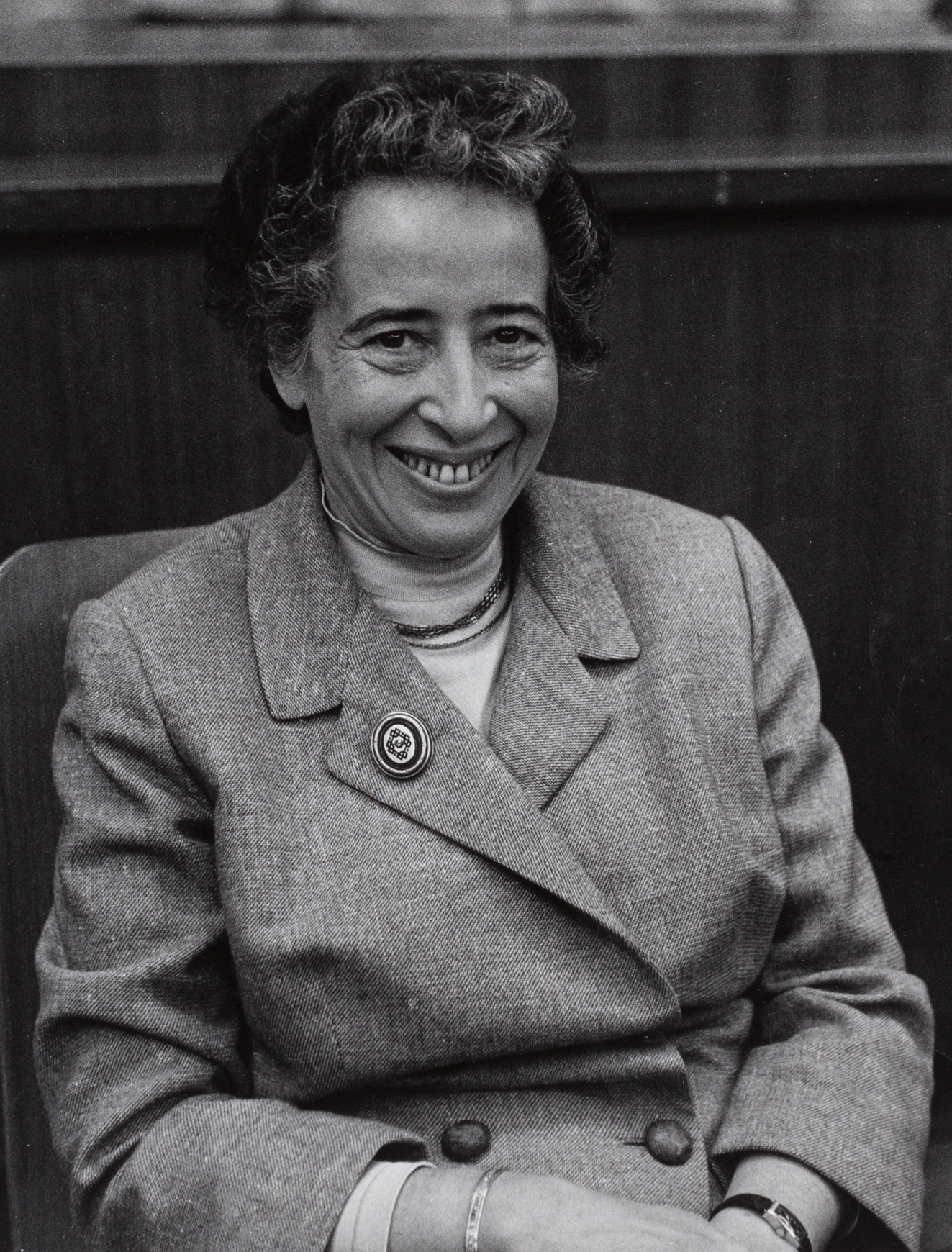
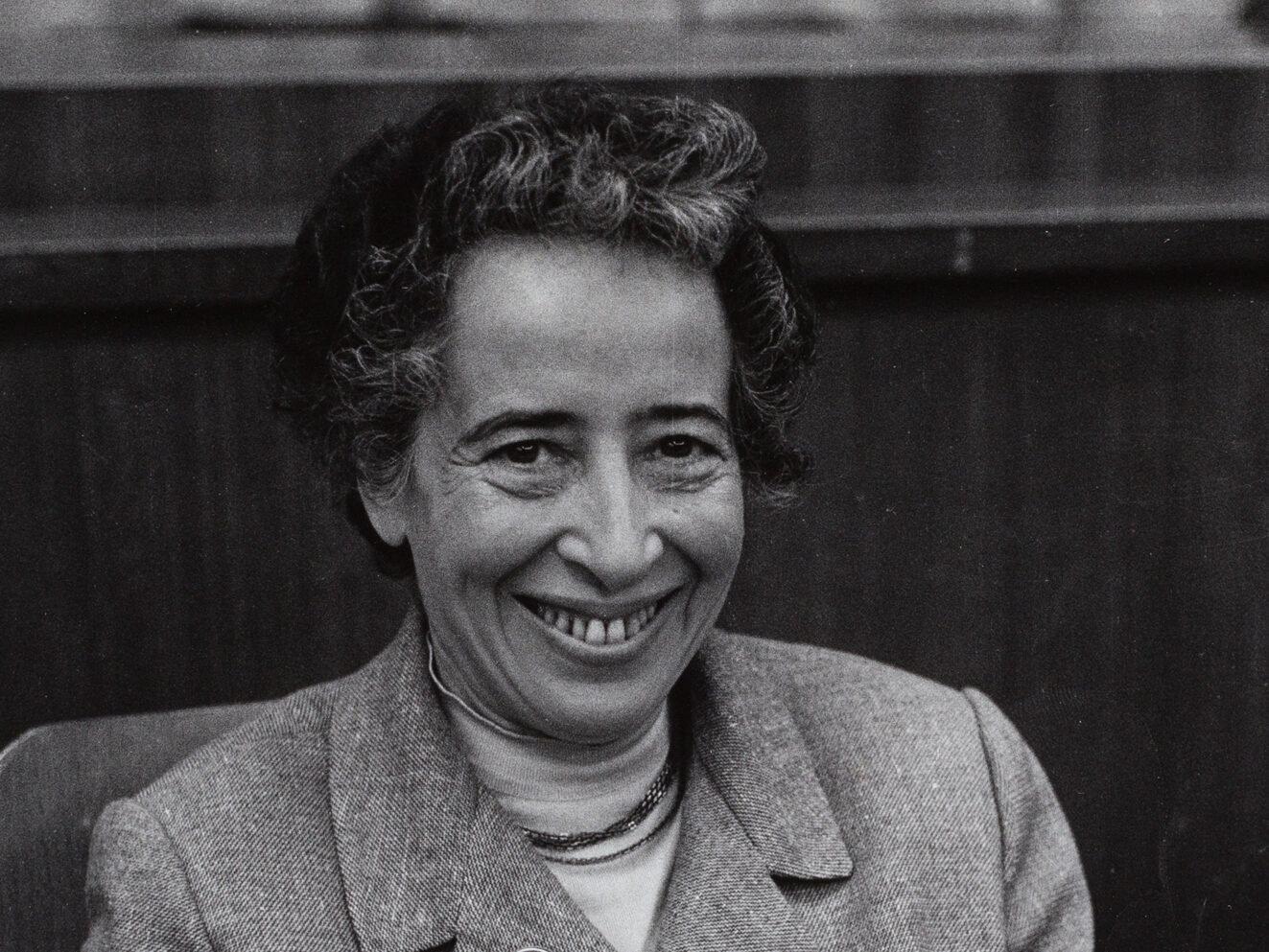
Hannah Arendt 1958 CC BY-SA 4.0; Münchner Stadtmuseum, Archiv Barbara Niggl Radloff
Immediately after the end of the war in 1945, Hannah Arendt wrote a text entitled Organized Guilt. It was one of the first attempts to politically and conceptually grasp what could no longer be denied: the “administrative mass murder” of millions of people and the systematic and industrially operated attempt to destroy European Jewry. As Arendt wrote, this did not require “thousands of selected murderers” because “total mobilization” implied everyone and thus resulted in the “total complicity of the German people.”
Arendt did not write as a historian or impartial witness, but as a political thinker. As someone who looks – and judges. “To live truly is to realize this present,” she noted a few years later. She asked how it had been possible for so many to participate and so few to object – and why, after unconditional surrender, so many simply wanted to forget.
Her thesis: under Nazi rule, guilt was not covered up or suppressed, but organized. It was divided up, depersonalized, morally gutted—in order to destroy responsibility. The line separating the guilty from the innocent, Arendt writes, was blurred so effectively that it became almost impossible to distinguish between those who committed the crimes and those who opposed the killings. It is not the individual who bears the burden of injustice, but everyone—and thus no one.
“Everyone just did their duty,” said the perpetrators—without cynicism, without remorse. The real achievement of totalitarianism lay in the production of fellow perpetrators. They know and feel no responsibility and perceive themselves merely as part of an apparatus, an order. Arendt quotes a camp accountant: “Did you personally help kill people? Not at all. I was just the camp’s paymaster. What did you think about what was happening? At first it was bad, but we got used to it.”
When guilt becomes a function, thinking becomes a disturbance. That is precisely Arendt’s point. Conscience was not eliminated, it was reshaped. Language was not destroyed, but recoded. Words such as “Final Solution,” “evacuation,” and “resettlement” served not to deceive, but to exonerate. It was possible to participate in the conversation—without knowing. Or rather, without wanting to know.
This diagnosis points to the essence of the modern state and its bureaucracy, which integrates every action into a system in such a way that no one needs to say, “I am responsible.” That was Arendt’s early warning—and it is more relevant today than it has been in a long time. Today, we find ourselves in a situation in which we are no longer just witnesses, but accomplices, participants in the blurring of the boundaries of violence and the obfuscation of responsibility.
It is not only since October 7, 2023, that we have been caught up in a dynamic that eludes any moral language—and at the same time is legitimized by language. International law guarantees the right to self-defense—for Israel as well as for the people of Palestine. It obliges states and armed groups to protect the lives of civilians. The Hamas attack on civilians, which has not yet been fully investigated, and the abduction of hostages to Gaza were crimes against humanity and must be punished as such. However, the fact that the shock and threat to Israeli society – and to Jewish communities worldwide – has been taken as a blank check to respond with further escalation of violence is driving the dynamic into the abyss.
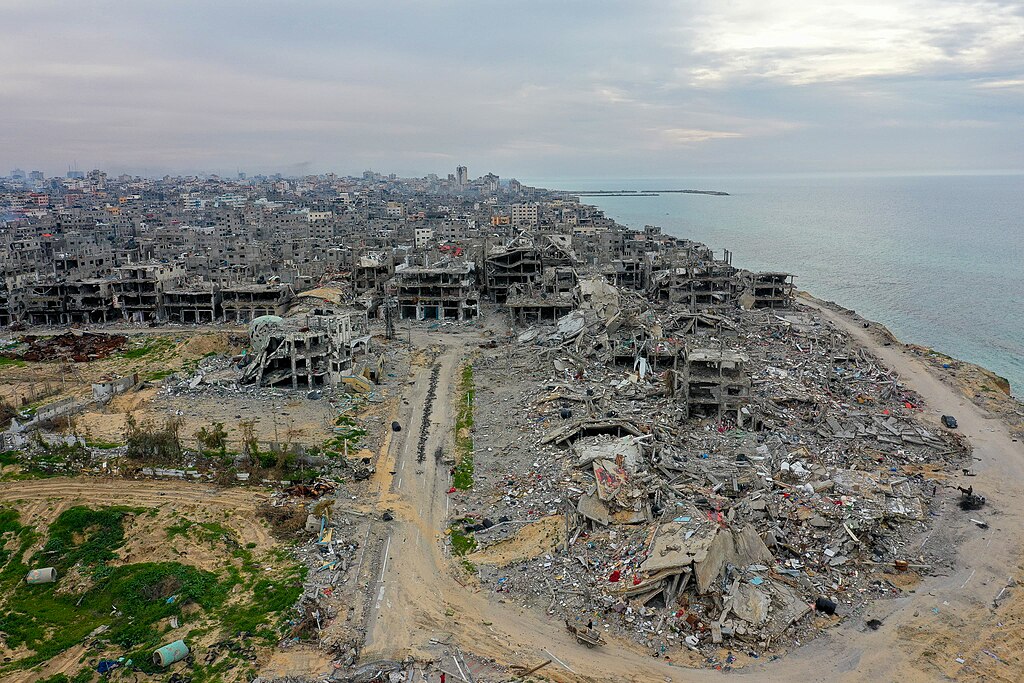
In Gaza, it can no longer be denied that systematic efforts are being made to destroy the Palestinian people’s right to life, both as a whole and in parts, through the complete destruction of all infrastructure, the starvation of the population, the mass killing of civilians, and the destruction of their natural resources. A besieged death zone—without refuge, without escape, without a future. An ever-growing number of genocide researchers and international law experts have concluded that the criteria for genocide have been met.
And the language? It works perfectly. It speaks of “precise strikes” or “surgical operations” where civilians are dying in their thousands. Every child killed is potentially a “human shield” or a terrorist in the making. It repeats like a mantra: “Israel has the right to defend itself” – and allows us to sidestep the question of how far this right extends, what it outweighs, where it ends. It asserts: “We are doing what is necessary,” and makes us forget that we are the ones who continue to supply weapons.
Once again, responsibility is being organized so that no one is responsible. The US supplies weapons, resources, infrastructure, and propaganda support, and during Joe Biden’s presidency, it sometimes declared that it had “red lines,” but these could be crossed without consequence. The UN warns, counts, documents—but its resolutions fall on deaf ears. The EU struggles to find the right words and is divided. The German government also supplies weapons, stands in solidarity with the Israeli government even where civilian life is systematically devalued and destroyed, and only expresses “criticism” when international isolation threatens—criticism that remains largely without consequence.
Responsibility is not openly denied—it is distributed, blurred, relinquished: through participation, through language, through silence. Structural violence—decades of occupation, blockade, the systematic destruction of infrastructure and resources long before October 7—gets ignored. Instead, a rhetoric of necessity and moral self-assurance dominates.
Arendt knew that anyone who wants to defend political thought must defend language. Not as ornament, but as a place of judgment. She showed how dangerous it is when terms lose their moral core—and how necessary it is to maintain distinctions: between perpetrator and victim, attack and defense, proportionality and the will to destroy.
Today, we are experiencing a linguistic regression: criticism is dismissed as mere worldview, and naming violence is considered a threat. Anyone who draws attention to the injustice against the Palestinians is suspected of anti-Semitism. Those who insist on injustice are supposedly endangering security. This reversal narrows the scope of what can be said—until defending the world in Arendt’s sense becomes impossible. For what does not appear cannot become the object of collective action. Where the sayable dwindles, the real is redefined—in the language of war, reality is not described, but made. Terms such as “human shields” ultimately place the blame on the victims. Those who describe a complete siege as “self-defense” shift the blame to where the dead were buried.
This language is functional. It creates distance, moral relief, approval. In press releases, government statements, and social media, it becomes ammunition: “terror infrastructure,” “safe zones,” “precise operations.” Each of these words stands between us and reality and prevents us from realizing it, as Arendt demanded.
And this is where history and the present intersect: Arendt’s text was written when the images from the camps were still fresh and Auschwitz was not an abstraction but an immediate reality. She wrote against collective blindness, against the willingness to move on to the agenda of the day. Not in the name of the past, but in the name of a future that was to be different. Today, historical guilt is frozen, without leading to any present political responsibility. Auschwitz has become moral property. The descendants of perpetrators now act as guardians of memory—and derive from this a responsibility that relates solely to Jewish life, not to the Palestinian life under bombs. This is not a lesson from history—it is its instrumentalization.
Arendt rejected any sacred inaccessibility of history. Memory that does not lead to judgment and action becomes a moral pose: “Never again.” Arendt would have asked critically: Never again what? Only Auschwitz? Or any dehumanization, expulsion, deprivation of rights? She argued for a plural and differentiated conception of responsibility—not exclusive, but inclusive: Those who learn from Auschwitz cannot legitimize disenfranchisement anywhere. Auschwitz must remain a radical ethical warning: Every form of dehumanization must be named, even if it originates from a state to which Germany has a historical obligation. Especially then.
Arendt distinguished between guilt and responsibility. Guilt concerns perpetrators. Responsibility concerns everyone who is part of a political order and obliges them to think critically, to differentiate, and to exercise judgment. It does not arise from identity, but from being part of the world. Those who live in a political order bear shared responsibility—not because they are all perpetrators, but because they are all members of that order.
Arendt would not have asked for solutions, but for spaces for action in which responsibility is shared, violence is named, and alternatives become audible. Such spaces exist on both sides, Israeli and Palestinian, and in the best case also connect both sides. But their existence is also threatened. In 2021, Israel banned six Palestinian human rights NGOs, including Al Haq in Ramallah, an organization that has documented human rights violations in the occupied territories for many years – committed by both Israel and Palestinians. The language of “security” and “counterterrorism” has been and continues to be used to justify the ban on these NGOs. This language has long been extended to Israeli NGOs that advocate for the rights of Palestinians. Breaking the Silence and B’Tselem were accused of being “traitors” as early as 2016. A new Israeli tax law seeks to impose an 80 percent penalty tax on foreign (Western!) donations to Israeli NGOs. In April, the Israeli police banned the organization Standing Together from showing pictures of Palestinian children killed in a demonstration. And in January, the former German federal government revoked the foreign policy clearance and eligibility for funding of the peace activist organizations Zochrot and New Profile in the middle of their ongoing project period.
None of this serves Israel’s security – quite the contrary – but it suppresses opposition to human rights violations. The language that obscures those weakens our judgment. Being able to judge is perhaps the most important political virtue, wrote Arendt. It is not loyalty that protects democracy, but the ability to distinguish. Those who want to learn from history must not be content with remembrance. Now is the time to act. To speak anew. To speak clearly. Because reality must not be defused by euphemisms. Arendt knew this. Those who speak of Gaza today should take her at her word.
Didier Fassin: Une étrange défaite. Sur le consentement à l’écrasement de Gaza, Paris (Editions La Découverte) 2024, 198 pp. Englische Übersetzung: Moral Abdication. How the World Failed to Stop the Destruction of Gaza, translated by Gregory Elliott, London/New York (Verso Books) 2025, 128 pp.
Didier Fassin says it all. In eight chapters, he talks about the destruction in Gaza, about the approval of it, and about how talking about it is made impossible and words are given new meanings: “Language is damaged when demands to stop killing civilians are ‚antisemitic‘, when an army that dehumanizes its enemies is ‚moral‘, when an enterprise of obliteration is a ‚riposte‘, when a military operation openly conducted against civilians is the ‚Israel-Hamas war‘. Thinking is suffocated when debates are prevented, lectures banned and exhibitions cancelled, when police enter institutions of higher education and prosecutors are imposed to ensure orthodoxy.” (p. 87)
Precisely because Didier Fassin says everything that everyone can know, everything that is accessible everywhere in the media: about the dead, the hunger, the bombs, the destruction, the blockade, the arms deliveries, the history of violence—the immediate violence of the Hamas attack on October 7, 2023, and the violent long history leading up to it, back to the Balfour Declaration of 1917— the justifications, the declarations of intent… he leaves us with a deep sense of the futility of all words. We know what he is reporting here. And it changes nothing.
In fact, there is a lot of talk, and almost always deliberately avoiding what is happening in Gaza, so that the talk erects a kind of sound barrier between Gaza and our knowledge. “The language to describe it seemed somehow dead. Or rather, an attempt was underway to induce its death by imposing a vocabulary and grammar of facts, by prescribing what must be said and condemning what must not be said (…).” (p. 5/6) And yet the reality is obvious, and everyone knows: whether you call it genocide or not, tens of thousands of people have been deliberately killed in Gaza, hundreds of thousands have been displaced and displaced again, and the survivors have suffered severe physical and psychological damage and had their livelihoods destroyed in the long term.
What does this insignificance of knowledge about what is happening before our eyes mean? We are witnesses without testifying. Didier Fassin regards the moral failure of the West, its “consent” to destruction, which lies both in allowing it to happen and in actively supporting it, as a profound historical turning point. And indeed, with the knowing silence about the destruction of Gaza, a point of no return seems to have been reached. Even if the normative order that at least claimed to value every human life has always been hypocritical, the open rejection of its values and principles opens up an even deeper moral abyss. The inequality of the value of human life is not only accepted and no longer metaphysically confined, but has become the new principle of a completely lawless world. But Fassin believes that one day history will be told differently: “A voice will be restored to the Palestinians and with it a language will be reborn. Words will find their true meaning again. (…) People will no longer dare to claim that some people’s lives are worth less than others’, and that the death of the former is not as grievable as that of the latter. It will be understood that the dehumanization of the enemy entails the loss of humanity of those who articulate it.” (p. 92).