Tag: war

  • Colonial versus anti-colonial transgressions of the civilian–combatant divide

    Nicola Perugini, “Between Anti-Colonial Resistance and Colonial Genocide: Gaza at the Limits of International Law”, The Journal of Imperial and Commonwealth History, November 2025, 1–14, doi:10.1080/03086534.2025.2578214.

    Perugini highlights a major blind spot in International Humanitarian Law (IHL) as to how it has recognised anti-colonial wars. Perugini points out that IHL’s limited recognition of anti-colonial violence – enshrined in the 1977 Additional Protocols which institutionalised the right to fight against colonial occupation through armed struggle – rests on a static state-centric framework where the civilian is imagined only as a passive, nonpartisan victim in need of protection, while it is the combatant who engages in violently dismantling colonial occupation and domination through anti-colonial resistance. However, historically we know that anti-colonial movements have challenged this IHL principle of distinction between civilians and combatants by blurring the line between the two in a collective struggle. Adopting the perspective of the colonized, Perugini thus calls for “decolonizing the civilian” in international law. To Perugini, this perspective “forces us to rethink the civilian as a figure of resistance rather than passivity” (p.2).

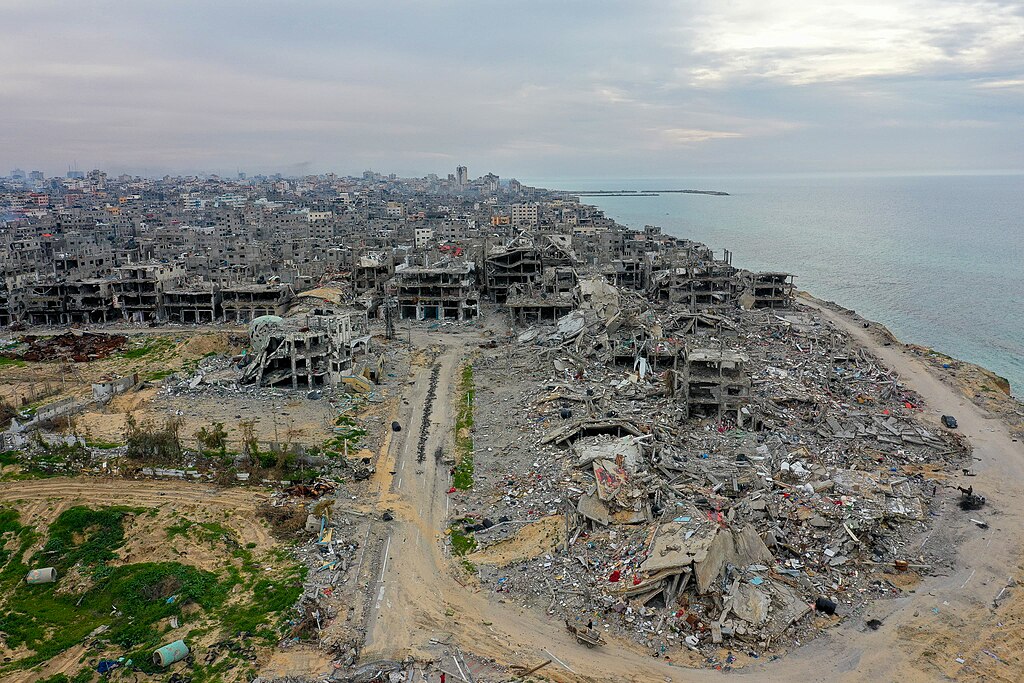
    In the context of Israel’s ongoing genocide in Gaza, the stakes around the distinction between civilians and combatants decide over life and death for most Gazans, and certainly for all males and even male children. As Perugini points out, Israel uses precisely this distinction to kill with impunity all those who dare to blur the line between civilians and combatants. The recent example of a local ZDF contractor also illustrates, how targetting of journalists is justified by Israel and German media by questioning the civilian status of journalists.

    More specifically, by drawing on Israel’s genocide in Gaza, Perugini highlights two dialectically entwined forms of transgression that are at odds with IHL. On the one hand, anticolonial forces merge the civilian and the combatant in their anticolonial struggle through, for instance, the network and infrastructure of tunnels which have a commercial and a military purpose. Through tunnelling, Palestinian resistance groups have undermined the distinction to be able to “challenge the asymmetry of the battlefield” through “subterranean warfare” (p.7). On the other hand, the state of Israel uses this very indistinction in order “to destroy the colonised people as people”. To Perugini, both transgressions of international law allow us to better grasp the limits of international law, as well as the relationship between colonial genocide and anticolonial resistance in settler-colonial contexts.

    Perugini’s call to decolonize the civilian in IHL thus allows us to better understand why anticolonial resistance necessitates the indistinction, and how IHL allows Israel to justify self-defence as a coloniser by denying the colonised their own right to self-defence. “This inversion of aggression and defence is central to the colonial logic of genocide.” (p. 10).

    https://doi.org/10.1080/03086534.2025.2578214

  • The terms “war” and “genocide” should not be played off against each other.

    The terms “war” and “genocide” should not be played off against each other.

    Both in internal KriSol debates and, for example, in an interview with Omer Bartov in German-language Jacobin, it has recently become clear that there are considerable reservations about the term “war” within movements in solidarity with Palestine. Instead, the preference is to link the moral and political assessment of the mass violence against Gaza and its population to the legal concept of genocide—even though for some time now, members of the German federal government have been deliberately using this term as an opportunity to avoid drawing any conclusions from the violence. They point out that the courts have yet to decide whether genocide has actually been committed, or they ignore journalistic inquiries about consequences of genocide altogether. The latter was the case, for example, at a government press conference shortly after the fragile ceasefire began in October 2025, which dealt, among other things, with the German chancellor’s considerations regarding the resumption of unrestricted arms exports to Israel. Obviously, the term “genocide” alone is not enough to build political pressure. Moreover, it is by no means certain that the courts will actually rule in a few years’ time that the Israeli government has committed genocide in Gaza.

    There is therefore ample reason to fear that a discursive narrowing to the term genocide could be used not only now, but especially in the future, to ward off responsibility and deny mass violence. Against this background, we advocate the strategic revaluation of an empirical-analytical concept of war that refers to observable reality, thereby emphasizing the political significance of empirical evidence and not making itself dependent on legal judgments.

    Genocidal war is no less cruel than genocide

    The term “war” is often considered inappropriate, especially by those who strongly condemn the mass violence against Palestinians and urgently demand political consequences.  They criticize that “war” implies symmetry—a conflict between sides with at least roughly equal capacity to act—and thus could enable both-sidesism in the assessment of mass violence against Gaza (this is also roughly the reasoning behind the rejection in the interview with Bartov linked above). We share the criticism of both-sidesism. At the same time, as peace and conflict researchers, we disagree with the impression that wars are symmetrical per se. Empirically, this is definitely not the case.

    “War” primarily refers to the circumstance that violence is exercised and suffered on a massive scale. Admittedly, in quantitative research, the term is indeed mainly attached to the number of battle-related deaths, suggesting that war consists primarily of combat between opposing sides. The idea here is that armed actors (at least one of them a state army) fight each other and that both combatants and (unintentionally or acceptably) civilians are killed in the process (see, for example, the Uppsala Conflict Data Program). However, such definitions have long been criticized within peace and conflict research and are considered overly simplistic and insufficiently reflective of the actual dynamics of war. The concept clearly does not apply to Gaza, for example, where civilians and civilian infrastructure were directly and immediately attacked, killed, and destroyed. Direct attacks on the civilian population also occur in wars for which no genocidal logic can be empirically identified, i.e., wars that do not specifically destroy the living and survival conditions of members of a national, ethnic, racial, or religious group, to stay close to the Genocide Convention. Examples of non-genocidal violence against civilian populations can be found, for example, in the context of military interventions – think of the US drone wars and the unspeakable term “collateral damage” – and also in civil wars, where non-state armed actors sometimes use violence against the civilian population to obtain food, labor, and forced recruits.

    When we nevertheless speak and write of “war” in such situations, this takes into account the fact that, from a global and historical perspective, mass violence has rarely been symmetrical and that it has very often been and continues to be directed against civilian populations. All forms of colonial, and often genocidal, violence since the 16th century could serve as examples here. In this respect, unilateral mass violence is not actually a special case. Rather, the symmetrical struggle between uniformed armies, which has mistakenly (only thanks to Eurocentrism) shaped the image of war in Western minds, should be considered to  be a special case.

    We therefore propose not rejecting the concept of war outright, but using it free of Eurocentric assumptions of symmetrical violence in order to bring the relevance of empirically proven violence to the fore. The advantage of such a term is that it can be used to characterize mass violence in very different forms as morally and politically relevant—because “war” is a man-made catastrophe, and the term signals that action is needed here. The second step is to empirically clarify the central characteristics of the war in question. One suggestion for the empirical description of mass violence in Gaza is “genocidal war”: that is, mass violence that, based on empirical observations, can plausibly be interpreted as an intent to destroy. Compared to genocide, “genocidal war” has the advantage that it does not have to be confirmed by courts, but is based solely on extensively documented empirical observations – which in politics is usually sufficient as a basis for decision-making and action! The use of the term “war” can and should therefore be used to counter arguments that court proceedings must be awaited before decisions can be made about consequences in relation to the Israeli government. Whatever the courts decide, the empirical evidence alone should be proof enough that a genocidal war has been waged and that this is just as unacceptable as genocide established by a court of law.

    This brings us finally to the de facto hierarchization of suffering, which also concerns Dirk Moses and is undoubtedly a core problem of the legal concept of genocide. This concept is intended to describe the worst of all crimes, but is so narrowly defined that the vast majority of mass violence cannot be covered by it and is thus inevitably labeled as “less serious.” Here, too, the concept of war could have a corrective effect in the long term by counteracting such a hierarchy.

    Taking a multi-pronged discursive approach

    Of course, it still makes sense to use the concept of genocide, especially to demand the application of international law. Our central point is only that it is unwise for movements in solidarity with Palestine to put all their political and moral eggs in one basket—especially in the case of international law, which is known to be selectively effective and permeated by colonial logics! We should pursue a multi-pronged discourse in order to escape a situation in which key actors deny responsibility for the most serious crimes and in which moral and legal condemnation are so closely intertwined that future acquittals would, in the worst case, amount to whitewashing. The term “genocidal war” allows us to do this.
  • An invisible university for Ukraine and the rest of the world

    Invisible University for Ukraine. Essays on Democracy at War, ed. by Ostap Sereda, Balázs Trencsényi, Tetiana Zemliakova, Guillaume Lancereau, Ithaka/London (Cornell University Press) 2024.

    It is a global phenomenon: Universities around the world are under massive pressure—from defunding, subjugation to market logic, the elimination of entire departments, political interventions, and attacks on academic freedom and freedom of teaching, to the targeted physical destruction of university buildings, the killing of scientists, and “scholasticide” when the aim is to strike at an entire people. Since 2022, the Invisible University for Ukraine (IUFU) has been offering online courses for Ukrainian students to help them work through their war experiences and the genocidal threat posed by Russian aggression, using innovative academic methods; almost 1,000 students have benefited from the courses so far. The collection “Invisible University for Ukraine. Essays on Democracy at War,” published just under a year ago, features very moving personal contributions from students and professors at the highest level of reflection in the Ukrainian context, showing what one would wish for in any other context: a new, honest, unreserved way of generating knowledge at the university.

    “The need for uncommon institutional responses to the autocratic pressure on higher education has been a recurring topic of discussion since the late 2000s,” write Ostap Sereda und Balázs Trencsényi in the introduction; as early as that, the “Western” model of university education had already lost credibility in Eastern Europ. “The Invisible University was also a response to this crisis of academia, experimenting, under the pressure of an unprecedented situation of mass dislocation of students and scholars, to relink the educational, research, and civic components in unconventional and innovative ways.” The Invisible University does not see itself as a solitary entity, but rather as part of a cross-temporal and cross-spatial network, connected to other similar initiatives in the 20th and 21st centuries, in a history that is briefly and impressively traced in the introduction.

    These initiatives, whether online or offline, have and always had a few things in common: a transnational, global perspective that combines global and regional perspectives and transcends national boundaries; a radically democratic approach that seeks dialogue rather than hierarchies; and a connection between the academic and the existential dimensions. The Russian war against Ukraine is the immediate catalyst for the Invisible University for Ukraine and the conditioner of its tensions, specifically: Although the IUFU works against Eurocentrism and uses postcolonial tools, it sees itself in a struggle that is, in addition to survival, about insisting on common “European” values. It must endure the fact that its civil engagement can conflict with the survival imperatives of war when it becomes critical of its own government. And it faces the (resolved) dilemma of how to deal with Russian colleagues as its main goal is to work toward a non-Russocentric understanding of the post-Soviet space and as it consistently boycots all Russian state institutions.

    The individual contributions show how the existential and the academic can be integrated and convey different, complementary lessons from the war. It is above all the dramatic changes in the concept of time brought about by the war – the altered temporalities – that have a profound effect on knowledge. The contributions spell out what this means in concrete terms: in the daily struggle for survival with the “sobering absurdity of death” (Denys Tereshchenko), where sacrifices are demanded and one makes them, or one doesn’t; in dealing with the media side of the war, the “digital witnessing” in the face of a volatile global public, and the ignorance of even well-intentioned reactions; but above all in readjusting the relationship between participation and observation in research and teaching. Only through honest dialogue can a future remain conceivable with new ideas – “my war is about creating spaces of dialogue” (Balázs Trencsényi). The feeling of “professional failure,” of “should have known” (Diána Vonnák), “wading through unmetabolized experience and a cacophony of guesswork, motivated speech, misinformation, and rudimentary analysis,” is made fruitful as a lesson in epistomology: “We could call it a fog of war in the epistemic sense, but if we flip this around, this fog is ever-present, the stuff of fieldwork, and navigating it is a predicament of any contemporary empirical research.”

    The anthology ends with an overview of all the courses that IUFU has taught since 2022 and the very moving and sometimes also funny short biographies of the contributors in the shadow of war. Tetiana Zemliakova, for example, who, apart from the IUFU, can only focus on the ontology of time: “She always knew she was living through the last days of historical humankind, but she could never guess these would be so stupid.”

    https://d119vjm4apzmdm.cloudfront.net/open-access/pdfs/9781501782886.pdf