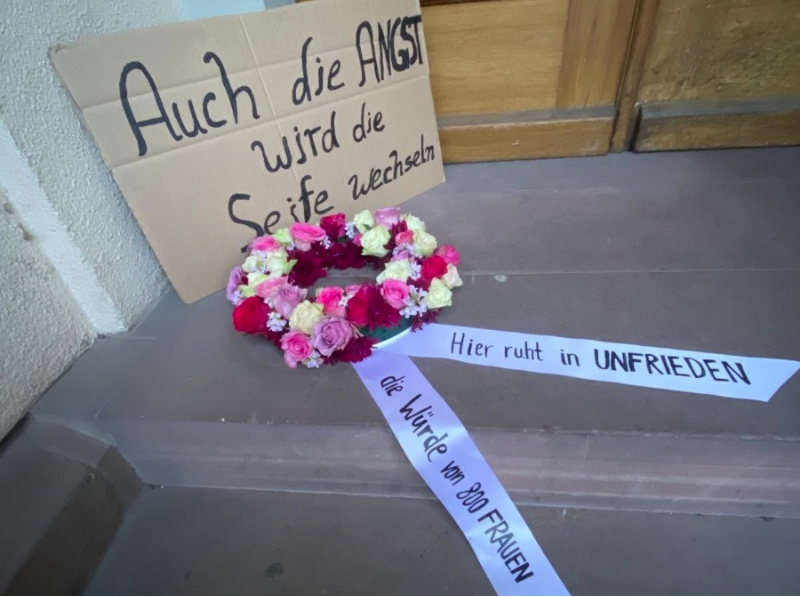
“Fear, too, will change sides. Here, the dignity of 800 women lies in unrest”, photo taken by a victim who wishes to remain anonymous.
The Facts
At least 800 women were secretly filmed on the toilet, under the shower and during student advisory consultations in Freiburg over a course of several years. On the 9th of March a German white male was convicted of the crime of “invasion of the most personal private sphere”, a term coined by German jurists to describe the filming of people in intimate contexts without their consent (see Section 201a of the German Criminal Code (StGB)). Ever since the case became public, more and more women discovered that they themselves were affected by this crime through independent research. The fact that the offender used these recordings for sexual gratification, which should be seen as a sexual assault, is of no relevance under criminal law. The perpetrator was sentenced to one year and nine months on probation.
The offender installed hidden cameras in the toilets at the student advisory offices of the university (Service Centre Studium, also SCS), where he worked, as well as in the toilets of the flats he rented out. The people affected were female colleagues, students whom he advised, and first year students who rented a room in one of his flats, after being scrutinised for their appearance at personal meetings. The offender regularly entered the flats under false pretences, in order to change the cameras’ memory cards. It was only 16 years after he had begun to make the secret recordings that some women were able to find the cameras there. Four hard drives filled with recordings were found at the perpetrator’s house during a search.
The Court’s Role
According to reporting by the Badische Zeitung, 70 female tenants from the period 2019-2024 were identified and 61 cases heard at the Freiburg District Court. Female employees from the student advisory offices were present as civil claimants, a legal status in German criminal proceedings that allows affected parties to actively participate, assert their rights, and seek compensation. Many of the tenants who were filmed before 2019 were not informed by authorities, as their violation “of the most personal private sphere” had exceeded the statute of limitations. They as well as the students who had been filmed in on the university premises had to have their involvement confirmed by the police upon request. Had the Freiburg police informed them they would have had the opportunity, among other things, to to assert civil claims for damages and compensation for pain and suffering.
The prosecution sought a two-and-a-half-year prison sentence for the perpetrator and argued that the act should be classified as “perfidious”, given the hidden cameras and that the footage was used for sexual gratification. The district court judge Andreas Leipold opted for a more lenient sentence and rejected the classification as perfidious. His reasoning was that the crime’s very nature (“in der Natur der Sache”) implied both the hidden camera and the sexual gratification. However, the perfidy of the sexual violence is well documented: the footage found on the perpetrator’s hard drive is not organised by date, but by the victims’ physical characteristics, sexuality and origin.
The judge reportedly told one victim that they must learn to live with the fact that some men, not all, were capable of such acts. A statement that absolves the perpetrator of guilt by referring to allegedly natural impulses and downplays individual responsibility.
The naturalisation and normalisation of sexual violence leave a bitter taste, and the sentencing casts doubts on how seriously the court takes these kinds of crimes. The names of the 803 afflicted women were known at the start of legal proceedings, the number of undetected cases likely being much higher. All of these women had their dignity and sexual self-determination violated, in some cases severely, with long-lasting personal and psychological consequences. The court’s proceeding and ruling did not generate a sense of justice but rather a feeling of repeated violation of their dignity, this time by the court. Court observers reported that the already convicted man asked the court if he could now get the footage back. This interaction conveys the impression that he feels neither remorse nor shame for his crimes. A sobering conclusion when considering Giselle Pelicot’s appeal that shame must shift sides. Now that the court proceedings have ended, the perpetrator is de facto a free man, given his suspended sentence. He had to pay 3.500 Euro to 30 victims, representing only a fraction of those affected, 105.000 Euro in total. According to local news he had to sell one of his two properties, however, he remains a property owner, possibly a landlord.
The University’s Role
The prosecution has appealed the verdict. The appeal concerns not only the sentence but also the determination of the extent of the offence(s) and, the participation of the joint plaintiffs. The perpetrator filmed in university’s bathrooms and during consultation in his office. Nevertheless, the university refrained from acting as civil claimant and victims who were filmed in university bathrooms were not represented in the proceedings.
The university claims to have been unaware of the situation previous to the conviction in March 2026. However, according to local news, the SCS offices had been searched by police in February of 2024, after the perpetrator’s hard drives had been seized. Moreover, the university stated in an information letter from the Vice-Rectorate for Studies and Teaching (Prorektorat für Studium und Lehre) dated 12 March 2026 that it had terminated the perpetrator’s employment immediately due to “concrete evidence of the offence”. In order to prevent continuous employment of the perpetrator a court settlement was reached. The Human Ressources office must therefore have been aware of the allegations of sexual assault.
By failing to assume the role of a joint plaintiff, the University of Freiburg failed to fulfill its institutional responsibility. University employees had to take on the role of civil claimant on their own, in order to participate in court proceedings and to be able to ask questions. In addition, the vice rectorate failed to inform the victims that the Baden-Württemberg Ministry of Science, Research and the Arts provides a trusted legal advisor for sexualised discrimination, harassment and violence. Only on the 20th of March 2026 the Minister for Science, Research and the Arts, Petra Olschowski (Alliance 90/The Greens) informed the audience at a university event that such a trusted legal advisor is available. Outraged members of the audience received no answer as to why the vice-rector for Studies and Teaching had told them that there was no such point of contact.
The University of Freiburg failed to fulfill its duty of care toward its employees, students and alumni. Only after the mobilisation by the students and employees and growing public pressure did the university offer information and invite people for discussion. Negative public attention comes at an inopportune time for the university, given its application for Excellence University status and the upcoming site visit by the evaluation committee in April 2026.
Sexual Violence as a Structural Problem at Universities
At the event, Minister Olschowski and the university leadership first emphasised the criminal energy of individuals, then the minister went on to address patriarchy as a structure that operates everywhere, “in the ministry just as at the Aldi counter”. In doing so, she failed to engage with the issue of sexual violence as a phenomenon at universities. While universities are often regarded as places of enlightenment and communal and societal progress, they are by no means free from discriminatory and violence-enabling structures. According to the UniSAFE study (2022) on gender-based violence in academia, almost one third of the students and employees surveyed at 15 European institutions have already experienced sexual harassment at their university or research institution. The study draws attention to the hierarchies and the relationships of dependency within university operations, which account for both the number of incident reports and the fear of disclosing them (Beaufaÿs, 2022).
Until now the handling of cases of sexual assault at universities has not inspired confidence. Studies reveal that the gap between reported cases of abuse and consequences or convictions for the perpetrators is substantial: most cases go unpunished (Hoebel et al., 2022). Nevertheless, the possibility of a false accusation is reliably invoked as a concern by professors. When sexual assault allegations arise, there is often a disturbing reversal of roles between perpetrator and victim, as was the case with a historian who worked at the Humboldt University in Berlin. He was accused of sexual assault by numerous women and yet was defended by many colleagues across Germany.
Students are particularly vulnerable in the university context, not merely because of the hierarchies and dependencies. Under Section 3 (3) of the General Equal Treatment Act (AGG), the university is in fact obligated to protect students from discriminatory harassment. However, the specific protection against sexual harassment under Section 3 (4) of the AGG applies exclusively to employees of a university and not to students. Since the requirements for establishing discrimination under Section 3 (3) AGG are higher than those under Section 3 (4) AGG – in particular because, in addition to a violation of dignity, a hostile environment must also be demonstrated – this creates, according to Kocher and Porsche (2015), a significant protection gap for students, which leaves them dependent on the protective function of their own university.
Furthermore, the implementation of the principle of gender equality and the prohibition of discrimination varies considerably across the individual federal states as well as individual universities (Kocher & Porsche, 2015). The University of Freiburg identifies sexualized violence and stalking as components of the prohibition of discrimination and has developed an action plan and a catalog of measures for sexualized assaults (Albert Ludwig University of Freiburg, 2021). However, the current case demonstrates that action is needed with regard to image-based and digital sexual violence, as well as the extension of the AGG to include students. Yet the opposite is looming: both the AfD nationwide and the CDU in Berlin want to abolish the AGG.
The Government’s Role
The fact that the law only protects victims to a certain extent has also become apparent with the case of Collien Fernandes, which has attracted attention nationwide. Minister Olschowski also emphasised that public toilets should be examined for cameras and that the law regarding digital sexual abuse should be revised.
Beyond criminal law, however, the structural causes that enabled the sexual assaults by the perpetrator at the University of Freiburg should also be addressed. Here is where the government holds a different kind of responsibility. The main victims were vulnerable tenants.
Women often experience sexual harassment from landlords or primary tenants, particularly in the context of housing crises in many cities, where young people just starting their education, studies, or careers are desperately searching for a place to live. Young women in particular must endure misogyny and sexual assault, and migrants and people of color must endure racism, in order to avoid becoming homeless. This abuse of power is fueled by material inequalities and dependencies that, driven by political will, are steadily increasing (WSI Inequality Report, see Spannagel, 2025). While, according to data from 2019, nearly 70% of millionaires in Germany are men and rental properties in Germany are almost exclusively owned by the wealthiest ten percent (Bach & Eichfelder, 2021), the search for housing is a nightmare not only for first-year students. Rents for a room in a shared apartment in German university towns continue to rise and will average 530 euros in Baden-Württemberg during the summer semester of 2026. For this reason, students at the University of Freiburg have come together to form an “Initiative for Affordable Student Housing” and, in November and December 2025, spent months in a protest camp to draw attention to the precarious housing conditions in Freiburg.
One of the women filmed by the perpetrator told the Badische Zeitung: The way he looked at her body during the viewing made her feel uncomfortable. She also found it strange that she had to send a photo of herself when applying for the apartment and that only young women were present during the viewing. The fact that the landlord constantly entered the apartment unannounced with his own key infringed on her privacy. But giving up the apartment and removing herself from this situation could have meant becoming homeless due to the tight and overpriced housing market.
Conclusion
To combat sexualized violence, we need meaningful laws that address the protection needs of those affected and classify gender-based violence as such. These laws must also be enforced. However, the growing awareness of the problem must not turn into so-called “carceral feminism” (punitive feminism), which relies solely on punishment in individual cases. Feminism is a liberation movement, and its goal of eliminating violence—particularly gender-based violence—cannot be achieved within punitive and incarceration-oriented systems, but only through the establishment of social justice.
Policies that demand and promote social inequality—and thus structural violence—enable and reward the abuse of power and sexualized and racialized assaults at universities, in rental relationships, and elsewhere. Current policies reinforce the conditions in the housing market and at universities, as well as the neoliberalization of academia, with strong dependencies within precarious funding structures. Stricter laws can act as a deterrent, raise awareness of the problem, and contribute to a sense of justice for victims and witnesses. Above all, however, stricter laws can denormalize sexualized violence. Furthermore, political vision and the will to shape policy are needed to combat the causes of strong dependency relationships and institutional hierarchies
Sources and Background Material
This text is based on information from observations, participation in debates and demonstrations, discussions with those affected, and the following sources:
1. News reports and blog articles
- Badische Zeitung. (2026). University employee secretly films more than 800 women – verdict in Freiburg. https://www.badische-zeitung.de/uni-mitarbeiter-filmt-heimlich-mehr-als-800-frauen-urteil-in-freiburg
- For Better Science (2026). German professor accused of sexual assault defended by peers. https://forbetterscience.com/2026/01/23/schneider-shorts-23-01-2026-marginalised-and-isolated-in-academic-publishing-activities/
- Radio Dreyeckland (2025). Protest camp against the student housing crisis. https://rdl.de/beitrag/protestcamp-gegen-die-wohnungsnot-von-studierenden
- Tagesschau (2026). Students under pressure: Shared apartment rooms are getting more and more expensive. https://www.tagesschau.de/inland/regional/badenwuerttemberg/swr-studierende-unter-druck-wg-zimmer-werden-immer-teurer-100.html
2. Reports and Monitoring
- Federal Anti-Discrimination Agency (ADS). (2020). Racial Discrimination in the Housing Market: Results of a Representative Survey. https://www.antidiskriminierungsstelle.de/SharedDocs/forschungsprojekte/DE/UMFRAGE_Rass_Diskr_a_d_Wohnungsmarkt.html
- Bach, Stefan and Eichfelder, Sebastian (2021). Tax Privileges for Real Estate Make the German Tax System Unfair and Inefficient: Commentary (37th DIW Weekly Report). https://doi.org/10.18723/diw_wb:2021-37-4
- Federal Association of Women’s Counseling Centers and Women’s Hotlines in Germany (2014). No Means No! “Condemn Rape” Campaign: Petition, Posters, and Postcards. https://www.frauen-gegen-gewalt.de/de/aktionen-themen/kampagnen/vergewaltigung-verurteilen/kampagne-vergewaltigung-verurteilen.html
- Kholodilin, Konstantin A. and Baake, Pio. DIW Weekly Report 41. (2024). Rent Burden in Germany: Has Not Increased in Recent Years, but Is Unevenly Distributed. https://doi.org/10.18723/diw_wb:2024-41-1
- Kocher, Eva and Porsche, Stefanie on behalf of the Federal Anti-Discrimination Agency (ADS). (2015). Sexual Harassment in Higher Education – Gaps in Protection and Recommendations. https://www.antidiskriminierungsstelle.de/SharedDocs/downloads/DE/publikationen/Expertisen/expertise_sexuelle_belaestigung_im_hochschulkontext.html
- Spannagel, Dorothee. WSI Distribution Report. (2025). Report No. 108, More Inequality – Less Political Participation. https://www.boeckler.de/data/p_wsi_report_108_2025.pdf
3. Academic Articles and Studies
- Beaufaÿs, Sandra. (2022). Power Relations and Abuse of Power in Academia. In L. Mense, H. Mauer, & J. Herrmann (Eds.), Countering Sexual Harassment, Violence, and Abuse of Power at Universities: A Guide. DuEPublico: Duisburg-Essen Publications online, University of Duisburg-Essen. https://duepublico2.uni-due.de/receive/duepublico_mods_00075205
- Hoebel, Merle; Durglishvili, Ana; Reinold, Johanna and Leising, Daniel. (2022). Sexual Harassment and Coercion in German Academia: A Large-Scale Survey Study. Sexual Offending: Theory, Research, and Prevention, 17, Article e9349. https://doi.org/10.5964/sotrap.9349
- Lipinsky, Anke, Schredl, Claudia; Baumann, Horst; Humbert, Anne Laure; Tanwar, Jagriti; Bondestam, Fredrik; Freund, Frederike and Lomazzi, Vera. (2022). UniSAFE Survey – Gender-based violence and institutional responses (Version 1.0.0) [Data set]. GESIS, Cologne. https://doi.org/10.7802/2475