North Rhine-Westphalia State Parliament, 18th legislative period: Draft bill of the state government. Law on the Strengthening of the University Landscape (University Strengthening Act), Publication 18/16798, November 25, 2025, https://www.landtag.nrw.de/home/dokumente/dokumentensuche/gesetzgebungsportal/aktuelle-gesetzgebungsverfahr/hochschulstarkungsgesetz.html.
The draft bill, which was initiated by the CDU-led Ministry of Science and referred to the Science Committee after its first reading on December 18, 2025, remains a threat to academic freedom and freedom of expression at universities in North Rhine-Westphalia, even after revision. On the surface it seems harmless: it aims to reduce shortage of skilled workers “through an attractiveness campaign for the higher education sector,” to reform lifelong learning at universities, to foster digitalization, to introduce quarter parity in senates as a standard model, – and to create “instruments to protect university members from assaults and hostility, discrimination, and the abuse of positions of power within the framework of university self-administration.”
Indeed, there is a pressing need to curb the abuse of power at universities. But this legitimate demand is being exploited to make it easier for the government to expel unwelcome students and sanction university faculty, staff, and leadership under the guise of protecting diversity at universities.
The addition of a “security right” and “integrity right” or “honesty right” (Redlichkeitsrecht) to disciplinary law in academia opens the door to exploitation for political purposes. Political exploitation is very likely if the new regulations and contact persons are designed and operate in such a way that academic freedom and freedom of expression are not prioritized. Science Minister Ina Brandes (CDU) openly stated in the state parliament’s science committee on January 21 that she was “extremely frustrated” that her hands had been tied in dealing with uncooperative university administrations such as that of the Düsseldorf Art Academy. Her hands might not be tied anymore with the amendment. It is imperative to recognize that the regulation excess of the new law, in those passages that do not concern abuse of power, is an attempt to interfere with university autonomy and academic freedom. Protection against abuse of power must be clearly separated from interference with fundamental freedoms.
Tom Delgado, What is Happening in Iran w/ Historian Arang Keshavarzian, February 5, 2026, https://www.youtube.com/watch?v=UeBpyHx–Cs.
In this interview by the Comedian and Tour Guide Tom Delgado, historian Arang Keshavarzian, a specialist on modern Iran and the Persian Gulf, sheds light on Iran’s current crisis. Although the protests from late December 2025 to mid-January 2026 fit within Iran’s long tradition of protest, the nature and dynamics of these protests, as well as the scale of violence used by the Iranian regime, are unprecedented.
Keshavarzian highlights factors shaping Iran’s domestic and foreign predicament that are often overlooked in media coverage and Campist debates while avoiding definitive predictions on outcomes. These factors include:
1. Iran’s 20+ year history of regional and nationwide protests feature diverse groups with varied demands. Key examples include the 2009 Green Movement over election fraud; 2017–2018 and 2019 uprisings against economic crisis, unemployment, high fuel prices, and Khamenei’s rule; and the 2022 Woman, Life, Freedom protests following the state murder of Kurdish Jina Mahsa Amini, demanding broader political change and an end to the regime beyond mandatory hijab.
2. The ongoing impact of foreign interventions, from the US- and U.K.-backed 1953 coup against Prime Minister Mohammad Mossadegh, who sought oil nationalization, through Shah Mohammad Reza Pahlavi’s repressive rule, and the 1979 Islamic Revolution, to today’s protests blending legitimate grievances and demands, likely CIA and Mossad involvements, and the regime‘s brutal crackdown. One example Keshavarzian cites to illustrate foreign powers’ co-creation of a regime-change narrative is former Secretary of State Mike Pompeo’s New Year’s 2026 X post: “Happy New Year to every Iranian in the streets. Also to every Mossad agent walking beside them.”
3. The Iranian regime’s eroding social base amid corruption, repression, sanctions, the June 2025 12-day war with Israel, and economic mismanagement.
4. The information war, including diaspora media outlets like Iran International and Manoto, which foster US/Israeli intervention and promote Reza Pahlavi, son of the former Shah, as Iran’s sole political alternative to the Mullahs. While some Iranians chant for Pahlavi and a nostalgic return to monarchy, others inside Iran and in the diaspora, who were persecuted under his father’s rule and are aware of its repressive nature, oppose him. Reza Pahlavi is also highly exclusive and hostile toward Iran’s ethnic and political diversity, prioritizing US/Israeli ties.
5. Prospects for the Iranian people, trapped between regime massacres and foreign powers like the US and Israel, that are exploiting the protests for their own political agendas.
Keshavarzian notes that most key leaders and groups capable of forming a political opposition or alternative in Iran have been brutally crushed, imprisoned, or executed by the regime. Some opposition groups, he says, want new negotiations to address not just foreign policy but also domestic issues: ending repression and the highly securitized atmosphere, enabling press freedom and internationally supervised elections, and creating conditions for unions, feminists, workers, environmentalists, and academics to regroup and strengthen again.
Keshavarzian adeptly analyzes this pivotal juncture by integrating political, economic, social, and geopolitical factors, amid current US-Israel-Iran tensions oscillating between negotiation and war rhetoric. Notably neglected in the interview, perhaps due to Keshavarzian’s academic framing, as he is pointing out himself, are the roles of workers’ unions, strikes, and struggles by ethnically marginalized groups in Iran (e.g., those of the Kurds and Baloch). Yet these efforts diversify Iranian perspectives on future governance.
Hannah Feuer: “Hundreds of Northwestern students can’t register for class because they won’t watch an antisemitism training video. Here’s what’s in it”, Forward, September 29, 2025.
It was always to be expected that mandatory anti-discrimination training in schools and universities could also be used to spread propaganda and suppress unpopular positions. Universities in the US are now using this tool to comply with Donald Trump’s executive order “Additional Measures to Combat Anti-Semitism” of January 29, 2025. At the prestigious Northwestern University in Chicago, around 300 students have now been excluded from course registration because they refused to watch a mandatory “anti-bias” video that—in a slanderous and false manner—defines anti-Zionism as a denial of the Jewish people’s right to self-determination. The video describes—again falsely—a Greater Israel as the only historical homeland of the Jewish people and equates—methodologically untenable—arbitrary and unverifiable “quotes” from “anti-Israel activists” with quotes from Ku Klux Klan leader David Duke.
Naomi Klein: „How Israel Has Made Trauma a Weapon of War“, The Guardian, 5. Oktober 2024, https://www.theguardian.com/us-news/ng-interactive/2024/oct/5/israel-gaza-october-7-memorials.
Ben Ratskoff: „Prosthetic Trauma at the Nova Exhibition: Holocaust Memory, Reenactment, and the Affective Reproduction of Genocidal Nightmares”, Journal of Genocide Research, 2. September 2025, https://doi.org/10.1080/14623528.2025.2551946.
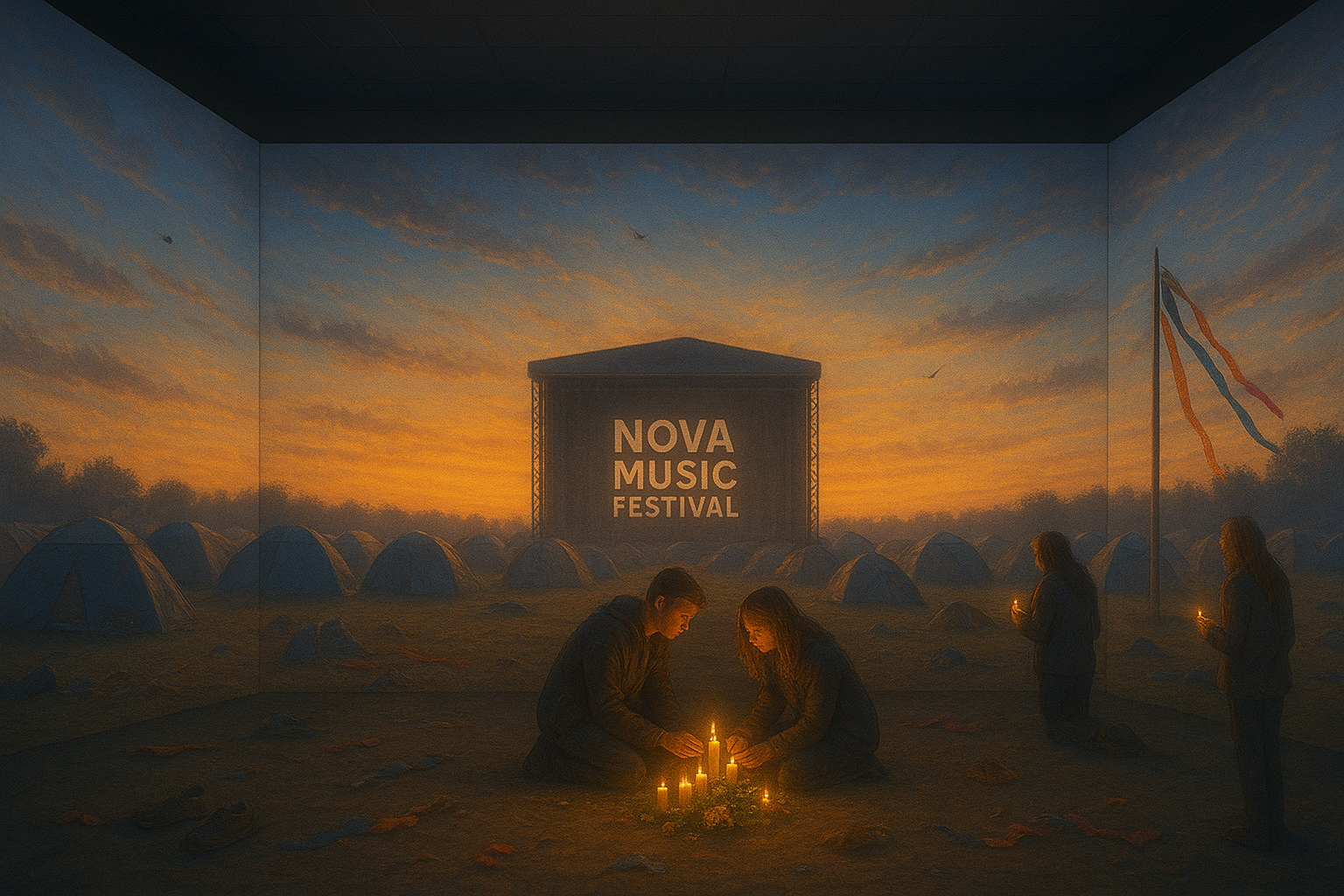
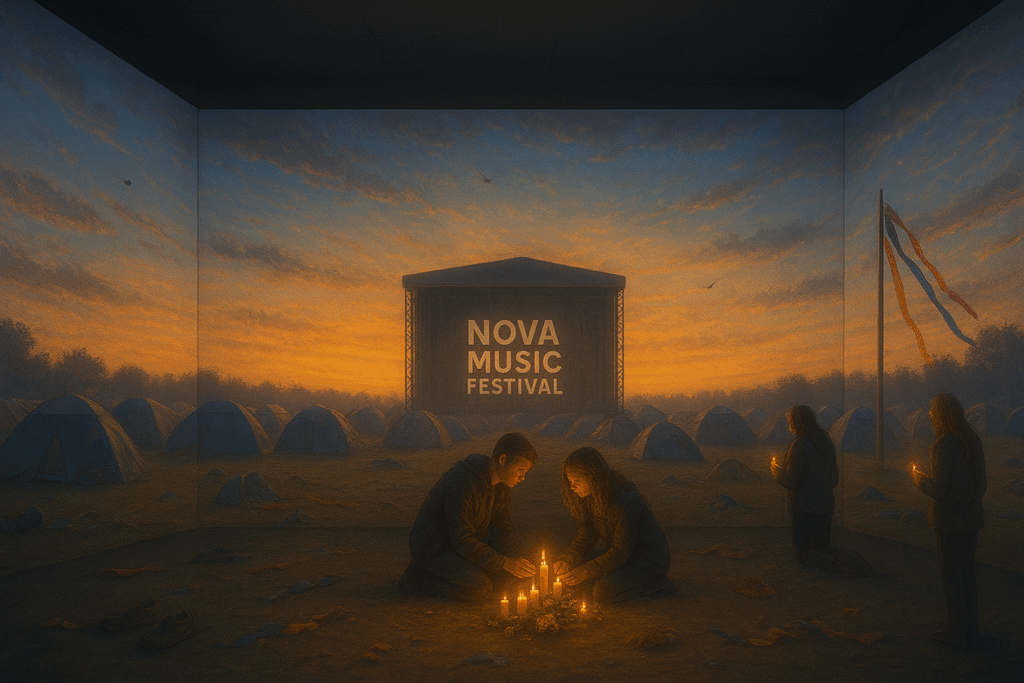
There are no public domain images of the exhibition’s immersive performance, but ChatGPT suggests this one.
The traveling exhibition “The Nova Music Festival Exhibition” (motto: “06:29 –The Moment the Music Stopped”) has been touring the world since the end of 2023. Previous stops were: Tel Aviv, New York, Los Angeles, Miami, Toronto, Boston. According to the website of exhibition and theme park designers Breeze Creative, it “reconstructs” the massacre of Palestinian combatants among the participants of the open-air trance party near Kibbutz Re’im on the morning of October 7, 2023 (in which an estimated 378 people died and another 44 were taken hostage), “using authentic objects collected shortly after the events — including burned cars, bullet-riddled portable toilets, abandoned camping tents with personal belongings inside, and the possessions of those murdered or kidnapped. Alongside these are gripping visual media: survivor testimonies, videos, and images capturing the horror.” “The Nova Music Festival Exhibition” was produced by the founders of the Nova Music Festival and the companies of Israeli cultural event organizer and festival founder Yoni Feingold. The Israeli government provided support from the outset, as did politicians in the host cities and many Jewish organizations. However, large sections of the Israeli population and the families of the hostages were and remained less unanimous. It is all too obvious that the Nova exhibition is enlisted as part of the Israeli government’s public diplomacy work, which it itself refers to as Hasbara, or Zionist propaganda. On the other hand, the exhibition is set in a context in which propaganda, information, documentation, and serious research are often difficult to distinguish from one another.
Now “The Nova Music Festival Exhibition” is coming to Berlin-Tempelhof, to the former airport building, under the patronage of Governing Mayor Kai Wegner, as announced in the local press on September 5. The announcement and the media coverage that is expected to be following makes it seem sensible to prepare by taking a closer look at the history, ideological implications, and curatorial strategies of this enterprise. Two texts are particularly recommended: “How Israel Has Made Trauma a Weapon of War” by Naomi Klein, published last year in The Guardian, and the essay “Prosthetic Trauma at the Nova Exhibition: Holocaust Memory, Reenactment, and the Affective Reproduction of Genocidal Nightmares,” published in early September of this year by Ben Ratskoff, a researcher in memory culture and the politics of the past. Klein and Ratskoff situate the exhibition project in the broader context of historical politics and memory culture activities in response to the Hamas attack of October 7, 2023, both within and outside Israel. Plays, films, a television series, VR online videos (such as the “Gaza Envelope 360 tour”) and themed tours of the dark tourism variety transform the traumatic events into various forms of visceral, immersive entertainment. Most of these products aim to draw views and visitors emotionally into the events of that day. The primary goal is to identify with the victims, to empathize with their suffering and death. At the same time, the effort involved in detailed documentation is often very impressive, and there are also more nuanced attempts to respond to the events of that day and its aftermath. However, as Klein argues, these products and the discourse surrounding them, consistently fail considering the research conducted in recent decades on the “ethics of memorializing real-world atrocity” and its eminently political dimension. Instead, the memory industry seeks to unilaterally dissolve the “difference between inspiring an emotional connection and deliberately putting people into a shellshocked, traumatized state, ” namely in the direction of “immersion”: “offering viewers and participants the chance to crawl inside the pain of others, based on a guiding assumption that the more people there are who experience the trauma of October 7 as if it were their own, the better off the world will be.” Another, similar yet crucial difference is that between “understanding an event, which preserves the mind’s analytical capacity as well as one’s sense of self” and “feeling like you are personally living through it.” The latter can be called “prosthetic trauma,” using a concept introduced by the historian Alison Landsberg (Prosthetic Memory: the Transformation of American Remembrance in the Age of Mass Culture) and the sociologist Amy Sodaro (Exhibiting Atrocity: Memorial Museums and the Politics of Past Violence).
Ben Ratskoff likewise draws on the concept of “prosthetic trauma.” His meticulous description and analysis of the Nova exhibition leads to the conclusion that Klein’s criticism of the historical-political instrumentalization of October 7 is just as valid as her objections to the breakdown of reflective distance in the mode of immersion: “Offering the pain and suffering of real victims as a simulated experience for public consumption, the Nova Exhibition underscores concerns that reenactment as a discursive mode and exhibitionary strategy obliterates the critical distance necessary for ethical reflection and contextualized understanding while nourishing destructive (and self-destructive) narrative panics and existential anxieties.” Ratskoff further emphasizes that such treatment of the memory of atrocities tends to reproduce rather than prevent genocidal nightmares, especially when the rhetoric and formats of Holocaust remembrance are transferred to the events of October 7, 2023: “Tropes and patterns drawn from Holocaust memory and the memorial museum form construct a powerful apparatus of emotional identification that blurs the figurative and the real, and memory and actuality.”
Wherever individual and collective acts of violence and experiences are “commemorated” institutionally, a gap has been widening for decades. State agencies and private-sector companies, often operating in public-private partnerships (as in the case of the Nova exhibition), that are involved in (trans)national remembrance and political education are torn between, to put it simply, education and explanation on the one hand, and emotionalization and identification on the other. Increasingly, the decision is being made in favor of the latter, of immersion. Since renowned historical museums such as the Imperial War Museum in London began staging the trenches of World War I and the bombing nights of the Blitz like ghost trains, hardly any major institution believes it can do without gamified exhibition concepts. Museums and memorials dedicated to the Holocaust, above all Yad Vashem in Jerusalem, have long been confronted with these expectations of immersive re-experiencing of the trauma and are giving in to them.
Regardless of the particularly charged events of October 7, 2023 and their commemoration, one might therefore ask: What are the functions and effects of the methods and technologies aimed at immersion and reenactment, which are increasingly being used in various contexts of memory culture, education, and therapy? When does the offer of identification turn into propaganda, empowerment into mobilization? How may the collapse of (critical) distance brought about and practiced in this way affect entire societies? For the making-immersive of history and politics, as practiced (not only) in the Nova exhibition, entails a deceptive unambiguity. Immersion has become the default mode of remembrance, the formula for political communication that rhymes participation with passivity, agitates by staging trauma. Now, “The Nova Music Festival Exhibition” will be open to visitors in Berlin. Where else but in this city would there be an opportunity to reflect on the fact that the aestheticization of violence and the instrumentalization of trauma have already had devastating effects in the past?