Tag: Ulm5

  • Update on the Ulm5 Trial (August 26 through October 7): The roles have completely reversed!

    Update on the Ulm5 Trial (August 26 through October 7): The roles have completely reversed!

    We have a lot to catch up on: the trial days from the second half of August and several trial days in late September and early October. September 8 marked the anniversary of the Ulm5’s “direct action” at and inside the Israeli-German defense contractor Elbit Systems. The trial against them, led by the Baden-Württemberg Attorney General’s Office in the Stuttgart-Stammheim courthouse—a location chosen solely for its political symbolism—was suspended for nearly a month during this time; the presiding judge was likely on vacation. For the defendants, this meant another unnecessary month under extremely harsh pretrial detention conditions in their respective prisons. Given the court’s conduct, prison sentences lasting years—up to five years—under the pretext that they formed a “criminal organization” do not seem unlikely.

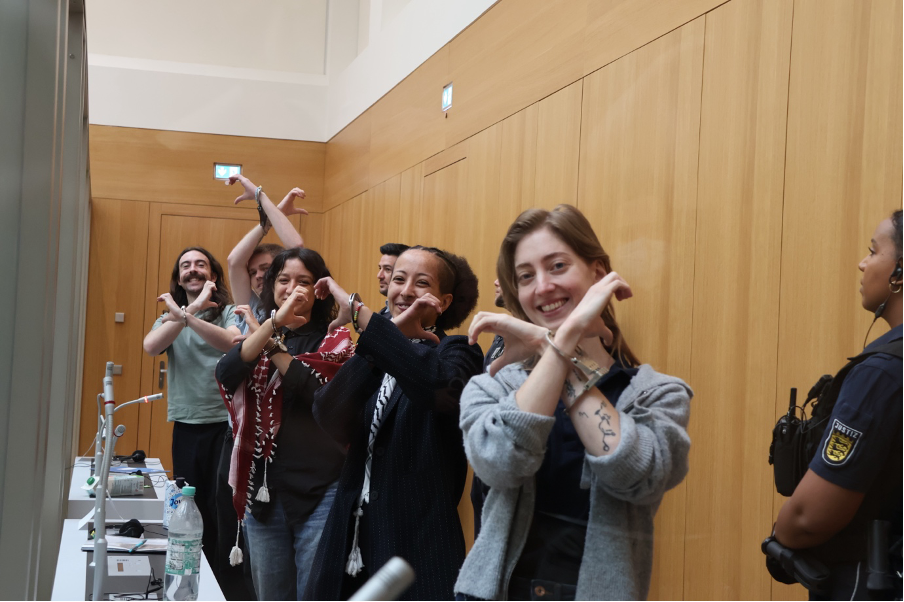
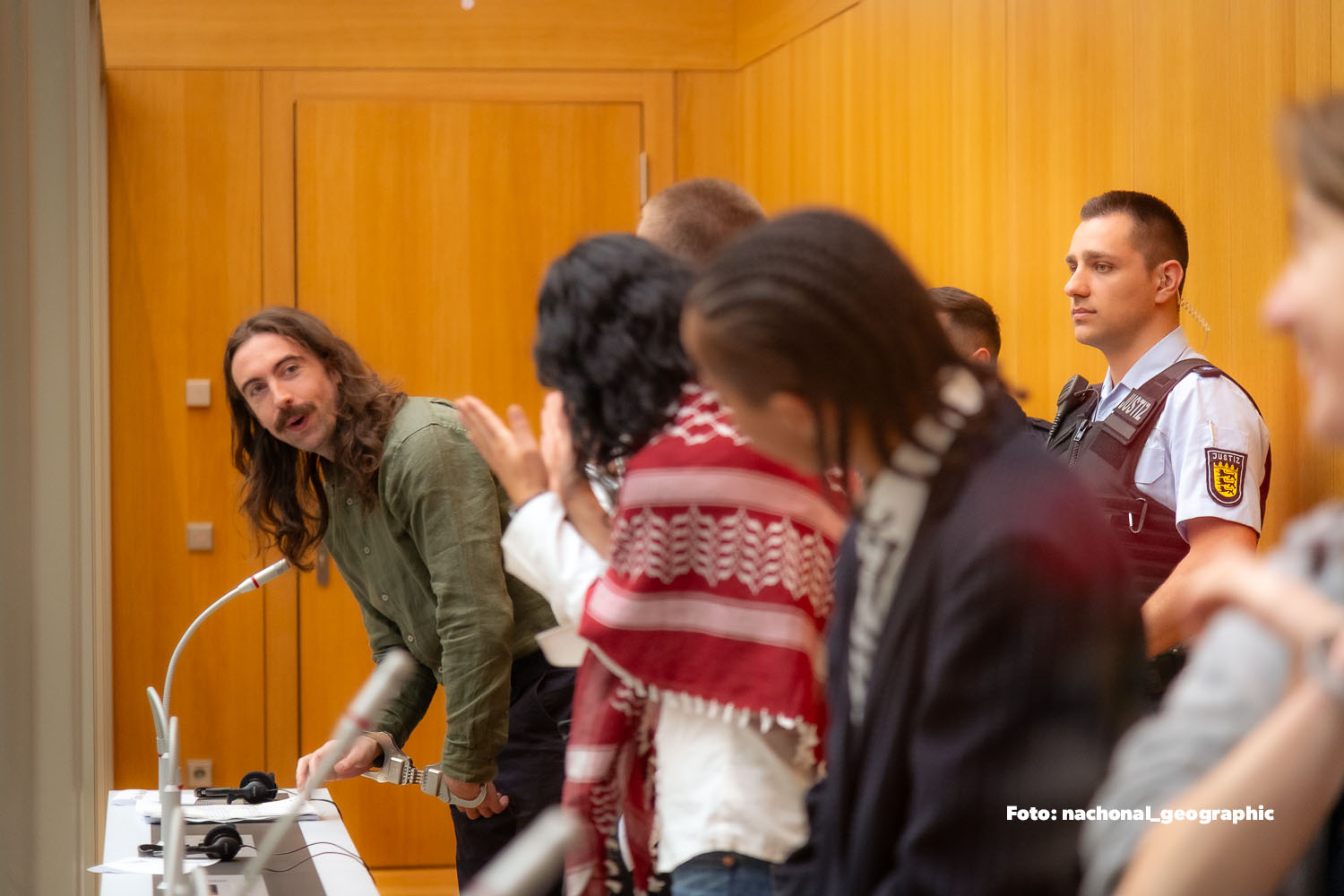
    But among those who have now been observing this trial regularly for more than five months, who almost feel at home in the gallery behind the glass wall—guarded by police officers in riot gear—and who have been forged into a community by the familiar, senseless harassment and the hopelessness regarding a fair trial, there is actually no despair, but rather a sense of confidence. This is first and foremost due to the determined, friendly, and ultimately cheerful demeanor of the defendants themselves: They are pale, though, because they never see the sun, and Vi, in particular, looks very emaciated, but when they’re led one after another in handcuffs down their glass corridor—smiling, waving, forming broken hearts with their cuffed hands, beaming at the audience—they themselves seem like the rising sun! They are completely unbroken, and that rubs off on everyone else—even the police officers, who are now far less unfriendly toward the visitors than they were at the beginning of the trial, and some of whom would probably like to fraternize with us.

    Daniel’s stepfather, a British-Irish Jew, shocked and disgusted by the accusations of anti-Semitism against his son, described the “two most lasting impressions” the trial has left so far as follows: “First and foremost, the resilience, compassion, outrage, humor, and unwavering integrity of the five, which becomes immediately apparent the moment they enter the courtroom. The cruel treatment and abuses by the German state seem to have only strengthened their deeply sincere convictions and empathy, rather than weakening them. Since Daniel and I have always had a very playful relationship, I’ve started performing a little ‘Rocky Horror Picture Show’/Tim Curry tribute dance from time to time when they’re brought in—just to see Daniel’s charming smile. I consider the Ulm5 to be wonderful, brave mavericks. – The second strong impression is the “infrastructure of impunity” that this courtroom and the judges and prosecutors are desperately trying to maintain. The court’s heavy-handed maneuvers, intended to demonstrate strength, feel almost embarrassing; and yet, the longer this trial goes on, the more palpable the unease in the courtroom becomes.”

    On the last two days of the trial in August, which I attended, this unease was downright overwhelming. Essentially, to an observer, the roles in this trial have completely reversed: the defendants and their committed lawyers are the prosecutors. On trial are Elbit, the German state, and precisely this “infrastructure of impunity”—impunity for facilitating and supporting the most serious war crimes, but also impunity for the blatant bias and manipulation by the investigative authorities. The Office of the Attorney General is becoming increasingly aggressive; the presiding judge appears jaded; and the police officers from the Stuttgart State Criminal Police Office (LKA) who were involved in the investigation against the Ulm5 are visibly unsettled on the witness stand. They are supposed to provide evidence for or against the defendants’ criminal conduct, but instead, one after another, they offer strong indications that something is amiss with the prosecuting authorities. Seeing these individuals, acting on behalf of the state, so helpless and on the defensive feels, as Daniel’s stepfather says, embarrassing; while the attorneys grill them, the audience is overcome primarily by vicarious embarrassment.

    The court session on August 26 was devoted to the questioning of a police officer named Jäger, one of the LKA employees who, on the morning of September 8, 2025—immediately after the arrest of Ulm5—were dispatched from Stuttgart to Ulm to take the investigation out of the hands of the local police. “The LKA investigates politically motivated crimes,” reads the very first line of the Baden-Württemberg LKA’s self-description on its website, and crimes committed in solidarity with Palestine are evidently a particular focus of its work. (This stands in stark contrast to crimes committed for and by Israel, which—even when they constitute the most serious war crimes—are simply ignored by German prosecutors and police authorities. In an ironic coincidence, it came to light the day after the Ulm5’s arrest that the IDF sniper and Munich resident Daniel G. is walking around freely unmolested, even though there is clear evidence that he murdered several unarmed civilians. To this day, the German authorities refuse to investigate him and other alleged war criminals residing in Germany.)

    The questioning of police officer Jäger took up most of the trial day on August 26 and part of the morning of August 27. This was primarily because, after each question, this witness would first remain silent for long periods, sometimes nearly a minute, only to then almost always reply that she could not remember, or to invoke her limited authorization to testify. Smartly dressed, young, blonde, with long, carefully curled hair and a pretty but completely expressionless face, she sat there feigning amnesia. Sometimes she would rest her index finger on her chin and gaze pensively into the distance, yet she could not even recall what she had included in her own notes filed with the court records, even though she was required to prepare for her testimony; so that the attorneys began to make fun of her, and even the presiding judge felt compelled to urge her to answer the attorneys’ questions.

    From what the attorneys were able to pry out of her, the following picture emerged: The State Criminal Police Office (LKA) in Stuttgart had been notified of the action by the police station in Ulm on the morning of September 8 and had immediately taken over the case. A team was assembled in Stuttgart by the lead investigator, Kropp—who had already been questioned at an earlier hearing. Kropp remained in Stuttgart, while the others—Ms. Jäger once said there were about eight of them—set off for Ulm between 8:00 and 9:00 a.m., received instructions at the police headquarters there, and arrived at the Ulm-Mitte police station around 10:30 a.m. (which is apparently housed in the same building), where the Ulm5 had been taken into custody in separate cells. Ms. Jäger’s task was to work with a colleague to record the identities of the accused; she was assigned an office for this purpose. They were dressed in plain clothes and brought each of the accused individually from their respective cells to have their identities recorded. However, Ms. Jäger could not recall what the cells looked like, nor what the police station’s premises look like at all, nor how many colleagues besides herself were present, nor what clothing the accused were wearing, whether they were injured or asked for help, or whether they requested to speak with their attorney or contact their relatives, nor how long they had to wait in the cells.

    All of the defendants, anticipating their arrest or turning themselves in voluntarily, had written a phone number on their arms and legs so they could contact their attorneys via that number after their arrest. Despite having been read their rights, their repeated requests to call this number were ignored. Throughout the day, the lawyers themselves had tried to contact their clients using the phone numbers of the Ulm police and the State Criminal Police Office (LKA) in Stuttgart, but had been fobbed off. This is clearly unlawful, and the attempts by the police officer to excuse herself by claiming memory lapses, and by the public prosecutor’s office angry outburst on this topic, aiming to suppress the lawyers’ questions, made for a pitiful spectacle.

    The detention of the accused on September 8 and 9—and perhaps until September 10, though this was not made clear—in the cells of the Ulm police station, about which many rumors were circulating, apparently looked like this: In the tiny cells, it is impossible to tell whether it is day or night; a bright light burns around the clock, and there is a hole in the floor for the inmates to relieve themselves; no toilet paper, no sink, no soap. The only furnishings are a plastic mattress and, presumably, a fire-retardant blanket. Some of the accused—perhaps only the two non-German, racialized, and gendered as female, Zo and Leandra?—were forced to undress completely and were given a sort of paper suit. Ms. Jäger could not recall Leandra being in tears, even though it was noted in the files. It is unclear whether they received any food, or what kind; at some point, Leandra is said to have refused food, but Ms. Jäger no longer remembers whether this was on September 10, when—though this, too, is unclear—perhaps only Leandra was not yet housed in a correctional facility and was still at that location.

    It is entirely possible that not only the Ulm5, but also all other people taken into custody in these cells in Ulm-Mitte, are subjected to such treatment. The law actually stipulates that human dignity applies even in a police station. But if the public at the Stuttgart-Stammheim courthouse is deemed capable of endangering the court or themselves with rubber pens, why shouldn’t a completely sober detainee—who brought her own arrest upon herself—be deemed capable, in an Ulm sobering-up cell, to injure police officers or herself with a bar of soap, a roll of toilet paper, or a pair of underwear?

    Furthermore, it was possible to reconstruct to some extent that Ms. Jäger began verifying the identities of the accused around noon, informing them on the way from the cell to the office with the phrase “you have the right to make a statement or remain silent, “you can also talk first to a legal counsel,” and that Ms. Jäger was one of the last LKA officers to leave the station on September 9 at 2:30 a.m. After the identity verification process was completed, she sat at the computer provided to her and wrote reports. At some point in the late afternoon, someone must have finally answered a call from the lawyers—probably in Stuttgart rather than in Ulm—and on September 9, within the statutory time limit, the defendants were brought before a judge under the supervision of their attorneys. However, it took another two weeks before Daniel could speak with the lawyers alone, and four weeks before he had any contact with his family or even the consulate—I know this from Daniel’s mother, Mimi.

    The story about the white powder, that the police laboratory concluded was probably laundry detergent, remains a mystery, at least to the audience. Ms. Jäger knew about it but couldn’t recall any specific details. From the lawyers’ questions and the list of evidence projected onto the wall, I gather that this powder was claimed to have been found in Daniel’s backpack, and that, on suspicion of drugs, a rapid test was conducted that same day, which was allegedly or actually a false positive, leading to the fabrication of the absurd accusation in the case files that Daniel had brought cocaine worth thousands of euros to the break-in at Elbit. The small bag containing the white powder was clearly added to the list of evidence only later; Ms. Jäger does not know whose handwriting it is. A few days later, the results of the laboratory analysis came in, but were not communicated to the attorneys. During Daniel’s detention review hearing, authorities still acted as if the drug suspicion were valid. It was only after seven weeks that the attorneys were allowed to review the corrected case file. Whether these irregularities were merely the result of poor investigative work or were intentional efforts to terrorize the accused, their attorneys, and their families will likely never be clarified.

    In any case, September 8 was a long day for Ms. Jäger! Apparently, she was allowed to sleep in the next day and had only a short day at the office in Stuttgart. On September 10, however, she found herself back at the Ulm police station and eventually accompanied Leandra to the Memmingen Correctional Facility, where Leandra remains incarcerated to this day. On the way there in the police van, Ms. Jäger noticed that Leandra had been tapping her foot to the music—she remembered that.

    In the weeks that followed, Ms. Jäger was involved in the investigation. To support the suspicion that Ulm5 is a criminal organization, there needs to be evidence that the group is organized and conspiratorial and prone to violence. If I recall correctly—I’m already having some memory lapses myself, but it’s also difficult when you’re not allowed to take notes—Ms. Jäger had analyzed Vi’s email accounts on the confiscated cell phone and now had to admit that the way the group planned their break-in at Elbit suggests they didn’t exactly behave in a particularly conspiratorial or organized manner. Vi, a native German speaker, handled the organization and was downright careless about it. The red suits with the inscription “Palestine Action,” ordered using their personal email address, did not arrive on time; the Airbnb apartment and rental car—both booked under her own name—were only secured at the last minute; and although Vi set up a Palestine Action Proton email account, they hardly ever used it. Indeed, to make the various bookings, Vi used her personal email address, with which she had earlier emailed the German Foreign Office – hardly the behaviour of a conspiratorial, organised criminal.

    To jog Ms. Jäger’s memory, the attorneys requested that she be sworn in—much to the astonishment of the international audience, who found it odd that in Germany, witnesses are not routinely sworn in, even though they are supposed to tell the truth anyway. Of course, the motion was denied.

    On Friday, August 28, although Ms. Jäger’s memory wasn’t quite as slow in not remembering, after a lunch break of over an hour and a half ordered by the presiding judge, there was little time left to question another witness from the State Criminal Police Office (LKA), a Mr. Herold. This witness, who had a degree in business administration and had worked for an auditor before joining the LKA, was more willing to provide information and recall details; and he was visibly very uncomfortable in his role. His primary task during the investigation had been to ascertain the biographies of the defendants. Instead of speaking with the defendants themselves, the internet was scoured in a process that the LKA calls OSINT but mostly seems to involve exploring Instagram and LinkedIn. Crow, a British citizen, was apparently suspected of having resided in Germany illegally because he was not registered anywhere. Mr. Herold had to admit that he was no expert in immigration law when the attorneys pointed out to him that British citizens are legally allowed to stay in Germany for three months without registration or a visa. He had listened to the music Crow used to play in a band and read the lyrics, and made a feeble—and immediately abandoned—attempt to dispute their artistic or professional value because the lyrics also contained political content—one song he remembered was about Black Lives Matter.

    Mr. Herold’s second task had been to research Elbit Systems, and here, too, he relied almost exclusively on the financial statements and annual reports available online, as if Elbit were a company like any other. It turned out that the Attorney General’s Office had failed to inform the State Criminal Police Office (LKA) that the attorneys had explicitly and urgently demanded an investigation into weapons production and Elbit’s involvement in the war in Gaza. Mr. Herold had made mistakes while copying and pasting revenue and profit figures; an entire zero was missing from the revenue figure, and numbers were repeated in the overview of profits from recent years. Mr. Herold agreed with the attorneys that the high percentage of profits for which Elbit does not specify a product division—profits that are, so to speak, up in the air—is unusual, and he had no idea where these profits actually came from. Once again, Daniel’s attorney, Benjamin Düsberg, was impressive with his detailed, confident knowledge of the context in which Elbit operates, including all the weapons systems, drones, and surveillance technology. Mr. Herold, too, seemed shaken by the fact that this technology—about which he knew as little as I did; he didn’t even know the basic terms—allows targets to be identified and destroyed without a human decision. He came across as a student who has to admit he didn’t do his homework, yet as someone who senses he has been misinformed and is embarrassed by his failure. The prosecutor—not Mr. Stengel, but Dr. Mark, a representative—kept angrily interrupting to insist that witnesses should not be questioned about their knowledge, but he, too, was in a difficult position, for what else should he have been asked about if not the knowledge he had gained during his “investigations”?

    At 4:25 p.m., in the middle of the questioning, the presiding judge suddenly declared the day’s proceedings over. The trial is not scheduled to resume for another month.

    It becomes increasingly clear that it is the German state—and its complicity in genocide—that is actually on trial here in Stuttgart-Stammheim. Daniel’s attorney, Benjamin Düsberg, filed a motion requesting that Olaf Scholz and Friedrich Merz be summoned as witnesses to shed light on Elbit’s arms deliveries to Israel and the murky circumstances surrounding that company. He also requested that the Israeli genocide scholar Omer Bartov be summoned as an expert witness and read aloud a passage from Bartov’s article in the New York Times from last July: “I’m a genocide scholar. I know it when I see it.” The Ulm5 group had apparently read this passage before their “direct action.”

    As early as August 14—there will be a separate article on this—Leandra’s lawyer Mathes Breuer had requested the subpoena of two historians as expert witnesses who are researching Elbit’s predecessor company in Ulm, Telefunken: specifically, Telefunken’s role in the “Third Reich” and in the genocide of the Herero and Nama. So this trial is not just about Israel; it is about Germany and Germany’s murderous continuities, and about the “future of genocide” that Bartov prophesies for us all.

    Here is a summary of the trial days on September 23, 25, and 30, and October 2 and 7:

    The testimony of LKA police officers continued, and the impression that they were not incriminating the defendants—but rather, on the contrary, incriminating themselves, the prosecuting authorities, the court, Elbit, and the German state—persisted. On September 23, a female police officer stated that Leandra and Vi had flown to Cairo, which was presumably meant to insinuate something sinister. When asked if she knew why the two had traveled to Egypt, she had to answer in the negative. Vi later explained that this trip only proved that, prior to the Elbit action, they had tried everything to do something against the genocide by legal means—namely, they had planned to drive through the desert to bring food to Gaza.

    On September 25, another police officer was scheduled to testify about the personal circumstances and connections among the five. She had only been able to find that social media posts from the band Crows had been shared by Zo; she made statements about Daniel that contained multiple errors; and when asked if she knew what “Palestine Action” was, she replied: She knew what the words “Palestine” and “Action” meant.

    Attorney General Stengel went so far as to claim that the name “Ulm5” referred to “Filton18,” the British Palestine Action group, and that this mode of referring to people carrying out actions was indicative of Palestine Action and evidence of an organized criminal connection. At which point the defense attorneys celebrated and confronted him with the “Chicago Seven”, “Shannon Five”, “Guildford Four” and at least a dozen other place-number combinations used to refer to groups on trial who are, in fact, innocent.

    On September 30, police officer Herold returned as a witness; he had been in contact with Elbit Systems but had chosen not to present the full text of the email from Elbit in the file, citing “data protection reasons.” Nor are the emails with the SWR journalist—who had provided the police officer with video footage of the lawful and registered “Shut Elbit Down” demonstration from April 2025—included in the case files. Apparently, he had examined that material using facial recognition software, but declined to say more about it, claiming it was not covered by his authorization to testify. The court did not show the video, but only stills in which Vi and Leandra can be recognized; the police officer mistakes Leandra for Zo. Leandra is smiling in the picture and wearing a T-shirt on which can be read: “Kill the Cop.” The image was, one imagines, intended to prove their propensity for violence. Mathes Breuer, Leandra’s lawyer, whose forensic cross-examination skills have shone in this trial, noted that something about the image was off and demanded to see the full image. It turns out that the image had been cropped: the T-shirt clearly read “Kill the Cop In Yr Head.” The audience starts to laugh. The police officer tries to excuse himself by saying his English isn’t very good. Later, defence lawyer Düsberg asks him if he hadn’t spoken to Daniel in English down in the cell—which he has to admit. And finally, after intense questioning, he has to admit that he took advanced English for his High School Exams. The public is laughing out loud at this point, and though the judge reprimands them, one had the sense that even she could see the absurdity. And then Vi makes a statement, again expressing their gratitude that the investigating authorities showed this evidence, here the images from this demonstration: These not only proved its peaceful and nonviolent nature but also that the defendants had exhausted all legal avenues of protest before deciding on “direct action.”

    On October 2, it was the turn of another young policewoman who was visibly very uncomfortable and even seemed close to tears. She was questioned about the thousands of photos, videos, chat logs, and apps she had been tasked with analyzing on Zo’s cell phone. Apart from the pictures and videos of Ulm5 before and during the incident—which everyone already knows about anyway because the defendants shared them themselves—a few pictures showing a Palestinian flag, and a picture of a small herb grinder with a cannabis symbol, there was apparently nothing of interest. The attorneys asked her what criteria she had used to determine what was relevant to the case and what was not. She had no answer to that. After the lunch break, a witness we were already familiar with—Police Officer Jäger, who had already impressed us at the end of August with her minutes-long and mostly fruitless, likely feigned, deliberations—was given the opportunity to answer three questions that were not, as she had claimed at the end of August, subject to the limited authorization to testify. Now she did recall that on September 8, 2025, “very late in the evening,” there might have been a phone call from attorneys at the Ulm police station, where the Ulm5 had been taken into custody after the incident; but she said she had only heard about it—a colleague had handled it.

    Finally, on October 7, police officer Gleiß was called to the witness stand for the first time—at last, one who appeared reasonably well-informed, competent, and more willing to engage with the defence attorneys. His task had been to investigate the personal connections of the accused to “Palestine Action.” He, too, had only scoured the internet and publicly available sources including the Wayback Machine for this purpose and had selected a sequence of screenshots he had taken from websites and Instagram accounts—for example, an online form from 2020 where people could register with Palestine Action UK. Defence lawyers Caroline Kaufman, Mathes Breuer and Benjamin Düsberg led the questioning, and a sort of forensic examination of details ensued, aiming to uncover the underlying assumptions behind the police officer’s investigation. There was a lengthy discussion about PA logos that appeared on the PA Germany Instagram site—specifically, whether differences in these suggest that PA is not an organization but rather a movement in which unconnected individuals use certain trademarks or publish content without coordinating with one another. Even on social media, people who do not know one another and are not organized can engage in “media work.” Breuer then asked the police officer why he referred to PA Germany as a “group” when its self-description was an “autonomous network.” And even if there were indeed “teams” within Palestine Action UK, that by no means implied that this was also the case for Palestine Action Germany.

    Through careful and precise questioning, it became clear to what extent the police investigation was shaped by preconceived notions. In fact, there is no evidence of organizational or group-based connections of any kind; rather, these were fabricated by the investigating authorities themselves, through arbitrary leaps across time periods and countries. “Palestine Action” in the evidence presented here is ultimately nothing more than a label for a particular approach used by unconnected and diverse participants in a broad movement—an approach that is also interpreted in very different ways.

    Another example of how the prosecution’s evidence turned out to be evidence for the defense was the earlier screening of the film “How to Kill a War Machine” on the morning of October 2. The defense had filed motions to prevent the screening of the film, arguing that it improperly suggested that the Ulm5 were connected to the Palestine Action UK activists featured in the film. In this respect, the action against Elbit Germany was not a copy of the actions by Palestine Action UK, as the Ulm5 had planned their action from the outset in such a way that they would be arrested—they did not wear masks, did not flee, etc. However, when the film was then shown, to many viewers in the public gallery it instead had an overwhelming impact in its indictment of the war crimes that the entire Palestine solidarity movement—and indeed the Ulm5—are fighting against. Anyone in the audience who hadn’t heard about the lawyers’ motions to prevent the screening thought the film was part of the defense’s case. It documented the ubiquity of war technology produced by Elbit in Gaza, how Gaza is shamelessly and openly marketed by Elbit Systems as a “testing ground,” it highlighted the consistent human rights-based motivation of PA activists in the UK, and made it clear why they decided to carry out these actions; it showed how often they were acquitted by juries; it depicted the brutal police violence and how Priti Patel, then Home Secretary, secretly met with Elbit Systems UK in 2022 and promised Elbit that she would speak with the police. – I knew little to nothing about Palestine Action UK beforehand, and it is not without irony that Attorney General Stengel, of all people, gave me the opportunity to learn about them.

    Daniel also commented on the screening of the film along these lines: On the one hand, he said, it contained nothing that Ulm5 hadn’t already brought up in their opening statements; the prosecution likely just wanted to conjure up a criminal connection by repeating the words “Palestine” and “Action” as often as possible. On the other hand, it might be better to optimistically seek common ground, and after all, the film established two facts: first, that Israeli actions in the Palestinian territories constitute a chronic crime against humanity; and second, that many people are now so appalled by their governments’ complicity that they are willing to risk their personal freedom to oppose these crimes. “In Germany, simply sharing the conviction with others that human dignity is more important than corporate profit margins can already be enough to justify a conviction for membership in a criminal organization.” Daniel concluded with a dig at the court’s decision to keep the defendants in pretrial detention for over a year: “Should the court find these remarks cynical, I would like to express my sympathy. I am at least aware that the court took note of the concerns expressed by the co-defendants regarding the fairness of this trial, since the court once cited them as grounds for denying our release from pretrial detention. It would be regrettable if these legitimate concerns were to prompt the court merely to punish the defendants and keep them in custody, rather than taking steps to incorporate into the proceedings something that has been striving with all its might to gain access from day one: the truth.”

    Otherwise, as always, the court’s mantra was: “Motion denied!” The motions to allow the defendants to sit next to their attorneys, to admit a court note-taker, and to permit the audience to have writing materials. Not yet decided are the motions to admit materials that could explain the defendants’ human rights motivations; the motion to allow Zo to speak English with the advisor for her bachelor’s thesis without a translator costing hundreds of euros; the motions to examine the German history of the Elbit Systems facility in Ulm—which, as part of the Telefunken company, was also involved in the genocide of the Herero and Nama peoples and in the genocidal exploitation of “Eastern workers” and concentration camp prisoners during World War II. In his statement on this motion, the Attorney General actually said—the audience could hardly believe their ears—that the labor of the “Eastern European workers” under Telefunken had been “alleged” forced labor, and maintained that the Ulm5’s action had nothing to do with German history but had been undertaken purely out of “Israel-related anti-Semitism.”

    The motion by attorney Kaufmann to take into account that Section 129 of the German Criminal Code (StGB) is, within the European framework, intended to address the joint commission of truly serious crimes—such as human trafficking, organized crime, and murder gangs—was rejected. Only the German version considers a criminal organization to exist even for offenses punishable by two years in prison, whereas the European framework requires that Section 129 be applied only to offenses punishable by at least four years. The court doesn’t mind that Germany is on a Sonderweg in political criminal law in this regard. The court also showed no interest in the Nazi origins of Section 129—the 1936 Nazi version of which was adopted by the Federal German Criminal Code after the war.

  • “Shame on you”: defendants speak in court – Notes from the Ulm5 Trial, 27 and 29 July

    “Shame on you”: defendants speak in court – Notes from the Ulm5 Trial, 27 and 29 July

    Old as the olive trees, July 29, video: Judith Scheytt

    This follow-up report covering trial days 13 and 14 on the ongoing Ulm5 proceedings is based on the trial observation by Insa Lee Koch on Monday 27 July and Aino Korvensyrjä on Wednesday 29 July. Insa was able to take notes during the trial due to a press accreditation, while Aino had to write up her observations after the trial. The report is also based on reconstructions developed in consultation with other court observers and attendants. All quotations are approximate rather than verbatim.

    Trial Day 13, 27th July (Insa)

    When I arrive at court on the morning of 27th July, the solidarity is once again running strong. A coach has arrived from Berlin carrying friends of the defendants and activists, some dressed as colourful clowns and charlatans in white puffy skirts, red and black tops, with their noses painted red. They are not the only ones who have come for today’s hearing. As I make my way into court and into the public gallery, I can see it is packed once again with family members, friends and members of the public. Vi’s brother is there. Vi cries when they spot their loved one in the public gallery. They did not know their brother would come. Two women who were imprisoned with Zo have also come, standing up and waving with big smiles as Zo is brought in. Zo’s face lights up when their eyes meet across the courtroom.

    The two women tell me that they have been banned from visiting Zo in prison, so the court hearings are their only opportunity to see and to support them. While we are chatting before proceedings begin, one of the court officers wearing riot-like gear approaches us and tells one of them that she cannot wear her tinted glasses in court. “Why?”, she asks. “Not allowed” is the brisk response, before he takes her out to hand her glasses to another officer who will lock them away for the court day (Later that day, a similar scene will unfold when officers ask another member of the public to remove their bandana, explaining that head coverings are permitted only for religious reasons.).

    Applications

    Proceedings begin late again, at 10.30 am. The court opens with a moving statement from Vi about the seating arrangements – something that the lawyers have made applications about many times before. With a clear and loud voice, composed and calm, Vi speaks about how, on the thirteenth day of the trial, she and her comrades still remain cut off from their own trial, separated from both their lawyers and the proceedings by a glass wall.

    Vi describes the arrangement as “shameful” (beschämend), arguing that it continues to dehumanise them while, outside, Germany’s largest aerospace exhibition (ILA) is taking place, where Elbit Systems is exhibiting military technology promoted as “battle-tested”. While attendees enjoy the exhibition as a family-friendly event, Vi tells the court, the same military technology on display is used to kill children and families elsewhere. Vi’s statement, which also functions as yet another application for the defendants to sit with their lawyers, is followed by the defence’s usual applications: to allow the proceedings to be transcribed by a designated transcriber seated with the lawyers; to permit members of the public to take notes (and, in particular, to allow MoP Nicole Gohlke from Die Linke to do so during her trial observation today).

    The ruling

    None of these applications are new. Yet today, for the first time, out of the blue and for no evident reason, Kathrin Lauchstädt, the presiding judge, has more to say, issuing a ruling (Verfügung) in relation to two of them: previous applications concerning the courtroom seating arrangements and the defendants’ request to speak with their lawyers in the holding cells during breaks without a separation wall. Everyone listens attentively as the presiding judge begins her ruling by rejecting both requests, along with a previous application by lawyer Düsberg to stay the proceedings. The seating arrangement, she says, reflects the spatial design of the courtroom, which was built for defendants to sit behind a glass wall. To change these arrangements, she argues, would create too great a risk that the lawyers would disregard the court’s rules.

    She then lists what she describes as examples of alleged misconduct: on the first day of trial, the defence lawyers staged a collective walkout and, upon returning, seated themselves in the dock. More evidence of alleged misconduct follows. The lawyers have repeatedly addressed the public, despite knowing that the gallery had twice been cleared because of disturbances. Rejected applications are routinely met with comments bordering on insulting behaviour, she continues, while the defendants themselves have repeatedly initiated contact through silent applause (“stiller Applaus” – waving both hands in the air), and communicated with one another from within the dock, including by exchanging notes. Therefore, she concludes, she sees no reason to ‘relax’ the seating arrangements.

    Disciplining and punishing

    The audience is stunned. This is the first time the judge has given a substantive ruling on these applications, yet it sounds less like a legal decision than an act of discipline and punishment—the lawyers later use both words in court to describe her ruling.  They request a three-hour break and, when they return—while the mothers and other family members, clowns and other supporters had spent the time seeking shade from the scorching sun in a nearby café and the gazebo outside—the lawyers are prepared.

    Speaking collectively, passing the floor from one to another, they present a forceful rebuttal. None of the reasons given by the judge, they argue, can be justified on grounds of security. On the contrary, they tell the court, the ruling is designed to curtail the rights of both the defendants and their lawyers.  Among them, they argue that the courtroom has sufficient space for all defendants to sit beside their lawyers, while the intercom system makes confidential and effective communication impossible.

    The lawyers also insist that their actions on the first day of trial were neither irrational nor unlawful but a pragmatic response after being denied the opportunity to make urgent applications (“unaufschiebbare Anträge”), including applications alleging judicial bias. Sitting in the glass dock, they argue, was the only way they would have been able to communicate confidentially at all with their clients that day.

    An absurd logic

    The outrage expressed in the lawyers’ response brings into sharp focus what seems evident to many in the public gallery: that this ruling is not simply about seating arrangements. Much more is at stake – namely, the court’s desperate construction of the defendants, and by extension of their lawyers and supporters, as dangerous collectives in need of discipline, policing and pre-emptive punishment. It is precisely this construction of a collective threat, implied by the ruling, that more than one lawyer ridicules in their response today. If silent applause is considered a security threat, lawyer Schuster argues, then surely a smile from the prosecutor or the raising of an eyebrow should be treated in the same way – an implication that would inevitably expose the judge to the “Vorwurf der Lächerlichkeit” (the accusation of rendering herself ridiculous).

    Lawyer Busl, meanwhile, argues that the judge’s conclusion that she sees no reason to relax the seating arrangement exposes the logical flaw in her own reasoning. The seating arrangement was never an inevitability. More importantly, she suggests, the judge’s wording applies the language not of the courts but of the carceral system, and reveals the underlying purpose of the ruling: not to safeguard the defendants’ legal rights, but to establish a moral relationship in which they must first “earn” the right to sit with their lawyers, much like prisoners who receive privileges only through good behaviour.

    The power of expression

    It comes as little surprise, when, after another fifteen-minute break, the judge confirms that her ruling will stand. The lawyers show no visible reaction. I can see some of the defendants and members of the public laughing quietly, some look despondent, and, above all, exhausted. Before proceedings conclude for the day, however, the lawyers make one final series of applications: that the panel of judges recuse itself on the grounds of apparent judicial bias displayed again on that day. The judge gives the defence until Thursday, 30 July, at 11 am to submit the application.

    As the defendants are handcuffed and led back to the holding cells, Mimi, mother of Daniel, unexpectedly finds herself leading a chant for the first time in her life. “Free, free Ulm Five.” “I have no idea how that happened,” she tells me later. Her voice is clear and strong. Again and again, the public responds in echo, the chant building into a crescendo that fills the entire courtroom.

    Later, Mimi tells me that the “note” exchanged between the defendants—which the judge had cited in her ruling as evidence of alleged misconduct—was, in fact, a quotation Leandra had shared with the others in the dock. It was her favourite line from Pessoa: “To express something is to preserve its virtue and to remove its terror.”

    Trial Day 14, 29 July 2026 (Aino)

    I arrive early on 29 July. While waiting in the long security queue, slowed down by procedures that seem to serve no other purpose than to delay the public’s attendance, I meet others facing prosecution for actions against German companies’ support for genocide. We exchange experiences. Since October 2023, I have observed numerous trials in Berlin targeting solidarity with Palestine and, before then, many others through my research and antiracist organising in southern Germany. One organiser tells us they have left Germany because of the repression while continuing their political work abroad.

    Once inside, the room slowly fills with familiar and new faces: relatives and friends of the defendants, activists from different campaigns and groups, and others whose reporting from Stammheim I have followed closely. Behind the bulletproof glass sit the lawyers of the Ulm5 from Berlin and southern Germany, many of whom are known as much for their longstanding involvement in antiracist and left movements as for their defence work. After a brief singing lesson, we begin singing in canon the song that has on previous occasions filled the public gallery:

    Old as the olive trees

    The wisdom of those who fight to be free

    Land and people will thrive

    In a free Palestine

    As the defendants are brought in, some members of the public clap; others keep singing. Vi, Zo, Leandra, Crow, and Daniel join in, singing this song they sang inside the Elbit Systems Ulm factory in September 2025. We meet each other’s gaze. The judges arrive, and the presiding judge, Kathrin Lauchstädt, calls for silence, bringing this moving moment of collective defiance to an end. The melody lingers in a low hum, exposing the fragility of her authority. The singing and humming will resurface throughout the day in this room, after the pauses to welcome the defendants, in the corridors and outside – and later in social media posts heard by tens of thousands in Germany and abroad (see the video at the beginning of the report).

    Applications

    Leandra speaks first. In a Southern Cone Spanish accent, with eloquence and sharp irony, she challenges the seating arrangement, an issue discussed at the previous hearing, and many times before. Her question to the presiding judge in June about why the defendants were kept physically isolated, as though they posed an imminent danger to everyone in the courtroom, has yet to receive a satisfactory answer. Anyone “with two eyes”, she notes, can see there is space for her between her two lawyers, making the court’s argument about courtroom design untenable and outright “absurd”. Although previous motions have been rejected, she reminds the court that the fundamental rights at stake are non-negotiable. “In our neighbourhood (en nuestro barrio)”, she says, “they would call this an abuse of power”. She links the highly restrictive seating order, the public’s note-taking ban, and the wider proceedings to an attempt to portray the defendants, lawyers, and supporters as dangerous, calling this a “show trial” (juicio show). This is another word that has been used repeatedly during the trial.

    Foto: Ignacio Rosaslanda

    In response, Senior Public Prosecutor Ronny Stengel once again cites a Stuttgart Higher Regional Court ruling on a complaint related to this trial that has been invoked in previous hearings, according to which the seating arrangement reflects the courtroom’s design while respecting both the presumption of innocence and the defendants’ fundamental rights. Daniel’s lawyer Düsberg replies that Leandra already noted the circularity of this reasoning. He compares it to Chancellor Friedrich Merz’s assurances to the Irish press that defendants’ rights are respected in Stammheim. These statements came in response to critical statements by the Irish parliamentary delegation who attended the trial and visited Daniel in prison the previous week. Ignoring the judge’s attempts to cut him off, Düsberg then stands to welcome German MEP Martin Sonneborn (Die PARTEI), who is attending the hearing and is seated with his assistants in the public gallery. The lawyer sarcastically praises the courtroom’s “glass installations”, which, he suggests, allow Germany to compete with Russia in the “first league”. Like Leandra’s remarks, the comment draws quiet laughter from the public.

    The defence then re-files applications to permit note-taking by the public, to allow a note-taking assistant for the defence, and to allow lawyers to meet privately with their clients during breaks without a glass partition. Crow’s lawyer Maja Beisenherz notes that such arrangements are standard in other cases heard in the same building.

    Lawyer Nina Onèr presents a motion on behalf of Zo, whose wrists have been damaged by regular transports in heavy-duty handcuffs. Since the trial began in April, they have suffered persistent bruising, pressure marks, swelling, and pain, and have recently begun to experience numbness. The court has ignored repeated warnings from Zo and the defence, as well as defence efforts to secure alternative transport arrangements through the prison. The injuries, Onèr argues, require urgent documentation and examination to prevent lasting neurological damage. With carefully restrained fury, she accuses the court of avoiding responsibility:  instead of initiating any action, the court has given the prison until the end of July to state its position. Citing the German Basic Law and the European Convention on Human Rights, she invokes the rights to bodily integrity and a fair trial, as well as the prohibition of torture.

    After a short adjournment, the presiding judge announces that a forensic medical expert involved in parallel proceedings in the same building, Dr Hohner, could examine the matter. The judge appears more concerned with establishing fitness to stand trial (Verhandlungsfähigkeit) than with the pain and damage already caused.

    State racism in action

    Crow then speaks, passionately, addressing Zo as their brother:

    “I appreciate the gesture of bringing in a doctor to check our hands. Nonetheless, I am upset and angry that this took more than ten hearings. Shame on you. You sit there with bored faces while my brother is in pain. We could see the marks on his hands from over here. Shame on you for hiding behind the law and misusing it to enforce suffering and torture on my brother. Shame on you for using our health and our rights as bargaining chips in your sadistic games of power. Shame on you for using our attempt to stop a genocide (…) to stage a show trial against us and terrorise us and the public. Shame on you. Shame on the judges. Shame on the prosecutor.”

    In the public gallery, I cannot help but think: Why is Zo, a Black person, subjected to this form of violence, while state authorities simultaneously deny that it is taking place? I remember a press conference where their mother, Nicky, spoke about the torture and abuse they had been subjected to after their arrest; they were left naked in a cell with only a nappy and denied medical attention. I am reminded of the accounts shared by Black people I met during research and antiracist court watching in southern Germany over the past decade. They spoke of violent abuse and intimidation at the hands of state authorities and guards in pre-trial detention centres, immigration detention facilities, asylum camps, and police stations not far from where we sit. In the German criminal legal system, just like the immigration enforcement regime, infliction of pain and inhumane treatment are heavily racialised.

    Lawyer Matthias Schuster reminds the court that the real issue is not fitness to stand trial but the shackling itself, which is physically harmful and humiliating, and cannot be justified by any danger posed by the defendants or by their conduct. The judge calls a one-hour recess, during which Dr Hohner examines Zo and Daniel, who also reported injuries. Rather than being an independent medical practitioner, Hohner works for the Society for Forensic Medical Examinations and Expert Assessments (GRUS GmbH), a Tübingen-based agency that provides expert reports for this court.

    The witness

    After the break, it takes me almost an hour to re-enter the building due to security controls. In the meantime, the doctor has already delivered their statement, confirming injuries commonly associated with the use of handcuffs. She recommended Zo to wear wrist warmers or socks between the handcuffs and their wrist.

    Then Mr Kienast is questioned as a witness. He was one of the police officers involved in searching Leandra’s phone after her arrest. His face looms large from the big screens on either side of the courtroom, amplifying the familiar theatrics of the trained police testimony. In response to defence questions, he repeatedly cites the limits of his authorisation to testify, refusing to answer questions about inter-agency cooperation, internal matters, and working practices, a justification repeatedly invoked by police witnesses in this trial. For instance, he withholds information about the software used to search Leandra’s phone, including its name and the search terms employed, and about his cooperation with Mr Gropp, an officer previously heard as a witness.

    Leandra’s defence confronts him with documents from the case file, including an extraction report generated by UFED (Universal Forensic Extraction Device), a software developed by the Israeli company Cellebrite. In this way, more than 10,000 images on Leandra’s phone were examined to identify nine or ten deemed “relevant to the proceedings”. Kienast acknowledges having little substantive knowledge of the topic of Palestine himself. He repeatedly appears to conflate “Palestine Action” with “Palestine-related actions”, for instance by presenting them as alternatives separated by a slash (Schrägstrich). This creates the impression that any Palestine-related action is associated with the UK-based group.

    Mathes Breuer asks whether Cellebrite’s Israeli origin poses a potential conflict of interest in the investigations. Implicit in this is the question whether software developed by an Israeli company might treat support for Palestine as inherently suspicious. More fundamentally, the issue is this: what does it mean when German authorities investigate actions targeting a German subsidiary of an Israeli arms manufacturer while relying on Israeli-developed surveillance technology? Kienast says he has never considered the matter and was unaware of the company’s origins.

    Several of his answers provoke quiet laughter in the public gallery, for instance, when he initially refuses to answer the defence whether he has met the Senior Public Prosecutor, Ronny Stengel. Given the routine cooperation between police and prosecutors in German criminal investigations, the question seems unremarkable. Pressed further, Kienast concedes that such meetings are possible but says he cannot remember how many took place. At one point, the presiding judge admonishes the public, insisting that the courtroom is not a place “to laugh at people” (auszulachen).

    Applications concerning Elbit Systems Germany

    Nearly four hours into the hearing, more substantial material is introduced. Düsberg submits an application to take evidence, seeking to admit delivery records from the global transport and logistics company DSV. These document shipments of military goods from Elbit Systems Germany’s Ulm facility to Israeli ports and airports between March and October 2025, both before and after the defendants entered the site. He argues that this evidence will establish that the defendants’ actions were justified under § 32 StGB (Notwehr), which permits necessary defensive action against an unlawful attack and encompasses the defence of others (Nothilfe).

    The attack consists of “war crimes, crimes against humanity, and genocide in Gaza”, in which the defence argues the Elbit group is complicit through its near-monopolistic role in supplying the Israeli military. Moreover, Elbit weapons systems used in Gaza are subsequently marketed as “battle-proven”. The shipments in question include laser warning systems and military communications equipment. Düsberg refers to reports by the Irish magazine Ditch that deliveries continued into May 2026. He further requests that arms-trade researcher Ruth Rhode of Shadow World Investigations UK be heard as a witness. Rhode is expected to testify on the nature and military uses of Elbit technologies in Gaza and elsewhere, including the E-LynX software-defined radio system, artillery rockets and guns, laser target markers, and surveillance systems.

    In a further motion, Beisenherz requests that Jan Erbe, Vice President of Elbit Systems Germany, and Haim Delmar, Executive Vice President and General Manager of Elbit Systems Ltd., be heard as witnesses. They are expected to testify to Elbit Systems Germany’s key role in developing integrated military information and communications systems, including the E-LynX communications system. Produced by Elbit Systems Germany, E-LynX is used by various countries’ armed forces and is being further developed with the Bavarian start-up Cucuyo GmbH. It forms an integral part of the Israeli military’s tactical communications infrastructure, including in operations in Gaza. Referring to earlier applications to take evidence, including that of Düsberg and another one filed by Breuer on 22 July, Beisenherz argues that the evidence will establish that the defendants’ actions were justified under Section 32 StGB [Notwehr/Nothilfe].

    A 2,5 week recess

    The court reserves its decision on the applications for later. Defence lawyer Onèr notes that, rather than investigating Elbit, the proceedings have been repeatedly delayed. As the chamber enters a further 2.5-week recess, she urges the judges to think of the five human rights activists held in overheated cells for opposing a genocide, recalling Crow’s remarks at the opening of the hearing. The public responds with applause before Kathrin Lauchstädt restores order.

    Shortly after 3 p.m., the hearing ends. The public again applauds and chants, “Free, free Palestine, free, free ULM5”, in farewell to Vi, Zo, Leandra, Crow, and Daniel. We file out through the security gates, humming and singing the olive-tree melody, before gathering at the roundabout to wave to the defendants. They will remain in isolation until 14 August, when the next hearing is scheduled, again at 9 a.m.

  • Playful: The police view on the Ulm5

    Playful: The police view on the Ulm5

    Picture showing, from left to right, Daniel, Crow, Leandra, Zo and Vi. Taken by Hebh Jamal, on 3rd July

    This report is based on my observations attending the trial of the Ulm5 on the 1st and 3rd of July. At the court, I got to know some of the mothers, families, friends, and activists who come to support them. I draw on my conversations and observations to continue Marion Detjen’s court watch reports, which covered proceedings up to day eight of the trial at Stammheim prison and can be accessed here and here. I focus on the afternoon of the 8th and 9th trial days (1st and 3rd July). Like all members of the public, I could not take notes because pens are considered a security threat by the judge. What follows is reconstructed from personal memory, conversations with the mothers of the defendants, and the records of other court attendants.

    I arrive at the courthouse on July 1st for the afternoon session, struck by the bleak surroundings, high security fencing, razor-wire, and stern looking officials in what seems like riot gear. The contrast with those here to express solidarity with the defendants is stark. These are, first and foremost, the mothers. I came because a mutual friend put me in touch with Nicky, the British mother of Zo. She greeted me with a big hug. Her warmth and openness are mirrored by the other mothers I meet: Vi’s mother and Mimi, Daniel’s mother. They come to trial as often as they can – to be a vigilant presence in the courtroom and to connect with their children. The court never sits on consecutive days, and, especially for family outside Germany, each day must be carefully planned, flights booked, accommodation organised, and time off work arranged. Some who wish to be there are unable to. And yet, the mothers say what they suffer is nothing compared to what their children are going through––Vi recently described some of the brutal conditions of their imprisonment in a six-page letter––, not to speak of  conditions in Palestine. 

    The mothers gratefully acknowledge support from activists and others. I witness this when I walk out of court with Nicky on my second court-watch day: a friendly stranger, wearing a hijab, who I had seen in the public gallery, walked up and offered her a place to stay whenever she is in Germany. People introduce themselves, express their solidarity, and cheer for the defendants as if they were family too. Outside, opposite the high-security prison adjoining the court, a gazebo is set up and decorated each day with art about Gaza, Palestinian flags, posters, books, and flyers. There is free water (water is not allowed in the courtroom – people drink from the tap in the toilets if they get thirsty) and snacks, mint tea and coffee, and people sit on the floor to get some shade. At the gazebo a sound system allows speeches to be made and music to be played.

    I meet activists from Baden-Württemberg and Cologne, locals who come in solidarity, students, and journalists. Some attend every trial day. The defence team give speeches and talk to family during breaks and after court. Perhaps most moving are moments of spontaneous solidarity from strangers beyond us: we hear a chant from behind the prison walls, “free, free Palestine!”, and supporters outside echo his words, adding “you are not alone!” When some people at the tent chant “free, free Palestine”, we hear an echo, again unseen, this time from the construction site next door. People laugh and respond. As Germany has repeatedly proscribed solidarity with Palestine, these moments become testimony to the strength of the struggle across the country.

    It is this solidarity – with all its strength, laughter and love – that appears to be on trial here. There are about thirty waiting outside the courthouse this afternoon. The mothers go to the front encouraged by other court attendees who know who they are. An officer instructs us to hand over passports, and disappears with them. We are brusquely instructed to keep our place in the queue, to enter in the same order as our passports. Only one person may enter the building at a time. There are more officers, stony faces, more questions. Once through the metal detector, a female officer gestures for me to enter a small windowless room. Family members of the Ulm5 and others have been sexually assaulted during this routine control. My security officer is not as invasive, only short tempered: she commands that I turn around and face the wall to firmly frisk me back and front. I am told to sit down, take off my shoes for checking; I must lift my feet so my socks can be checked too.

    The court is designed for trials of terrorism and national security matters. Its architecture and feel is more restrictive than any courtroom I have seen before. There are armed officers in the riot gear-like uniforms everywhere outside the courtroom, I count seven standing against the walls, and the courtroom itself is manned by more. The public is separated from proceedings and the defendants by a glass wall. The judge has on previous occasions cleared it when she felt it was too noisy and once paused proceedings and brought a member of the public who had made a noise to the bench and started reading out their personal details. Nicky, like the other mothers, is careful not to antagonise the judge for fear of being thrown out: trial days are a rare occasion when she can see her child and be a witness to the proceedings, and she does not want that to be taken away. “I will stand by my child who I taught principles of fairness”, she tells me. When the defendants are brought in, everyone in the public gallery stands up, people start clapping and cheering. The Ulm5 also smile and make eye contact with loved ones, they seem calm and composed; Mimi would later speak about “the atmosphere and stance of moral clarity” that surrounds them. The mothers and defendants form their hands into broken hearts. But Nicky and the other mothers remain silent when the public bursts into spontaneous chants of “Free, free Palestine” as they worry about the judge’s possible punitive reaction. When the judges walk in, the entire room falls silent.

    Day 8, 1st July 2026

    I rely on Seán Ó Maoilearna’s reconstruction for the first half of the court day. It began with a motion from defence lawyer for Zo, Nina Onèr, regarding separation from their clients by the glass wall. Communication is through an intercom, criticised by the lawyers for being unreliable and for its lack of privacy. Alternatively, the lawyers can speak to their clients in their cells but even there they remain separated from them through a glass wall. Onèr noted that in another trial in the same courthouse, of Reichsbürger conspirators who shot and injured two police officers, the same arrangement was not in place. In that case, defendants and defence meet during breaks in rooms without barriers. The prosecutor rejected the comparison to the Reichsbürger trial saying the same rules did not apply as some of the defendants were not on remand  (unlike the Ulm5 who have been detained for 10 months now).

    More requests were made: defence lawyers asked for an update on a previous application to record translations via the court’s microphones so as to check for accuracy, and an update on the application for the public to use pens and paper. No application was granted.

    The trial’s first witness was called, Bastian Gropp of the Baden-Württemberg state police (Landeskriminalamt) who wrote the police report on which the prosecution based their charges. Several members of the public would tell me later how nervous he seemed, his face twitching on several occasions. Gropp told the court upon questioning by the judge and the prosecution that he had not been present at the arrest of the Ulm5, nor did he visit Elbit Systems Deutschland. Only after the case began was he informed that the company produces night vision and radio transmission equipment. During cross-examination he confirmed that he had not investigated whether the case could be counted as ‘emergency assistance’ regarding war crimes or crimes against humanity committed by Elbit Systems. He also confirmed that the state prosecutor (Generalstaatsanwalt) advised that the role of Elbit Systems was irrelevant. Upon further questioning, he revealed he had met or telephoned with the prosecutor at least five times, but declined to say who had initiated this, where they had met, and who else had attended. Gropp affirmed his role was to establish facts that both incriminate and exonerate. However, exonerating facts were not investigated. The prosecutor interjected at this point that it had been clear from the outset that there were no grounds for justification.

    When I join the day’s proceedings, the witness has gone. The mood between defence, prosecution and judge is visibly tense. More than once, I hear members of the public comment that the morning revealed the bias in the investigation as any potential for justification had not been investigated; and that the witness had repeatedly claimed he was not authorised to answer questions put to him by the defence. The afternoon stretches out with long extracts from the investigation file read out by two judges on either side of the presiding judge: traces, damage, objects found on the site. Repeatedly, this refers to the incident as an “attack”. The public and defendants grow visibly bored as the passages – most seeming to involve accepted facts – are read out in a monotonous voice.

    For me, the most remarkable moment in the afternoon is what happens during the break. As soon as the judge calls a 5-minute break, the officers sitting with the defendants get up to handcuff them. They make moves to take the defendants down to the cell, but the public and lawyers protest by tapping the glass wall to indicate that their clients should be allowed to stay. The judge agrees, and almost immediately, three officers stand along the glass partition to disrupt the public’s view. “Hey, was machen Sie da? Warum machen Sie das?” (Hey, what are you doing there? Why are you doing that?), a woman who had been translating proceedings into English for Nicky and others, shouts. “Warum nicht” (why not?), comes the aggressive response. Some laugh in disbelief at this non-sequitur. Later, a defence lawyer brings this up in court, including that all five are handcuffed even for a five-minute break. The judge ignores this, claiming it is news to her, doesn’t say anything about the handcuffing, and the trial continues.

    Moments such as these are glimpses of resistance – by the defendants, public, and lawyers – and speak of the refusal to give in to the state’s disciplining of the singing, joy, and solidarity in- and outside the courtroom. Another moment that stands out is during a thirty-minute break. The public is growing tired. When we get back into the room, just before the judges come back in, some start to sing quietly, getting progressively louder:

    Old as the olive tree
    The will of those who fight to be free
    Land and people will thrive
    In a free Palestine

    People repeat the song as a canon, until the entire courtroom is filled with a beautiful harmony, a stark contrast to the monotony and legalistic language of the reports all afternoon. When the defendants are brought in, handcuffed, in single file, they join the singing, smiling towards the public gallery. The solidarity is palpable, the mood almost joyful. Nicky leans across and whispers, “we have to be careful, the judge hates singing”. Again, there is the fear of the gallery being cleared. When the judges enter the courtroom a few minutes later, the public falls silent. Proceedings commence again.

    Day 9, 3rd July

    During their day off from attending court, the mothers were busy. Some had to work, Mimi went to visit Daniel in prison, and I accompanied Nicky to a meeting with the lawyers and to a public event held in Madrid that she, Mimi, and Daniel’s sister Clara spoke at remotely, organised by Roser, an activist and journalist who has followed the trial meticulously from the start. What impresses me most is the mothers’ strength, resilience, and the support and care they show one another. The only time I see Nicky become emotional during the panel is not when she talks about her child in prison – despite the routine denial of basic rights, the heat in a heatwave, working conditions, or the prison’s neglect of their health. The only time Nicky tears up is when speaking of the conditions in Palestine and what she describes at the panel as the suffering and death inflicted upon children there.

    The spontaneous solidarity is there again at the courthouse. There are new faces, and some I recognise from the trial two days ago. We wait to see if we can catch sight of and greet any of the Ulm5 being transported by prison van to the courthouse. Hebh Jamal, a journalist and filmmaker comes to court this morning, greeted warmly by the mothers and activists who have come to know her; she takes pictures of the defendants and the public.

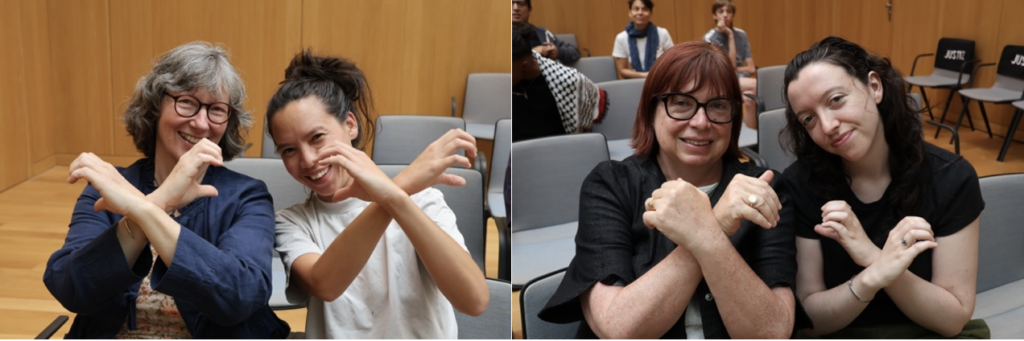
    Pictures taken by Hebh Jamal on July 3rd, showing on the left Nicky Robertson, mother of Zo, and Insa Lee Koch (author). On the right, Mimi Tatlow-Golden, mother of Daniel, and Clara Tatlow-Devally, sister of Daniel.

    It’s nearly 10 am by the time the trial commences. As the defendants are brought in, the public calls out “free, free Ulm5”. There are smiles, gestures of broken hearts and waves. The morning starts again with applications: first Leandra’s lawyer Mathes Breuer and Daniel’s lawyer Benjamin Düsberg on the seating arrangements and the defendants’ separation from the lawyers. Nina Onèr, Zo’s lawyer, asks once more for the public to be allowed to bring writing implements into the courtroom. The judge gives the prosecution until Wednesday next week to respond to the first applications in writing, but the application about writing implements is rejected again.

    The next application, brought by Leandra’s defence team Anna Busl and Mathes Breuer, is for the lead prosecutor, Ronny Stengel, to be recused for bias and lack of objectivity, evidenced – the lawyers argue – in both investigation and trial. The long list of alleged lack of objectivity includes: bias during the investigation, including his immediate ruling out of considering the defendants’ motivations for their actions; insistence they were driven by antisemitism; meetings with the investigation lead Gropp , of which – contrary to legal requirements – no records had been kept; and an alleged failure to ensure a fair trial throughout. The lawyers put it to the court that the prosecutor’s violation of his duty to be objective constitutes an abuse of state power and undermines basic principles of fairness.

    As the lead prosecutor is not present today and cannot respond, his replacement, a Dr. Mark, tells the court he thinks little of the application. He dismisses the defence’s claims of alleged failures to investigate as “wolkig” (“cloudy”), prompting a sharp response from defence counsel. A defence lawyer describes the prosecution’s conduct as “völlige Inkompetenz”(“utter incompetence”), prompting the judge to reprimand counsel for their choice of words. Once again, the judge grants the prosecution until the following Wednesday to respond in writing to this application.

    The remainder of the day is taken up by the second witness, a police officer called Kai Dominik Niewald from Ulm. He coordinated the police response and arrest of the Ulm5 on the night. Dressed in a t-shirt and jeans, the informality appears at odds with his role in this trial. Initially led by the judge, Niewald describes his recollections: being called to the scene, entering the building, making his way to the room , and conducting the arrests. At first he describes on-site security claiming they had seen an axe. Here Daniel seeks to contact his lawyer, who calls for a break; later, on cross-examination, Niewald agrees no axe was found anywhere in the building or in the surroundings.

    During cross-examination, some of the questioning centres on a “white powder” Niewald says was found in a backpack that police officers brought out of the room after the defendants were escorted out. He initially suspected the powder, tightly packed and sealed in a plastic bag approximately 10×3 cm, was an explosive. He tells the court he changed his mind having seen a smile on Vi’s face. Vi looks confused and tries to speak to her lawyers. After a break, Vi’s defence lawyer Matthias Schuster cross-examines Niewald. Why did he not take steps to secure this alleged explosive? Niewald has no answer other than the implication that he trusted Vi’s response. This rather undermines the image the prosecution and court have tried to build of dangerous criminals that present a risk to the court and the public.

    Those in the public gallery appear confused by the discussion of the white powder. I also watch Vi and Zo glance at each other and laugh in what looks to one of the mothers like “disbelief”  when the powder is first mentioned. When Niewald says he changed his mind about what it was because of Vi’s smile, the defendants laugh, joined this time by members of the public. “Why would he believe someone he has just arrested?” the person sitting next to me whispers. Later in the cross-examination, it emerges that Niewald was told by his colleagues that the powder was a class-A drug. When it finally becomes evident it was not a drug at all, this is a surprise to Niewald. Once again, there is an audible drawing of breath from the public gallery.

    The exchange leaves observers with many unanswered questions. Why did a police officer, suspecting an explosive, place the substance in a police car, without taking further precautions? Why would the police tell each other something was a class-A drug when it was not? Why was the substance not on the indictments? Why, as emerged during defence questioning, was it not mentioned in the subsequent seizure report(Sicherstellungsprotokoll), and only appears to have been added later to the file? As it was not an explosive or a drug, what was it? Washing powder? Sugar? By the end of the hearing, many questions remain unanswered.

    Another notable moment in the defence’s cross-examination was when a lawyer for Leandra, Anna Busl, asked Niewald if he had been in contact with Gropp, the investigation lead. Earlier, Niewald had said his involvement in the case had ended on the day of the event and had no contact with Gropp since last September. Yet now he stated he had spoken with Gropp about two weeks ago. What had they spoken about? He refused to answer this as it was an internal work-related conversation (“innerdienstliches Gespräch”). This led to another application from the defence: the witness should give evidence on this pre-trial discussion with the lead case investigator. The judge rejected this, so the defence sought a formal judicial decision, arguing that while exemptions for police witness evidence cover investigatory tactics, a conversation between police witnesses shortly before a court appearance (after an investigation had been finalised many months earlier) falls outside such exemptions. The judge put the decision back to the next court date, 22 July.

    For me, what stands out is how the emerging narrative contrasts with the court’s portrayal of the Ulm5 as a security threat: the evident calmness, care and ordinary human conduct of five people who, on the night they broke into Elbit Systems in Ulm, were unarmed, did not pose a threat to the police, and co-operated from the moment of arrest (Vi even offered to translate for the others). On the police’s own admission, there was no danger to personal safety from the defendants. Leandra’s lawyer Mathes Breuer had asked Niewald whether he would describe the atmosphere in the room as playful (“spielerisch”). He answers no. Breuer asks the court to show footage from the police bodycam, and we hear Niewald observe, shortly before breaking into the room, that “the persons are sitting in the middle of the room and playing together or something” (“Derzeit sitzen die Personen in der Mitte im Raum und spielen miteinander oder so”).

    This image of relaxed calm and cognizance is reflected in how the defendants  watch the witness give evidence from behind their glass partition– heads high, alert, smiling. Throughout the day I see them engage in small acts of care: sharing moments of humour or reassurance; passing a pack of mints, hands briefly touching; at times talking quietly to the person next to them. When the court breaks, with the next hearing date over two weeks away, the Ulm5 quickly hug before officers step forward to handcuff them and take them out again. Nicky, Mimi and the public stand up one last time, clapping and cheering before making their way home – to catch trains or planes to elsewhere in Germany, the UK, Ireland, and beyond.

    The trial continues on July 22nd.

  • The Ulm5 Trial: Hostility towards life

    The Ulm5 Trial: Hostility towards life

    Human faces in the prison system; video: Ignacio Rosaslanda

    (For my previous report covering the Ulm5 trial up to May 22, see here.)

    Unfortunately, there is still no regular media coverage of what is unfolding in the Stammheim courthouse— —a trial that resembles a chamber theatre more than a show trial. The trial, which is scheduled for a few days a week at most and thus is stretched out artificially over 8.5 months, has been reported on only very sporadically in the mainstream media, with coverage limited to brief snapshots. The critical and solidarity-driven scholarship featured here on this platform cannot truly compensate for this media failure. In my view it should, rather than providing updates, be developing research and ideas for contextualizing and gaining a deeper understanding of both the trial and the real events that the trial seeks to obscure and punish.

    In that context, here are just a few key points based on what I’ve been able to gather from observers about the progress of the trial —without guaranteed accuracy:

    • The proceedings continue to move at a snail’s pace. Court days often last only a few hours. Much of this time is spent on motions filed by the attorneys—which are rejected by the presiding judge—as well as on long recesses. Members of the audience have started working on an “Ulm5 Bingo” game, but – due to the judge’s most frequent utterances – have barely gotten past the two terms “motion denied” and “recess.”
    • The fundamental violations of rights by the court have still not been remedied: The attorneys are fighting for the defendants’ right not to be forced to sit in the glass cage and to be able to communicate with their attorneys without a microphone, as well as for the right to a trial that is genuinely open to the public. As noted previously, only the few press representatives are allowed to bring writing implements into the court. The absurd reason given is that pens could be used as weapons to stab and slash others; even wax crayons and bendable children’s pencils remain banned. The defense attorneys must repeatedly file motions—even if they have no chance of success—so that they cannot later be accused of having acquiesced to the court’s rules.
    • Then there are multiple motions for recusal, for which the presiding judge constantly creates new reasons. The most recent example, from a few days ago, was the “sergeant-major” episode; —the audience could remember this exchange even without recourse to pen and paper: The presiding judge ordered, “Quiet at the back!”; Attorney Schuster replied, “Excuse me, but this is a courtroom, not a barracks parade ground, and you are not a sergeant-major!” Presiding Judge: “Yes, I am!” Attorney Schuster then complained about the judge’s “insolent tone” and filed a motion for recusal . At the request of the defence, the presiding judge dictated the minutes.
    •  
    • The next day, it turned out that the defendants were not informed—as was their right—of the outcome of this motion, namely that it had been rejected. So more motions followed. It also turned out that the wording reported by the judge as well as the prosecutor did not match what everyone present had heard. There is suspicion that the presiding judge altered the transcript retroactively and is lying. So, yet another motion for recusal.
    • On the eighth day of the trial, when the heat wave was at its worst, the defendants were permitted to drink water. Previous motions to be allowed to drink water had been denied.
    • At least there was one moment when the court was confronted with reality: Attorney Nina Onèr succeeded in her motion to present a recently published report—“What the Wounds Are Telling Us” by the Dutch newspaper *de Volkskrant*, which won the 2026 European Press Prize—which, based on hundreds of photos, videos, X-rays, diary entries, and interviews with doctors and nurses in Gaza, horrifically documents that children—including very young children—are being deliberately murdered in large numbers and are dying under the most appalling circumstances. (The Ulm5 had spray-painted “Babykiller Israel” on the wall, referring, they and their defence lawyers said in court, to a contemporary reality that had nothing to do with the antisemitic medieval blood libel legend.) As the language of the court is German, the English translators had to translate this text on the spot. Both struggled with this text; the second is reported by those attending to have struggled to keep her voice from breaking. Once again, the defense attorneys managed—as it were, through the back door—to present arguments or materials that, contrary to the prosecution’s narrative, hinted at the defendants’ true motivation.
    • The presentation of evidence in this trial has begun at last, however, it did not begin with the presentation of evidence from the ground up, but—as was feared—with its manipulation. A video was shown that the police had compiled from footage that Ulm5 had filmed themselves. The police video, the court was later to hear from one of the defendants, omitted segments that would show that the defendants were NOT violent offenders or terrorist-minded extremists, but rather went to great lengths to ensure that no people—and indeed no living beings at all—would come to harm. One of the defendants, Crow, was able to point this out, though it appeared that the presiding judge did not take note of the criticism regarding the video’s editing.
    • Another defendant, Vi, said that their motivation should be clear, and that it should also be clear that pretrial detention was not justified. Zo also spoke up and made a statement about the relationship between “force” and “violence,” which the translation failed spectacularly to convey accurately, to the consternation of those in the public gallery who could hear Zo’s original in English from within the glass cage.
    • Originally, the testimony of the lead police investigator—who wrote the 200-page report on which the indictment is based—was supposed to have been heard on June 29. The defense attorneys filed an objection to his being called as a witness, arguing that he was actually part of the prosecution team. This was used as a pretext for the presiding judge to end the trial day early—although the actual reason can be suspected relates to the embarrassing situation created by the “sergeant-major” episode.  

    When reflecting more fundamentally on this trial, two themes occupy my thoughts :

    First, the significance of life/vitality as a form of resistance, and the diverse strategies of repression aimed at extinguishing that vitality. I am moved by a short video clip showing the arrival of the prisoner transport van—which brought Daniel from Ulm Prison to Stammheim—at the entrance to the Stammheim courthouse. The van stops at the gate for a few seconds. Behind the barred side window in the dark interior, you can see Daniel smiling and forming a heart with their hands. That cheerful, free smile so characteristic of Daniel—a human face! Then its rear window comes into view. On it, the faces of three young people in uniform advertise job openings in the justice system. The contrast between the generic human faces on the rear window and the living human face behind bars is almost unbearable. “Free Daniel” in its dual meaning: freedom for Daniel, and the Daniel who despite all remains free, in captivity. Daniel told the magazine Freitag about the lack of stimulation and the boredom in prison: yard time is only between 8:30 and 9:30, offering a chance to talk with fellow inmates, but there are no trees, no bushes, no nature. “I’m allowed to walk around in a concrete yard—there’s no greenery here.” You’re not even allowed to send the defendant a dried petal: indeed, smuggling a plant into this prison would be an act of resistance.

    The ritualized sequence of the trial also strikes me in this light. It is intended to establish legal certainty and predictability. Yet the alienation it creates—of which the lawyers’ war of interpretations is merely one manifestation— also serves another purpose: namely suck vitality and freedom out of those present. In this sterile, oppositional atmosphere, where obedience or defiance seem to be the only available attitudes, an open smile, a heartfelt word, and—in general—honest, unguarded, human, and lively behaviour—which is actually necessary for finding the truth—are made as difficult as possible. That is also why the public gallery claps and cheers when the defendants enter the courtroom, and why, despite the judge’s orders,  some can’t help but react with noise when one of the attorneys says something incisive and true. This is also why it is so moving to see how the defendants communicate with one another nonverbally, behind their glass partition, and show concern for one another.

    The second theme is the comparison with the Baader-Meinhof gang (RAF), which is constantly being thrust upon us—even by those who are actually critical of the German state’s „Staatsräson“. The only point of comparison I accept is that the Ulm5 trial is also of great historical and public significance and should therefore be documented, just as the RAF trial was, with verbatim transcripts and video/audio recordings. And yes, of course there were also young, vibrant people among the Baader-Meinhof members who found the injustices and genocides of their time morally and politically too unbearable to remain idle. And yes, of course, the state resorts to potentially any means in its fight against everything it perceives as hostile. But otherwise, the comparison falls short. It only serves to justify repression, even when it purports to criticize it.

    Unlike the Baader-Meinhof gang, the Ulm5 have clarified their stance on violence. As Crow explained, it was of the utmost importance to the five that no one come to harm. To see themselves as an “Army Faction” of whatever sort, to collect weapons, to kidnap, injure, or kill people, would be completely incompatible with their fundamental motivation. But, Zo noted, even the dichotomy of “violence against property versus violence against people” no longer holds when the very foundations of life are being systematically destroyed and life itself is very real threatened with annihilation. The Ulm5’s action was not directed against people, nor against department stores, police stations, cars, the Springer skyscraper, or the like, but solely against weapons production in the midst of an ongoing genocide. In Gaza, not only are children being slowly and cruelly murdered, but large parts of Gaza have been transformed into death zones where not even a blade of grass grows anymore. Damaging the instruments of death used for this purpose constitutes as much—or as little—“violence against property” as rendering a murder weapon harmless. That is why the lawyers are arguing for the motivation having been on the grounds of a state of emergency and emergency assistance.

    If one takes resistance against the destruction of the foundations of life as the criterion, the comparison now is not with the Baader-Meinhof gang (RAF), but rather with the Last Generation. Imagine that—and this is very likely—temperatures in our sealed-off city centers will soon exceed 40 degrees for long periods of time: there is only concrete, no trees, no shrubs—“there is no greenery here.” Would tearing up these sealed surfaces then still count as “property damage,” or rather would it constitute a constructive act that benefits plants, animals, and people—and indeed also property, created by and for people? We face the threat of ever-larger zones where life has been destroyed and life has become nearly impossible. Gaza stands as a horror scenario that is becoming a reality wherever racialized populations, in particular, are deemed entirely superfluous and troublesome; and that is what drives young people to take action, such as the break-in at Elbit.

  • Report on the Stammheim trial against Ulm5 (until May 22)

    Report on the Stammheim trial against Ulm5 (until May 22)

    The Ulm5 behind the glass wall at the Stammheim trial, May 29th; photo: Ignacio Rosaslanda

    What did the Ulm5—five young people living in Berlin with Irish, British, Spanish, and German citizenship—do? In the early morning of September 8, 2025, while the war in Gaza was still raging, they broke into a building belonging to the Israeli arms manufacturer Elbit Systems Germany in Ulm, damaged computers and other equipment, toilets, windows, and measuring devices, and spray-painted slogans on the walls (the Attorney General’s Office considers “baby killers” in particular to be anti-Semitic). According to the prosecutor’s office, several others who are being sought had also sprayed slogans and possibly red triangles outside and then fled.  The Ulm5 filmed themselves during their break-in and vandalism and then waited to be arrested. Beforehand, each of them had delivered a short speech to camera, justifying their actions as resistance against the ongoing genocide and again using some of the slogans that the prosecutor’s office considers to be incriminating. Other unknown individuals edited the videos and uploaded them to social media after the incident. Some of the group’s statements and actions link them to “Palestine Action,” a Palestine-solidarity sabotage network previously active in the UK.

    (I happen to know two of the individuals involved in the act: one—Daniel, an Irish citizen—since they were a small child; our families have been friends for three generations; the other—Zo—only very briefly, as a student at Bard College Berlin. They’re both gorgeous!)

    From the very beginning, it was clear that the judicial system in Baden-Württemberg would treat the Ulm5 as enemies of the state. Strange incidents occurred—a few of which cannot be made public while the trial is ongoing—along with all manner of harassment. For 30 hours, while they were held at the police station in Ulm, they were denied contact with lawyers. Zo sat in their cell for six hours having been forced to undress completely and given only an adult diaper to wear. Daniel sat in their cell for much of the 30 hours, they later wrote to their girlfriend in a letter, without clothes, naked except for underwear. It wasn’t until two weeks later that Daniel‘s court-appointed attorney was given an appointment to speak with Daniel in Ulm prison. For a month, Daniel‘s family was not allowed to contact them, and even Irish consular staff were not allowed to visit.

    Instead of suspending pretrial detention on bail, as is customary when there is no risk of flight, it is being extended further and further, with the trial not beginning until seven months later and the trial dates stretched out as much as possible. At the moment, the court plans to reach a verdict only in January 2027, that is, after 16 months of pretrial detention.

    Pretrial detention at the Ulm Am Frauengraben Correctional Facility is very harsh: except for one hour of yard time early in the morning every day, sometimes one hour of access to a gym once a week, and a half-hour of visiting time every two weeks, he is in solitary confinement with no access to the outside world except for a television. Letters take weeks and sometimes up to 5 months to arrive. Only after six months, after multiple appeals, was a court order issued granting Daniel the right to purchase fiction books. When Daniel‘s family was finally allowed to visit, they sat separated from them in a glass enclosure and could communicate with them only faintly through small drilled holes; physical contact was not permitted. It was only when Irish members of parliament went to the German ambassador in Ireland and lodged a complaint that this unlawful practice was discontinued after five months.

    Because of these harassments alone, the defense attorneys were embroiled in a battle with the court from the very beginning. At the latest when the Stuttgart Higher Regional Court, in upholding the decision in February that the suspects must remain in pretrial detention, were antisemites with „high criminal energy“, and stating that they faced long prison sentences (all this without hearing evidence from the defence), it became clear that the judiciary was biased and not interested in a fair trial.

    There are several peculiarities of the German court system that have a structurally negative impact in a political trial such as this: 1) Unlike Anglo-Saxon legal systems, German procedural law does not provide for a jury, but rather, in addition to the three professional judges, only two lay judges, who, while formally equal to the professional judges, generally do not develop their own corrective dynamic because they are in the minority; 2) Prosecutors are subordinate to the Ministry of Justice and are bound by instructions; they are part of the executive branch. While judges are independent and not bound by instructions, they are structurally close to the prosecutors: As judicial officials, both share a common career path, a common employer, common associations, common institutional interests, common conferences, cafeterias, social networks, and a similar self-image. Prosecutors, too, are bound by a duty of “objectivity” and are supposed to investigate not only incriminating but also exculpatory circumstances. This moderates the prosecution, but conversely, a judge who wants to advance his career or simply keep the peace among his colleagues can hardly afford to alienate the prosecution and, by extension, the government. The prosecution and the court tend to act as a united front, albeit with divided roles. 3) Simply as a counterweight to this, criminal defense attorneys—who are primarily obligated to their clients and work as independent professionals—often hold left-leaning and state-critical views in Germany. 4) My impression: The dominance of state interests and the blurring of roles, combined with certain personal character traits, foster the impression in political trials that members of the judiciary are actually weak, insecure individuals who are not free in their actions and compensate for this with passive-aggressive authoritarian behavior. This, in turn, leads to petty fights in the courtroom with attorneys and the public that actually undermine the dignity of the court. 4) There is no provision for verbatim transcripts to be prepared of the court proceedings in most German trials. One of the three judges takes the minutes, and the presiding judge determines what is noted down and what is not. Lawyers may have something entered into the record, but only after the presiding judge has granted them the floor. In the absence of verbatim transcripts, not to mention audio recordings, lawyers are forced to constantly ensure that what they say is actually recorded. This slows down the proceedings and contributes further to the impression of indignity. 5) Trials must be public, the press must be admitted and allowed to take notes. However, members of the public not accredited as press may be barred from bringing writing materials under courtroom regulations. From my experience at the Berlin-Tiergarten District Court, paper and a (often poor-quality) pen are at least provided in such cases. At the Stammheim Regional Court, however, you receive neither pen nor paper and must rely on mnemonic techniques to remember what happens throughout the long day. Visitors are searched before entering, sometimes roughly and with force in intimate areas, even after surrendering all personal items including belts and going through a metal detector. The public nature of the trial is undermined by the ridiculous insinuation that the audience could use a pen or paper to attack “participants in the proceedings”—a scenario in which, at Stammheim, behind a bulletproof glass wall, the audience would have to attack either each other or the court officers standing around in combat gear: stab vests, padded clothes, reinforced leather gloves, armed and carrying handcuffs. 6) And as is likely the case everywhere in the world, the architecture of the court itself expresses mistrust toward the audience. In Stammheim, the bulletproof glass walls separate not only the defendants but also the audience from the courtroom.

    The Ulm5 trial involves a host of other issues that are actually uncommon in German legal proceedings. From the very beginning, the court has been completely unresponsive to the defense attorneys; Presiding Judge Kathrin Lauchstädt subjects them, the defendants, and the public to harassment that seems as arbitrary as it is unnecessary. All attempts by the defense attorneys to engage in dialogue with her in the run-up to the trial failed. She refused to accept phone calls or emails from the defense (only snail mail), while—as the attorneys have since discovered—communication with Attorney General Ronny Stengel took place via email. On the first day of the trial, she did not allow the defense to speak at all, without giving any reasons for doing so. There is no judicial decision or justification for the discriminatory seating arrangement, and the judge has provided no schedule for the trial days, despite repeated requests from the defense. The 16 trial days initially announced were arbitrarily extended last week by another 28 days, stretching into January. Not only does this prolong the defendants’ pretrial detention, it also makes it virtually impossible for the lawyers to continue running their law firms in Berlin, Munich, Nuremberg… The experts to be appointed do not know when they are supposed to appear in court and cannot plan accordingly. Since the defendants filmed their own actions and the facts are clear, one wonders what is actually supposed to happen during these 44 days. Perhaps this is an empty threat. But perhaps the court also intends to carry out this strategy of attrition in earnest. Although the trial days officially begin at 9 a.m. and the public must arrive as early as 8 a.m. for security checks and searches, the proceedings do not actually begin until around 10:30 a.m.; lunch breaks of two hours or more are scheduled, and the presiding judge uses every pretext to interrupt the proceedings or even adjourn them for the day entirely. Indeed, after 4 sitting trial dates so far, only about 8 hours of actual court proceedings have been undertaken.

    On the first two days of the trial (which I did not attend), the court got no further than establishing the defendants’ identities. When proceedings did take place at all, they always concerned the attorneys’ motions to be allowed to file motions before the indictment was read, in order to clarify issues that had not been resolved before the trial began due to the presiding judge’s refusal to engage. The lawyers want 1) to ensure that the defendants are allowed to sit next to them, as is customary, because only then is confidential communication possible. This is in line with multiple European Court of Human Rights rulings. The arrangement of having the defendants behind a glass partition, where they are supposed to follow the proceedings and translations as well as communicate with their lawyers via microphones and headphones, significantly curtails their right to legal counsel and violates Article 6 of the European Convention on Human Rights, the right to a fair trial. This has been repeatedly refused by the judge. 2) The attorneys seek to ensure that they may bring a law clerk to prepare verbatim transcripts, or alternatively, to permit audio recordings. This has also been refused repeatedly by the judge – contrary to custom. Indeed the prosecutor, invited by the judge to take a view on this, remarked that it was not necessary as this case was neither of contemporary nor of historical significance. 3) Due to the apparent prejudgment evident in the court’s refusal to allow the defence to speak at all on the first day of proceedings; the court’s highly prejudicial media statements likening the Ulm 5 to multiple murderers, terrorist coup plotters and rival gang warfare participants; and other matters, the attorneys have filed a motion for recusal against the presiding judge.

    The first day of the trial ended dramatically: After one of many arbitrary recesses, the lawyers protested the seating arrangement by moving en masse behind the bulletproof glass in their robes, with their laptops, ready to work and reading to wait for their clients there and stand beside them. They basically occupied the glass box. Like an overwhelmed elementary school teacher, the presiding judge ordered them to take their seats within five minutes. When the lawyers refused to comply, the judge adjourned the hearing, sent everyone home, canceled the hearing days scheduled for the following week as a collective punishment, and extended the trial into January. It wasn’t until May 20, after a two-week break, that proceedings resumed.

    In the following, I describe what I saw and experienced on the third and fourth days of the trial, the days on which I was present myself:

    Report from Wednesday, May 20, the third day of the trial:

    On the way from the subway’s last stop to the prison and courthouse, we run into the other mothers (Vi’s, Crow/Walter’s, and Zo’s). For me, these mothers are and remain the most striking figures of the entire process. They greet each other affectionately. At home, some of them cry their eyes out, but when they talk to each other, they laugh at the absurdities. They laugh at how the court asked the defendents for their current addresses of the respective detention centers. They laugh at Vi’s answer in German to the question about her marital status: “leeedig” („ledig“ is a German bureaucratic word for not married). “Either you’re married or you’re a ‘spinster’”. The laughter helps a lot, and if I had to choose between the fate of the mothers or the sad existence of the presiding judge, I would always choose the fate of the mother. When we arrive in front oft he court house, the activists treat them with touching courtesy, they always let them go to the very front of the lines.

    The mothers are all in their mid-50s to early 60s and were, until recently, by no means „radical“. For some time, the families weren’t sure if the lawyers’ conflict strategy was the right one. But the unjust and harsh treatment of their children from day one, the many acts of harassment, the absurd accusations of anti-Semitism, and the countless experiences of being at the mercy of a state power that is blind to reality, self-contradictory, and inhumane have driven them completely to the side of the activists in solidarity with Palestine. Not only in court, but also before every prison visit, they are searched and frisked and, depending on the facility, might not be allowed to bring in either paper or pens. Before her prison visits, Daniel’s mother tries to write the most urgent things she wants to tell Daniel in the scant half-hour visit on the back of her hand. “Does the German state realize how they are radicalizing women over 60 whose skin is too wrinkled to write prison notes on their hands?”

    You can see Stammheim Prison from a distance. The courthouse is right next to it. It was rebuilt in 2023 in a corporate-chic style. The interior of the building was compared to a “wellness oasis” in an architecture magazine; Daniel’s stepfather jokes that he will only give it two stars on TripAdvisor. “The Stuttgart hospitality thing—measured cordiality.”

    The numerous court officers in the gallery are dressed in riot gear and ready to interpret their powers broadly and arbitrarily. While we wait for the trial to begin, a row of seats reserved for the press is opened up to the public. The mothers want to move to the front so they can see their children better behind the glass partition. They are denied this for no reason: “I have my instructions,” says the court officer. “Just following orders,” say the mothers; this excuse sounds familiar in Germany. The activists hunch in their seats so the mothers can still have a somewhat clear view. 

    After a delay of over an hour and a half, the defendants are finally brought in, and at first it is a shock. Vi is wheeled in on a chair, handcuffed, by several officers. She has lost over ten kilos in detention in Schwäbisch-Gmünd, where there is apparently not enough to eat; they say it is cold and dirty within the old walls of a former monastery. She really looks terrible. Has something happened? Can she no longer walk? Her friends from her hometown of Offenbach, who have traveled here for the day, are fighting back tears. But when the others, too, are not walking on their own but are carried in by four police officers each, it becomes clear to that this is a protest: Unlike the RAF defendants, who withdrew from the trial by going on a hunger strike, the defendants do want to participate in the trial, but with this action they are demonstrating that they do not accept the glass partition, being handcuffed and separated from their lawyers.

    This is not the only difference to the RAF trial that comes to mind: The RAF defendants had killed people, whereas the Ulm5 defendants have only damaged property and harmed no living being. The RAF defendants refused to participate in the trial by going on a hunger strike. The Ulm5 defendants want the trial to proceed but insist on their rights. The RAF defendants did not claim that their actions were intended to hinder, for example, the Vietnam War or the Shah’s policies in Iran. The Ulm 5 wanted to hinder the genocide in Gaza and Germany’s support for it, at least temporarily. Today, the state is attempting to exploit the symbolism of the RAF trial. A dynamic of radicalization happens today as it happened then. However, the defendants and the defense are doing everything in their power today to counter dehumanization and the violation of life, and to insist on the rule of law.

    As the defendants are escorted to their seats, the audience greets them with a standing ovation and sustained applause. Today, however, unlike on previous trial days, there are no cheers and no singing. One of the mothers had asked the activists waiting outside the entrance to refrain from cheering and singing so as not to provide further pretexts for interruptions, but she told them to clap as they entered. We know how important this encouragement and support from the audience is for the defendants.

    The first few hours of the trial, which has finally begun, are consumed by the complicated legal maneuvering surrounding the motions with which the attorneys have already spent the first two days attempting to assert their clients’ rights: these include the stigmatizing nature of the proceedings, the restrictions on communication and public access, the recording of proceedings, and—since these motions are constantly being denied without justification—the court’s bias. In addition, the lawyers are trying to secure permission to show an eight-minute film as part of their opening statements—using the courtroom’s equipment or on a screen they have brought with them. Presumably, it is a film showing the war crimes committed in Gaza using Elbit’s weapons systems. The court is determined not to allow this under any circumstances.

    The contrast in demeanor and bearing between the court and the lawyers is striking. The presiding judge embodies, in a jarring way, the archetype of the timid bureaucrat. One cannot help but feel that she is not making decisions freely, but is somehow receiving instructions from above—or is, in some incomprehensible way, biased and incompetent. The lawyers—a total of 11 court-appointed and private defense attorneys, of whom 7 or 8 are present—are all quite young. While there may have been  disagreement about the trial strategy during the preparation phase, the court, with its obstructions and incompetence, has achieved the opposite of what it intended. The lawyers are not intimidated, but appear determined and completely united. 

    The Attorney General seems even more intransigent than the judge, less insecure, contemptuous; he speaks little, and when he does, he makes himself as incomprehensible as possible. He clearly has a problem with the lawyers’ media relations. Time and again, he mentions media coverage, “international and domestic,” as if it were something objectionable for which the lawyers were responsible. At one point, he warns that he will not let it pass if, as he fears, the lawyers’ opening statements were to “depart from the foundations of the Basic Law.” He apparently confuses German national interest/the „Staatsräson“ with the Basic Law. He laughs when the lawyers later speak about the war crimes in Gaza. For his part, he contributes to delaying the trial by usually not responding to the lawyers’ motions, or responding only briefly, and reserving the right to submit written statements, for which the presiding judge has given him until the middle of next week.

    In the end, the presiding judge must hear one final motion before the indictment is read: a defense attorney requests that the public be excluded during the reading of those sections of the indictment that deal with the alleged “anti-Semitism” of the crime. She argues that her client’s safety at Stammheim Prison is at risk, as right-wing ideology is circulating there; a prison chaplain had approached them and unsolicitedly given them a book on anti-Semitism. Since someone from the BILD newspaper is also sitting in the audience and it is actually surprising that there hasn’t yet been a full-scale smear campaign against Ulm5, the lawyers, and the family members, there may be some truth to the fear. But my impression is that the motion primarily gives the defense attorney the opportunity to explain, even before the indictment can be read, that her client’s actions were not directed against Jews, nor even against the State of Israel, but exclusively against the leadership of Elbit Systems, its weapons production, its involvement in the genocide in Gaza, and German support for it. The many other motions, which may seem confusing to the public, also allow the defense—regardless of whether they are rejected or not even admitted—to present the defendants’ motives before the prosecutor can shape the narrative by reading the indictment.

    The indictment focuses primarily on “Palestine Action Germany,” as an alleged part of “Palestine Action Global,” which is said to have emerged from “Palestine Action UK,” and attempts to prove that these networks constitute organized “crime” and a “criminal organization” into which the defendants’ act was “integrated.” The preparations for the act, and above all the red Palestine Action overalls that the Ulm5 would have worn had the postal mail delivered them in time, serve as evidence of “membership”.  But since the act was a one-time occurrence, and apart from this single act, an organization named “Palestine Action Germany” has not had an appearance anywhere else to date, and above all, since trespassing and property damage alone do not constitute serious crimes, the justifications for assuming the existence of a criminal organization do not really hold up. Apparently, this is why the Attorney General needs the astronomical figure of over one million euros in damages, for which he provides no evidence whatsoever. He also needs the accusation of anti-Semitism to make the act appear particularly reprehensible. The slogans and the mere fact that Elbit Systems is an Israeli company are supposed to substantiate the accusation of anti-Semitism. To insinuate that the defendants support Hamas, the red triangle and FTRTTS are used as evidence.

    After the long, imposed lunch break, when most of the press had gone home, the lawyers were finally able to deliver their opening statements. They have obviously decided not to address the charges brought by the State Attorney General’s Office at all. Their defense is not a defense, but rather a full-scale offensive. Two lawyers begin with presentations on the history of the RAF trials and the symbolism of Stammheim, and they explain the defendants’ one-time, symbolic refusal to enter the glass box. One lawyer, who had intended to show the eight-minute video featuring footage from Gaza, states for the record that he was denied the opportunity to present his case and has nothing further to say. One lawyer draws a parallel to the members of the climate activist group Last Generation, who caused millions in damage and yet were not taken into pretrial detention. Daniel’s lawyer, Benjamin Düsberg—who is simply excellent at rhetoric—presents on the war in Gaza and how, above all, children were killed, starved, and injured, deliberately and systematically; he speaks in detail about the types of weapons produced by Elbit Systems, how they are used for genocidal warfare, how Germany supports this weapons production; what international law prescribes and how international law relates to German law. “No one who has even a shred of heart and reason left can turn a blind eye to this.” As he speaks, two of the defendants are crying. I no longer remember where Düsberg stopped and the lawyer Breuer took over, or who read the quote from Fritz Bauer: the defendants’ actions—trespassing and property damage—were not merely excusable, were not merely justifiable as self-defense; they were resistance, necessary resistance against an ongoing genocide, “the least they could do,” after all other means of persuading Germany to cease its complicity in the crimes had failed. The lawyers concluded that the criminals were sitting on the other side; Elbit and Germany should be the ones on trial, whereas the defendants had drawn the only correct conclusion from the lessons of National Socialism and the Holocaust: “Never again!”

    The presiding judge seemed to be listening, at least. The prosecutor, on the other hand, made dismissive hand gestures and even laughed once. When asked if he wished to respond, he sneered that he had nothing to “replicate,” since nothing relevant to the trial had been presented.

    Outside, we meet the lawyers. They are confident. The presiding judge is making one mistake after another. Indeed: her weakness and lack of composure are glaringly obvious. Nevertheless, that very evening, the information screen in the subway displays a version of the story that blames the “chaotic day of proceedings” on the defendants who allowed themselves to be dragged in, and on the lawyers with their motions. This is the epistemic violence that Mimi had said was almost harder to bear than the physical violence of imprisonment and deprivation of liberty: “It’s unbelievable when you experience this live, and then have to hear and read what the state and the media have to say about it—and that’s something completely different.” When you’re being fed a pack of lies; when you’re forced to accept a false, constructed parallel reality instead of the reality perceptible to your own senses.

    Report from Friday, May 22, 2026, the fourth day of the trial

    It is the day on which the defendants’ statements are finally expected. As we wait in the morning sun in front of the supporter camp, Greta Thunberg comes around the corner, with her heavy backpack, accompanied by Judith Scheytt and Hebh Jamal, just like the rest of us from the subway; completely unassuming and without any fuss being made about her arrival.

    Yesterday, Roser, the most active activist, visited another trial that is currently taking place on alternate days in the very same courtroom in Stammheim out of curiosity—one that involved a person charged with membership in a terrorist (!) organization. She reports: This defendant had not been in pretrial detention at all, but had arrived by taxi. He was treated politely and courteously by the court and was informed of his rights; a “normal” trial, which once again shows just how abnormal the Ulm5 trial is. At the entrance in front of the courthouse there is a notice box that shows all the upcoming trials, with hearing dates—for the public, one would think. When I take a photo of them, a police officer approaches and aggressively orders me to stop.

    Security checks: At the entrance, the punk-style policewoman who is nice and discreet and already knows me takes over the pat-down in the booth again. But others end up with a policewoman who is a sadist. Mimi after the afternoon check: “She stuck her hands up inside my bra, pushed the underwire up hard—very painful—and felt my breasts. Like both palms on the whole of both my breasts, I consider it a sexual assault.” In response to her loud complaint: “Hey, what are you doing? That’s not normal,” she replied: “That’s how I always do it,” but at least refrained from reaching into her pants between her legs, as she did with Greta, the other mothers, and four journalists. This happened to every woman as far as we know who was sent to this woman including the very experienced trial observer representatives from the Basic Rights Committee NGO, who have filed a formal complaint already. The lawyers will file a formal complaint about sexual abuse.

     In the courtroom, the slips of paper for the “press” are no longer on the chairs but are laminated and glued to the backs of the chairs in the first two rows. No one is supposed to get the idea to use the slips of paper for writing anymore. It is details like these that make one particularly feel the court’s meanness.

    The defendants are led to their seats behind the glass partition, on foot today. Vi looks much better; in fact, the defendants are in high spirits. Mimi and Jem were able to visit the day before; he’s doing well, despite the terrible prison conditions and even though a fellow inmate he’d befriended during the morning yard walks has disappeared. When the sun creeps over the prison walls, they stand on their tiptoes to feel a few rays on their faces. Daniel does hundreds of push-ups in his cell every day and looks stronger than ever. It seems they won’t succeed in breaking the defendants and their families.

    Now the lawyers are raising the motions that had previously been denied: Regarding the seating arrangement, they have discovered that the presiding judge lied: Stammheim was designated as the courtroom from the very beginning; no other venues were even considered, even though there were 14 or 15 other courtrooms in the region. The fact that no eye contact with the clients is possible, and above all that they cannot simultaneously follow the proceedings and communicate with their lawyers, constitutes a violation of their rights that they will not accept. In response, for the first and only time so far, the young prosecutor sitting next to the Attorney General speaks up and asks—perhaps ironically, since it is quite cramped at the lawyers’ tables—where exactly the defense thinks the defendants should sit? This is a perfect setup: The lawyers laugh, one (Anna Busl) speaks up and thanks her for the question: Where the prosecution is sitting right now—that is the right place for her clients! Because in fact, they are the real plaintiffs, and the real accused are Elbit Systems and the German state, which supports genocidal warfare. The prosecution could then sit down behind the bulletproof glass and see what the trial looks like from there.

    Regarding the issue of recording, the lawyers cite the RAF trial as a historical counterexample, where the court permitted a court reporter. Above all they point to the obvious practicality. The Attorney General counters for now that the RAF trial had media and historical significance for contemporaries and posterity, whereas he considers this trial as insignificant. (Posterity will see it differently.)

    On the question of pen use in the audience: the attorneys point out that the pretext that pens could be used as stabbing weapons is absurd. The Attorney General claims that he has reasons to be afraid as he and the judges have been named on Indymedia and threatened “with sanctions.” Defense: they are sorry to hear this, but the audience can’t be blamed for that, and what does it have to do with the pens?

    The motion to make an audio recording of the trial is denied. In most cases, the Attorney General does not present oral arguments but instead refers to written statements, for which the presiding judge sets a deadline for the following week. When the attorneys point out that the motion to at least bring the defendants out of the glass enclosure for their opening statements must be decided immediately due to time constraints, the judge wants to end the day’s proceedings entirely—it is noon, after only an hour and a half of proceedings. Great unrest in the courtroom: are the defendants once again not to be given an opportunity to speak? Several lawyers cite the principle of expeditious proceedings, their clients’ civil liberties, and the fact that the presiding judge herself had referred to the principle of expeditious proceedings on the very first day; they also mention the families who had traveled from abroad to hear their children. The judge has to give in, but orders another two-hour lunch break, probably in the hope that most of the press will no longer be present by then.

    I, too, am prevented by this long lunch break from hearing the statements. But according to reports from others and Mimi’s account, only Daniel managed to speak up, and not the whole of his statement. At first, the presiding judge granted the request to let the prisoners out of the glass box for their statements, but with a “meanness” attached (as one of the lawyers put it): They were to be led to the witness stand in handcuffs. Daniel therefore preferred to deliver the speech behind glass after all, rather than be paraded “like an animal”, according to Düsberg. Daniel spoke in German about his exclusively humanitarian motives for the act: the systematic destruction of the foundations of life in Gaza, the artificial famine, the sexual violence against Palestinian prisoners. The Ulm5 had wanted to “cause a stir,” to at least temporarily interrupt the arms shipments. “Looking the other way is reprehensible, but supplying the equipment for it is even worse.” The accusation of anti-Semitism did not surprise him, but it outraged him: “To label resistance against occupation and mass murder as anti-Semitism is a disgrace.” –

    After this sentence, which landed powerfully in the room, the presiding judge completely lost it: She seized upon a brief and isolated cheer from the audience as a pretext to interrupt Daniel’s statement—not to remove the disruptor from the courtroom, but to have them led through a side door from the gallery into the courtroom itself and to stage a small trial within the trial there: She had the person’s ID card handed to her and began to read out their personal details before everyone. When the lawyers, the defendants, and the audience covered their ears and protested, she must have realized the illegality of her action. She abruptly closed the hearing and went off for the weekend.

    To be continued.

  • James Joyce in Ulm Prison

    James Joyce in Ulm Prison

    James Joyce and Sylvia Beach in front of a wall of books, posters, and pictures that one can dream of in prison. CC0 1.0 Universal, www.archive.org

    James Joyce and Sylvia Beach in front of a wall of books, posters, and pictures that one can dream of in prison. CC0 1.0 Universal, www.archive.org

    Daniel, an Irish citizen, has been in pretrial detention at Ulm Prison, Frauengraben branch, since the beginning of September last year. He is one of the so-called “Ulm 5,” who, according to their lawyers, “ are accused of breaking into the Ulm site of the German branch of Israeli arms manufacturer Elbit Systems on September 8, 2025, and causing property damage there”, with the specific aim of preventing genocide in Gaza. The criminal proceedings, in which the 5 are accused of “membership in a criminal organization, among other things” are political, and have been transferred to the State Security Chamber of the Stuttgart Regional Court. The trial (and thus pretrial detention) is expected to last until the end of July, meaning that Daniel will spend eleven months in solitary confinement: in a single cell, 23 hours a day, with no contact with the outside world except for a television, handwritten letters, and a half-hour visit every two weeks. Furthermore, no books may be sent to Daniel. Nor may books be donated to the prison library, not even via any online retailer. Daniel himself is not allowed to buy fiction or poetry. The prison permits only non-fiction books for study and training purposes, but has declined, despite requests from Daniel’s lawyer, to define these parameters – or even to facilitate ordering such non-fiction books other than the three he has received in 6 months to date. Complaints have been rejected, and appeals to the prison administration have gone unheard. The only way to send Daniel books is in photocopies or print-outs, distributed across letters. He wanted to read Ulysses by James Joyce. The printout from Project Gutenberg weighed 1.3 kg; a letter must not weigh more than 100 grams; that makes 13 letters.

    If the prison administration has its way, Daniel will have to be content with maximum five books per week from the prison library. The prison administration cites “security reasons (possibility of manipulation, introduction of illegal substances such as synthetic cannabinoids, etc.)” that make purchasing or accepting book donations “fundamentally impossible” and considers the inventory of its library to be sufficiently “diverse and appropriate.” If the prisoner considers that the available English-language books are not sufficient, then they believe that defendant ought to content himself with the books in German. (Daniel speaks some German due to his mother’s German family.)

    Daniel’s lawyer filed a court motion “to no longer prohibit him from purchasing the books Lone Wolf by Adam Weymouth, Ulysses by James Joyce, and The Prison Letters by Nelson Mandela, or to no longer refuse him the assistance necessary for their acquisition.” At the end of January, the State Security Chamber of the Stuttgart Regional Court rejected the motion. (File number 18 KLs 36 Js 123125) One might recommend that the State Security Division re-acquaint itself with Kafka (not available in the Ulm prison library), as it wrote in its reasoning: “Access to literature is of such existential importance to interested prisoners that a discretionary refusal of access to a library is hardly conceivable; but how borrowing works is up to the prison, so there is no right to access an open-access library.“ The court echoed the prison’s argument that prisoners buying books themselves, or having them sent to them, isn’t “possible for security reasons” and that it would be unreasonable to expect prison social workers to assist in such matters .

    Daniel has long since finished with the English-language collection available in the prison library. Most of these approximately 70 books were apparently purchased in the early 1970s and mid-1980s: a children’s book about a widowed mouse (1971), a study on the reading skills of people with learning disabilities (1969), a novel about an artist and one about a frustrated career woman, Wild West knockoffs, crime novels, spy novels, love stories, and thrillers from the Cold War, three volumes of Harry Potter, Orwell’s Animal Farm, a volume of Hemingway, Jack Kerouac’s Desolation Angels, The Last of the Mohicans, not by James Fenimore Cooper, but by someone with the name Watson Brown (probably a children’s book adaptation), Kim by Rudyard Kipling, a volume of Mark Twain, the 1974 debut novel by Native American Renaissance author James Welch (interesting!), a history of Germany, two books about the Vietnam War, a humor book, a biography of Reagan, three Bibles. The gem of the collection are Toni Morrison: Beloved, and indeed also Joyce’s A Portrait of the Artist as a Young Man. A volume by Kurt Vonnegut is also listed, but it’s in Serbo-Croat. In addition to the 70 English-language titles, there are over 600 titles in all kinds of other languages, in particular a large collection of Turkish books that were donated at some point.

    So we copy or print out Ulysses, Moby Dick, and other books of world literature, fold up pages, and divide them between small envelopes in the permitted size. Most recently we have even carved up books and sent pages detached from their bindings.

    The German-language collection with which the prison believes Daniel – a philosopher and neuroscientist who works on AI/machine learning projects on ecology, social and colonial justice – should content himself, comprises around 3,000 fiction titles and around 1,300 non-fiction books: general advice books and guidebooks, particularly on personal care and nutrition, Guinness World Records and animal books, encyclopedias, the house book of good manners, popular history, biographies, Deutschland Deine Sachsen (Germany Your Saxons), Erinnerungen eines Frauenarztes (Memoirs of a Gynecologist), a great deal of Christian literature, plus around 50 Korans and Islamic books, which are categorized under the strange heading “state religion,” countless puzzles, board and card games (a cruel irony for someone in solitary), four guitars “from Pastor Mayer,” six Olympia typewriters, and, darkly fitting for prison: Denken Sie sich frei! (Think Yourself Free!) by H.M. Glogger, Slow Down Your Life by Kai Romhardt, and Albert Speer’s Spandau Diaries.

    Of the fiction titles, Daniel’s mother writes that the list, though it may be just right for some people, and that’s fine, makes her “sad,” and this feeling of sadness, also concerning our own reading history, grips us as well. How much rubbish we read in the 1980s! Gwen Bristow, lots of Pearl S. Buck, Felix Dahn: Ein Kampf um Rom (A Battle for Rome), Michael Ende, Ludwig Ganghofer, Gone with the Wind, Don Camillo and Peppone, Arthur Hailey, Daphne du Maurier, endless Karl May. Then all the school reading material by post-war German and Swiss-German men: Grass, Walser, Frisch, Dürrenmatt, Handke, Böll, lots of Siegfried Lenz, and many others whose names are forgotten today; no Uwe Johnson, no Ingeborg Bachmann. The following authors luckily passed us by in our youth: the 18 titles by Ulm local author Manfred Bomm (Notbremse – “Murder on the ICE train on the Ulm-Stuttgart line”), 29 books by Marie Louise Fischer, countless works by Uta Danella, C.C. Bergius, Josef Müller (Das Leben will dir Beine machen! – Life wants to get you going), a good dozen by Willi Heinrich: (Schmetterlinge weinen nicht – Butterflies don’t cry – about the “intoxicating love of an older man for a young girl”), 53 Konsaliks and 30 Simmels. There are, ironically, an awful lot of crime novels. Are John Grisham and Donna Leon must-reads? Manfred Bieler, Michael Crichton, A.J. Cronin, Eva Demski? Hans Herlin sounds quite interesting: Der letzte Frühling in Paris (The Last Spring in Paris) – “Paris 1944: The last spring for German soldiers in Paris. Power is crumbling, the Gestapo and Abwehr are rivals.”

    Of those 3,000 German fiction titles, we can really recommend just under 30 to Daniel: first and foremost, a volume of Brecht poems, whose piercing observations of Germany in the 1930s provide many uncomfortable echoes in the world today. Then there are some classics that our grandparents also read (Ivo Andric: Viziers and Consuls, The Bridge on the Drina, Stories from Bosnia, Lampedusa’s The Leopard, Flaubert’s Madame Bovary, Maupassant’s Bel Ami, Pasternak’s Doctor Zhivago, Annette Droste-Hülshoff’s Selected Stories, Roger du Gard: The Thibaults, selected stories by Stifter, Musil’s The Man Without Qualities, Effi Briest and Stechlin by Fontante, a volume of Tolstoy, two volumes of Dostoevsky, even Anna Seghers’ The Seventh Cross, Hans Fallada’s Little Man, What Now?, Marlen Haushofer’s The Wall, Kempowski’s Dog Days). There is Peter Härtling, Ingo Schulze, Jenny Erpenbeck, and Kruso by Lutz Seiler. We would immediately borrow Elias Canetti’s autobiography, Arthur Koestler’s The Gladiators (“written in 1939 immediately after his break with communism”), Gustav Meyrink’s Der Golem and Walpurgisnacht, and by Fritz Rudolf Fries: Das Luftschiff, as well as by Jurek Becker: Amanda Herzlos.

    But it’s understandable that even this selection is saddening. Having to read the one volume of Susan Sontag in German translation would, we expect, make Daniel even sadder. It’s painful when the state determines what you’re allowed to read, and in which language, whether that’s in a school library or a prison. No one should be allowed to prevent you or your fellow prisoners from buying or receiving donations of Ulysses, Nelson Mandela, Kafka, or even Palestinian literature.

    The legal situation is actually on the side of the prisoners. Prisoners, whether unconvicted of any crime and in pre-trial detention, like Daniel, or serving a sentence, continue to enjoy fundamental and human rights other than the right to personal freedom (of movement). The right to access books is part of freedom of expression and information (Art. 5 (1) GG; Art. 10 (1) ECHR; Art. 19 (2) ICCPR). Prisoners also have a right to education (Art. 2, 1st Additional Protocol to the ECHR; Art. 13 IPWSKR) as a cultural right that is indispensable for human dignity and the free development of personality. In 1989, the Committee of Ministers of the Council of Europe issued recommendations on “Education in Prison” (R (89) 12). According to these recommendations, prisoners’ educational opportunities should be comparable to those in the outside world, the range of learning opportunities should be as wide as possible, and prison administrations should facilitate and support education as much as possible. In 2006, these recommendations were supplemented by the European Prison Rules – also in the form of recommendations from the Committee of Ministers (R (2006) 2). They stipulate that all prisons should have a library for use by all prisoners, which should be adequately equipped with a wide range of leisure and educational resources, books, and other media (Rule 28.5). If possible, the prison library should be organized in cooperation with public libraries. It appears that this may even have been done in Ulm, suggested by the loving little clips describing most of the books in the catalogue.

    In 2015, the United Nations General Assembly adopted minimum standards for the treatment of prisoners, known as the Nelson Mandela Rules (UN GA Res. 45/111). Rule 117 states that prisoners awaiting trial shall be allowed to obtain books, newspapers, and writing materials at their own expense or at the expense of third parties, insofar as this is compatible with the interests of the administration of justice and the security and order of the institution. The fact that the “security” reasons claimed by the prison and echoed by the court are illogical is evidenced by the fact that ordering books, or having them sent, via online retailers is permitted in many other prisons across the Federal Republic, presumably without constant threats to their security.

    German prison law also contains provisions on access to books. The relevant law for remand prisoners in Ulm Prison, Code II on the Prison System in Baden-Württemberg, stipulates in § 39 sentence 1 that remand prisoners must be given the opportunity to “occupy themselves in their free time.” And in sentence 2: “In particular, sports facilities, leisure groups, community events, continuing education events, and the use of an institution library shall be offered.” However, setting aside the fact that leisure activities and community events are almost impossible in 23-hour solitary, the very focus of that provision raises concerns that German lawmakers have not really understood the meaning of cultural rights. Eric Steinhauer noted years ago that library services in prisons are “conceptually the stepchild of both prison and library legislation” (E. Steinhauer, Bibliotheken und Büchereien in den Justizvollzugsgesetzen [Libraries and Book Collections in Prison Laws] in: Petra Hauke, Andrea Kaufmann, and Vivien Petras (eds.), Bibliothek – Forschung für die Praxis, 2017, p. 511). The prison administration at Ulm Prison, Frauengraben branch, is simply unaware of the cultural right to read Ulysses, even though they could probably look it up somewhere in their non-fiction books in the “PhilPsyPäd” category and see that learning constitutes more than just technical training and entertainment. For German prison law and German prisons, the “institutional library” is on a par with the tennis table, the weights room, and the television. Yet in accordance with human rights, the regulations governing the prison system must be interpreted in such a way that they take into account the recommendations of the Council of Europe, which in turn are to be understood as implementing the rights of prisoners guaranteed in the ECHR: prisoners have a right to their own personality, to education and dignity, and to books of their own choice.

    According to these provisions, access to books, their provision and possession, may be restricted if this would jeopardize the security and order of the prison. However, prison authorities must determine this with regard to specific content – they must make a “fact-based risk assessment” (KG, decision of 17 November 2017 – 2 Ws 99/17 Vollz). Before completely refusing access to certain texts, it must examine whether a measure that less severely impairs prisoners’ rights could be applied – for example, whether it would be sufficient to remove certain “dangerous” pages (see ECtHR Mehmet Çiftci v. Turkey, judgment of November 16, 2021, Chamber II, Bsw. No. 53.208/19). There have been a few German court decisions that found it lawful to deny prisoners access to the book Wege durch den Knast (Ways Through Prison). The fact that the prison authorities classified the entire book as potentially dangerous was considered permissible because of “statements hostile to the prison system” and “destructive instructions for action” that were “scattered throughout the book” (KG, decision of November 17, 2017 – 2 Ws 99/17 Vollz; OLG Nuremberg decision of March 9, 2017 – 1 Ws 26/17).

    This is a non-fiction book that is critical of prisons, not literature. However, Daniel and his fellow prisoners in Ulm are being denied books, not because of their content, but because of a repeatedly asserted security risk posed by their materiality. Could one theoretically bribe someone at Amazon or Thalia to smear synthetic drugs on the pages of a book or hide a weapon in the spine? This is too far-fetched to be taken seriously. Given the stubbornness with which state authorities are now denying political prisoners the right to order or receive works of world literature, another suspicion arises: Literature, art, and the freedom of personality once again appear potentially dangerous. Art itself is a disturbing factor in the prison library – that also becomes evident in how poorly the genre of poetry is represented at the Ulm Prison. Apart from that volume of Brecht poems, there are only “festive poems,” German poems “for everyone,” Robert Gernhardt’s 555 funny poems from 5 centuries, the “cheerful, thoughtful, and ironic verses” of Franz Walter Leyh, and by Heinz Ludwig Arnold: Komm. Zieh dich aus (Come. Take your clothes off).

    Ulysses was banned in the US in 1921. One judge at the time ruled that it seemed “like the work of a disordered mind”, suggesting that the courts may not be ideal arbiters of the value of literature. Art and literature confront readers with other possible worlds – with the possibility of freedom. When reading, one can easily conclude that the world we live in is fundamentally wrong, perhaps especially if you are in prison. But banning reading is, in the end, more likely to fuel such thoughts rather than to silence them.

    Update: After this article was published, on March 9, 2026, the Stuttgart Higher Regional Court ruled that the “Ulm Correctional Facility was obligated to decide on the defendant’s requests to obtain the books Lone Wolf by Adam Weymouth, Ulysses by James Joyce, and The Prison Letters by Nelson Mandela, as well as other books (novels or non-fiction) still to be determined, in accordance with the Senate’s legal opinion” [i.e., positively]. (OLG Stuttgart, 6 Ws 7/26)